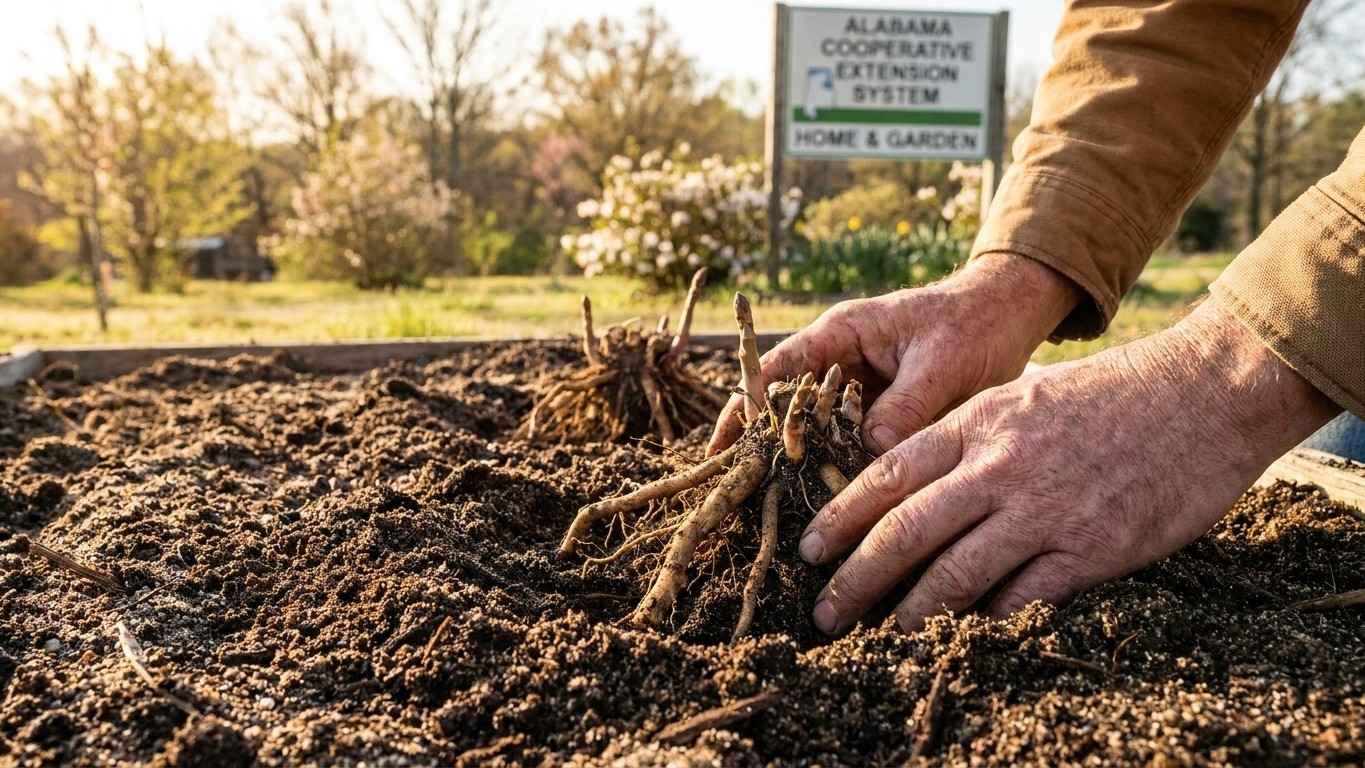

In the Houston area, asparagus crowns go into the ground around early spring, timed to land near the region’s last frost window of February 4 to March 1. That window matters less for frost protection than for giving new roots a full season to spread before the heat arrives. The bigger decision isn’t the calendar, though. It’s the ground these crowns will occupy for the next 10 to 15 years, because the one real requirement asparagus makes of a gardener is that the soil drains.
The short answer
Asparagus is not a crop you replant every spring. Once a bed is established, it stays put for 10 to 15 years, producing from the same root system season after season. That single fact should decide where you dig, more than any question of sun exposure or nearby plantings. Utah State University Extension, the source behind the planting method described here, is direct about it: most soils will grow asparagus fine, as long as they drain.
The soil that USDA lists as representative of Texas is the Houston Black series, a Vertisol clay found in the Blackland Prairie belt. It’s a soil with a reputation: it cracks open into wide fissures when dry and turns to something close to glue when wet. The surface layer runs heavy, about 20 percent sand, 54 percent clay and 26 percent silt, with organic matter around 3.0 percent and a surface pH near 7.9, on the alkaline side. USDA classes it as moderately well drained, which sits right on the edge of what a 15-year asparagus bed can tolerate.
That’s a description of one representative soil series, not a verdict on your yard. Texas covers a huge range of ground, from river-bottom loam to Hill Country limestone to whatever mix a builder left behind after grading a subdivision. If your garden happens to sit on something close to true Houston Black clay, and standing water lingers after a heavy rain, don’t fight it for a decade and a half. A raised bed, even a simple mounded row 8 to 10 inches high, moves the crowns out of the slowest-draining layer and lets excess water move off rather than pool around the roots. Working coarse compost or expanded shale into the top foot of a heavy bed before planting can also open up drainage without changing the fact that clay holds water longer than sand ever will.
The only way to know what you’re actually working with is a soil test on your own plot, not a state-level average. A test won’t tell you much about drainage directly, but a simple hole test does: dig a foot down, fill it with water, and watch how long it takes to disappear. If it’s still standing after several hours, that’s your answer, and it means a raised bed isn’t optional, it’s the only way this planting survives its own lifespan.
Will the summer here water it for you?
An asparagus bed has a fairly specific thirst. For its first two years, while roots are establishing, it wants 1 to 2 inches of water every other week. After that, once the crown system matures, it settles into needing that same 1 to 2 inches roughly every three weeks. Whether the sky delivers that on its own depends on the month, and in this region, the answer changes across the season.
- June: the reference station used for these normals records about 6.0 inches of rain for the month, which comfortably covers even the more demanding two-year-old bed’s twice-monthly need, at least on paper.
- July: rainfall drops to 3.77 inches, the driest month of the summer stretch, and this is where a young bed on any soil, and a mature bed on sandy or fast-draining ground, will likely fall short without a hose.
- August: rain climbs back to 4.84 inches, still short of what a two-year-old bed’s every-other-week schedule adds up to across four or five weeks of peak heat.
Add those three months together and the region averages about 14.6 inches of rain across the summer, out of roughly 51.8 inches for the year. That sounds generous until you remember it rarely arrives on a schedule. A single thunderstorm can drop an inch in an hour and then nothing for two weeks, and on the Houston Black clay described earlier, that inch may run off the cracked, dry surface rather than soaking down to the roots at all. On sandier ground, the opposite problem shows up: water moves through fast and the bed dries out again within days.
None of this replaces a rain gauge staked in your own bed. The monthly normals above describe what the region can typically expect over a 30-year average, not what falls on your particular row of crowns this July. A gardener who checks the gauge after each storm, and tops up with a hose whenever a two-week stretch falls short of an inch, is doing more for a 15-year bed than anyone relying on the calendar alone.
When to put the crowns in
Crowns go into the ground in early spring, while they’re still dormant. In the Houston area, that lines up with the region’s last spring frost window, which runs from around February 4 to around March 1. That’s a 30-year average, not a guarantee for any single year, so treat it as the season to watch rather than a date to circle. Crowns are planted in furrows about 8 inches deep, and the trench isn’t filled in all at once. As the young shoots grow through the season, soil goes back in gradually, about 2 inches every other month, until the furrow is level again.
Growers who’d rather start from seed instead of buying crowns can do that too, though it adds a year to the wait before the first crowns are ready to move into their permanent bed. Seed-started plants are typically grown in a nursery row for a season, then transplanted as young crowns the following early spring, at the same 8-inch furrow depth. For most home gardeners, buying dormant crowns direct-planted in that early spring window is the faster path to an established bed.
Whichever route you choose, the variety question comes down to plant sex more than anything else, since that’s what the available research actually documents. Two named all-male varieties, Jersey Giant and Jersey Knight, don’t put energy into producing seed, which the literature associates with somewhat higher spear production over the life of the bed. Two others, UC 157 F1 and Purple Passion, are male/female types. No source consulted here publishes flavor differences, yield numbers, or a reason to prefer one over another beyond that sex distinction, so treat any stronger claim you see elsewhere with some skepticism.
| Variety | Plant sex |
|---|---|
| Jersey Giant | All-male |
| Jersey Knight | All-male |
| UC 157 F1 | Male/female |
| Purple Passion | Male/female |
Whatever variety you plant, remember the bed won’t be ready to harvest right away. Asparagus needs its first two full seasons just to build root reserves, with no cutting at all until year three.
Common questions
Can I Plant Asparagus Crowns before the last frost date?
Crowns are planted while dormant in early spring, and in the Houston area that generally means working around the region’s last frost window of February 4 to March 1. Since that’s a 30-year average rather than a fixed date, watching soil temperature and the immediate forecast matters more than planting on a specific calendar day.
How long before I can harvest asparagus after planting?
Not until year three. The first two seasons are entirely about the crown building its root system, with no cutting at all. Even once harvest starts, the rule for when to stop each spring isn’t a fixed week count, it’s a visual one: stop cutting once most of the spears coming up are thinner than a pencil.
What if my soil doesn’t drain well?
Given that a bed sits in place for 10 to 15 years, poor drainage is worth solving before planting, not after. A raised or mounded bed, 8 to 10 inches high, moves crowns above the slowest-draining clay layer. Working coarse compost into the top foot of soil before planting helps too, though it won’t turn heavy clay into sand.
Do I need to water asparagus all summer?
Young beds need 1 to 2 inches every other week for their first two years, then roughly the same amount every three weeks once established. Since the region’s summer rainfall averages only about 3.77 to 6.0 inches per month, and arrives unevenly, a rain gauge and occasional hand-watering during dry stretches, especially in July, keep the bed from falling short.
Some gardeners also time this by the Moon: when to plant asparagus by the moon, as almanac tradition rather than fact.