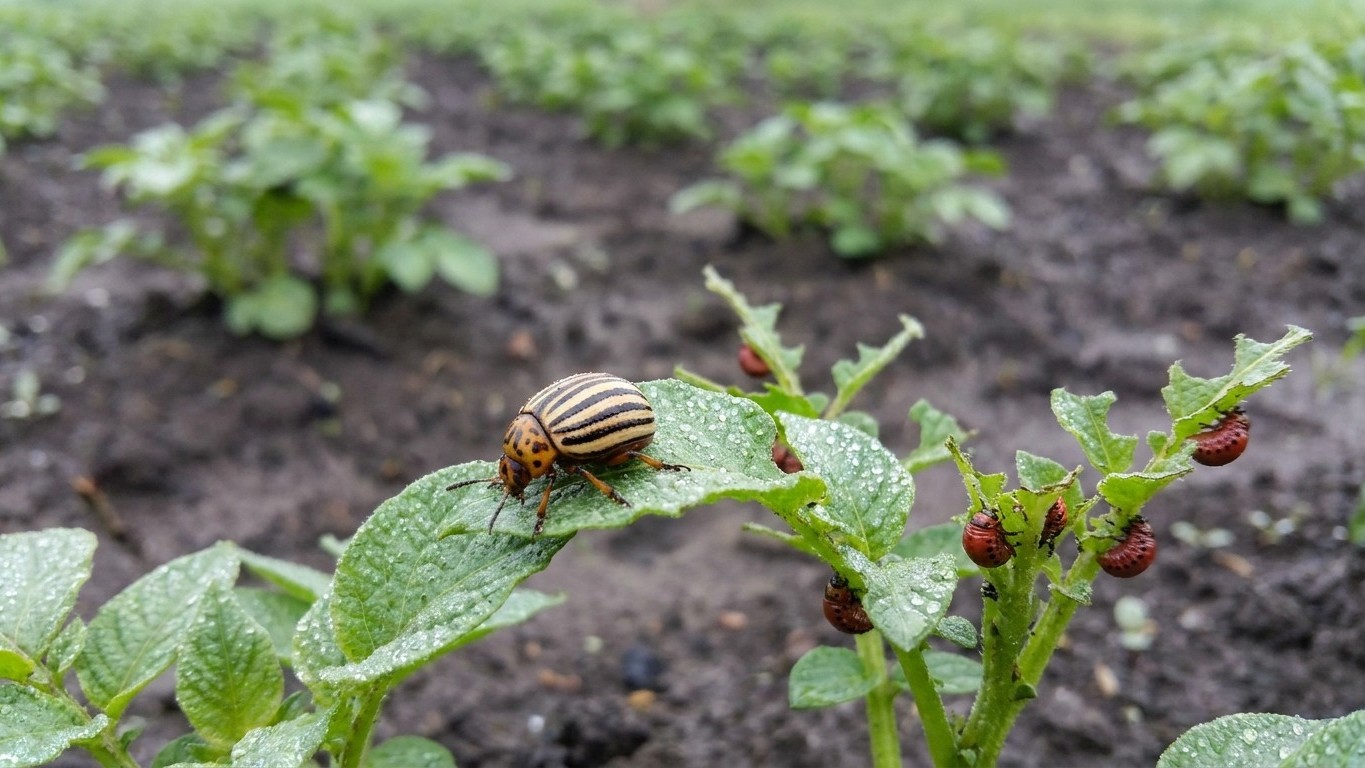

Three insects show up on potato foliage in Saskatchewan gardens with any regularity: Colorado potato beetle, grasshoppers, and thrips. Each follows its own calendar tied to the province’s short frost-free stretch, and each leaves a different signature on the leaf. None of the three is unique to potato, but potato is often where a gardener spots them first, since the leaves sit low, spread wide, and get checked more often than a shrub in the back corner of the yard.
Which pests attack potato in Saskatchewan

Montana State University Extension, Urban IPM and NDSU Extension document eleven insects likely to turn up in a Prairie yard or garden: Apple maggot, Boxelder bug, Brown marmorated stink bug, Colorado potato beetle, Corn earworm, Emerald ash borer, Grasshoppers, Miller moths, Social wasps, Thrips, and Yellowheaded spruce sawfly. That’s the full documented list for this border territory, since Saskatchewan-specific pest tracking at this level of detail isn’t published here, and the two extension services covering the states just south of the line are the closest sourced authority.
Of those eleven, only three ever put a mark on a potato plant. Colorado potato beetle chews leaves as both larva and adult, and a heavy infestation can strip a row bare within days. Grasshoppers feed on potato foliage along with nearly everything green once the natural vegetation around a yard dries out. Thrips scrape at leaf surfaces and can also work over flowers and fruit skin on other crops nearby.
The other eight have nothing to do with potato, and it’s worth saying why so nobody spends a season worrying over the wrong bug. Apple maggot lays eggs inside apple fruit, not tuber or leaf. Boxelder bug feeds on boxelder and maple seeds. Brown marmorated stink bug targets tree fruit and some vegetable fruit, but isn’t documented as a potato feeder. Corn earworm goes after corn ears and tomato fruit. Emerald ash borer attacks only ash trees. Miller moths pass through as nectar-feeding adults, a nuisance insect rather than a crop pest. Social wasps hunt and scavenge rather than chew plant tissue. Yellowheaded spruce sawfly feeds exclusively on spruce needles.
When each one shows up, and what it does first
Saskatoon’s average last spring frost falls around May 18, and that figure is a midpoint from Environment and Climate Change Canada’s 1981-2010 climate normals for the Saskatoon SRC station, not a guarantee. In one year out of two, frost lands later than that date, so it works as the center of a planting window rather than a safe day to trust. Because potato seed pieces usually go in once soil has warmed past that point, most insect activity begins several weeks after shoots emerge, not at planting itself.
Thrips tend to be present earliest and are the hardest to notice at first, often feeding before any visible damage appears at all. Colorado potato beetle follows within the first two to three weeks after emergence, moving up from where adults overwintered in the soil as the ground warms. The earliest sign is small, round holes punched through young leaves; skeletonized, ragged foliage comes later once larvae hatch and feed in clusters.
Grasshoppers build up later in the season, as eggs laid the year before hatch and nymphs start feeding on whatever green growth sits closest. On potato that shows up as notched leaf edges that worsen through the warmer, drier weeks of summer, as grasshopper numbers peak and dried-out native vegetation pushes them toward garden rows.
In sequence, the pattern runs thrips first and quietest, Colorado potato beetle arriving within the first few weeks after emergence and doing the most visible early damage, and grasshoppers building steadily through the back half of the growing season as the prior year’s egg beds mature.
Telling the damage apart from everything else
A leaf with holes or a strange sheen doesn’t automatically mean an insect did it. Soil trouble, water stress, and disease all leave marks that get mistaken for chewing, and the fix is entirely different depending on which one it is.
| What you see | Possible insect | Possible look-alike | What tells them apart |
|---|---|---|---|
| Small round holes in leaves | Colorado potato beetle | Early blight or other leaf spot disease | Disease shows concentric ring patterns with no torn edges; insect holes have clean chew marks and often egg clusters on the leaf underside |
| Notched, ragged leaf edges | Grasshoppers | Hail or mechanical damage | Grasshopper damage spreads gradually across a bed over days; hail or tool damage appears all at once, across many plants, with bruised tissue |
| Silvery or bronzed leaf surface | Thrips | Potassium deficiency or drought stress | Thrips leave fine black frass specks visible with a hand lens; nutrient or moisture stress skips that detail and tends to hit older leaves first |
| Bare, skeletonized foliage | Heavy Colorado potato beetle feeding | Natural late-season dieback | Skeletonizing leaves the veins intact; dieback happens evenly across the whole plant, insect feeding often starts at the growing tip |
None of that replaces an actual look at the plant. The single most useful habit is checking leaf undersides with a hand lens before deciding anything, since the presence or absence of frass specks and egg clusters is usually what separates an insect problem from a soil or weather one. Past that point, a county extension office can confirm what a photo or symptom list can’t.
What actually works here, and what is a waste of time
On a season this short, timing does more work than any treatment applied after the fact. Hand-picking Colorado potato beetle adults and their orange-yellow egg clusters off leaf undersides in the first couple of weeks after emergence keeps the population from ever reaching the larval stage that does the worst damage. A floating row cover placed at planting and removed before flowering blocks early adult colonization outright, and rotating potato away from the previous year’s nightshade bed cuts down on adults emerging right where last year’s crop grew.
For grasshoppers, turning over soil at garden margins in late summer or fall disturbs egg-laying sites before they overwinter, and a row cover during the peak dispersal weeks keeps young plants out of reach while natural vegetation is still green enough to hold their attention elsewhere. Reflective mulch laid early in the season can cut down on thrips landing on young foliage, though it does nothing once an infestation is already established.
What doesn’t work is spraying on a fixed date without checking what stage the insect is actually in. A treatment applied after adults have already laid eggs, or after grasshoppers have already dispersed from dried-out margins into the garden, spends effort on a population that’s already done its damage. It’s also worth separating seed quality from insect control: certified seed potato guards against virus carried in uncertified stock, not against Colorado potato beetle or thrips, and treating it as pest insurance is a mismatch that costs a gardener a season of confusion.
Where to check this for your own county
What’s documented at the state or provincial level rarely matches what’s actually in one particular garden. Montana State University Extension, Urban IPM and NDSU Extension cover the pest activity for the states bordering this territory, and both operate county extension offices set up to field exactly this kind of local question. A call to the office nearest your side of the border usually beats any general list, since pest pressure shifts from one rural municipality to the next, and sometimes from one yard to the one next door depending on windbreaks, soil, and what grew there the year before.
The frost date used earlier in this piece comes from a single climate station, Saskatoon SRC, and northern or upland districts run weeks behind that normal. The same caution applies to pests: a county office that has fielded local calls all season knows whether Colorado potato beetle has actually been a problem nearby this year, in a way no province-wide list can.
The most useful next step is bringing an actual leaf sample, or a clear photo of the damage and the underside of the leaf, to that county office rather than trying to match a symptom to a list from a screen. That single conversation settles more than another hour of comparing pictures online.
Common questions
Does Saskatchewan have its own documented list of potato pests?
Not at this level of detail. The list used here comes from Montana State University Extension, Urban IPM and NDSU Extension, the land-grant services covering the neighboring states, because equivalent province-specific tracking isn’t published for this territory.
Is Colorado potato beetle the most damaging of the three?
It’s usually the most visible, since larvae feed in groups and can strip a plant within days. Grasshoppers and thrips cause damage too, but it tends to build more gradually across the season.
Can uncertified seed potato introduce insect problems?
Uncertified seed is a virus risk, not an insect one. Certified seed potato protects against disease carried in the seed piece itself; it has no bearing on whether Colorado potato beetle, grasshoppers, or thrips show up in the garden.
Should planting be timed around the average last frost date?
The May 18 average for Saskatoon SRC is a midpoint, not a safe date, since frost falls later than that in half of all years. Treat it as the center of a window and check locally before deciding when to plant.