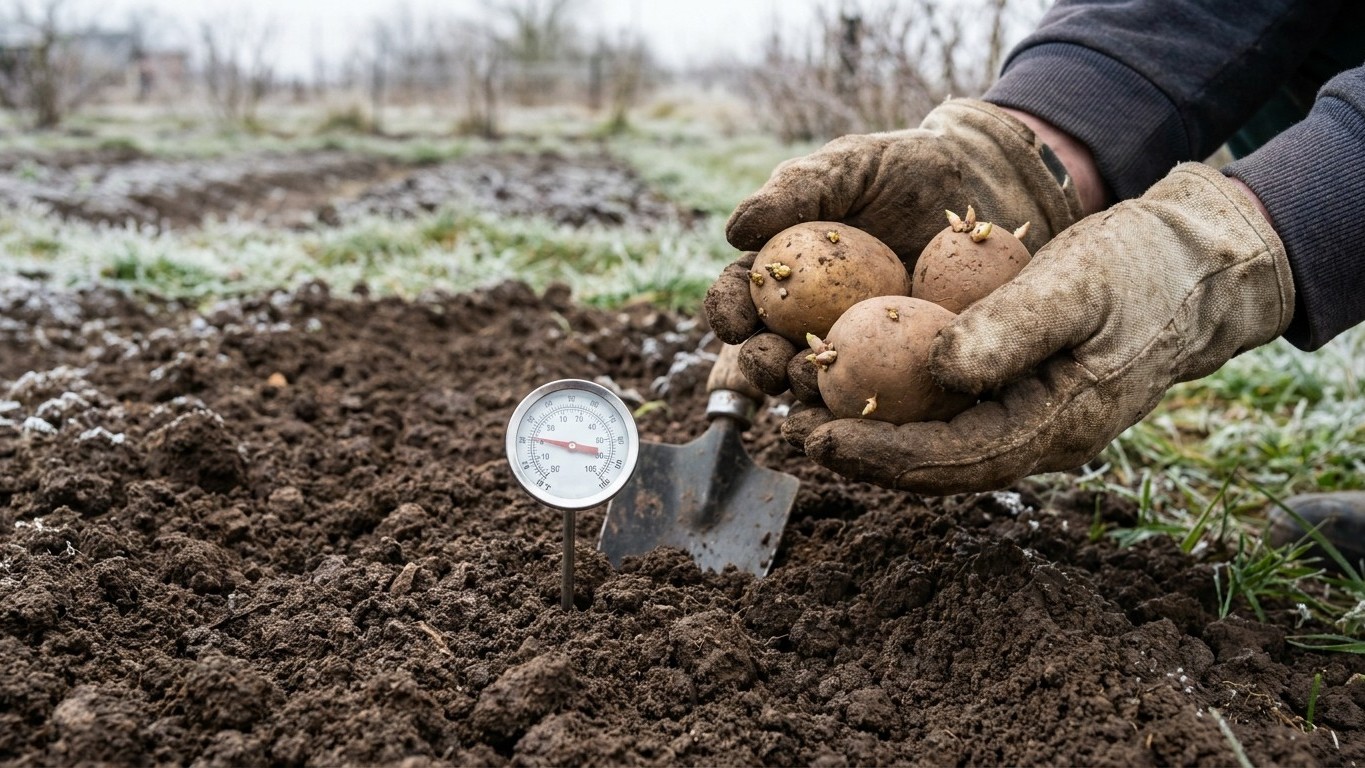

Potatoes go into Saskatchewan soil roughly two to three weeks before the last spring frost, not after it. Around Saskatoon, that frost lands on average in mid-May, which pushes the planting window back into late April. But “average” is the wrong word to lean on here, since it marks a midpoint, not a guarantee. Soil temperature, not the calendar, is what should trigger the shovel, and it’s worth understanding that threshold before you commit a bag of seed potatoes to the ground.
The short answer
Environment and Climate Change Canada’s Canadian Climate Normals (1981-2010) put the average last spring frost at the Saskatoon SRC station at May 18. Utah State University Extension and the University of Maine Cooperative Extension both describe the planting rule the same way: potatoes go in as soon as the soil reaches 50 F, which works out to 14 to 21 days before the last frost date. Counting back from May 18, that lands the Saskatoon-area planting window somewhere between about April 27 and May 4, depending on how fast the soil warms that particular spring.
That’s a mean date, not a safe one. Environment and Climate Change Canada’s normals describe a 30-year average, which means that in roughly half of all years, frost has fallen later than May 18. Treat the date as the center of a window, not a line you can plant right up against. It also comes from a single station. Saskatoon SRC measures Saskatoon’s own microclimate, and a province this size is not one climate zone. Northern districts, higher-elevation ground, and areas farther from the moderating effect of the South Saskatchewan River valley typically lag weeks behind what Saskatoon records. If your garden sits in one of those pockets, shift the whole calculation later, using your own area’s frost history rather than the Saskatoon figure.
The other piece worth holding onto: this window exists because of soil temperature, not superstition about frost dates. Potato seed pieces planted into ground colder than 50 F tend to rot before they sprout rather than gain anything from an earlier start. Planting exactly on the frost date, or after it, skips past the part of the season when soil is warming through that critical range and often costs you three weeks of early growth the plant needed before summer heat arrives. That timing has consequences worth understanding on their own, which is the next question.
What actually decides it
Soil temperature, not air temperature or the calendar
The frost date matters only because it correlates, loosely, with when soil in a given area typically climbs to 50 F. It is not itself the trigger. A gardener with raised beds, sandy soil, or a south-facing slope may see soil hit 50 F well before the frost-date math predicts it, while heavy clay in a low, shaded yard can lag behind by a week or more even in the same town. This is the reasoning that carries beyond Saskatoon: wherever you garden, a soil thermometer read at planting depth over several consecutive mornings tells you more than any date on a chart. If the soil says 50 F, the seed potato is ready to go in, regardless of what the calendar says about frost.
The heat ceiling that comes later in the season
Utah State University Extension and the University of Maine Cooperative Extension both flag the same upper limit: soil temperatures above 90 F inhibit tuber set and fill. That’s the mechanism that makes early planting worth the frost risk in the first place. A potato plant needs to be well established, flowering, and setting tubers before summer heat pushes soil past that ceiling. Once soil temperature crosses 90 F, watering more does not restart the process. Tubers that haven’t sized by then largely stop. This is why the entire system leans toward planting early rather than late: a plant that goes in near the frost date, rather than two to three weeks ahead of it, loses those early weeks of cool-soil growth and runs straight into the heat ceiling before it has sized a real crop.
Applying this reasoning elsewhere
Any gardener, in any part of the province, can use the same two thresholds to work out their own timing: find the soil-temperature floor (50 F) that starts the clock, and the ceiling (90 F) that ends useful tuber growth, then count backward from whichever local frost date applies to that specific piece of ground.
How to do it
- Find the average last spring frost date for your specific area, not just a province-wide figure, since a single provincial number hides weeks of local variation.
- Push a soil thermometer to about 4 inches deep in the planting bed and take a reading at roughly the same time each morning for four or five consecutive days.
- Once those readings hold steady at 50 F or above, treat that as your green light, even if it falls well before the frost date itself.
- Buy certified seed potatoes rather than saving grocery-store tubers or last year’s uncertified stock, since uncertified seed carries a real risk of virus that can undercut the whole crop before it starts.
- Cut larger seed potatoes into pieces with at least one or two eyes each, and let cut pieces sit for a day or two so the cut surface can dry and callus before planting.
- Plant the pieces and cover with roughly 3 to 4 inches of soil, spacing them to allow room for hilling as the plants grow.
- Keep hilling soil over the base of the plants as shoots emerge, both to protect tender growth from a late, lingering frost and to give developing tubers more room and darkness as the season moves forward.
What goes wrong
- Planting on the frost date instead of ahead of it. Waiting for the calendar to clear the average last frost skips past the two to three weeks of cool-soil growth the plant needed and shortens the whole window before summer heat sets in. Check soil temperature instead of counting days on a calendar.
- Missing the early window and running into the heat ceiling. A late-planted crop that’s still trying to size tubers when soil crosses 90 F largely stops progressing right there, and extra watering doesn’t reverse it. In areas with hot, short springs, the better plan is to plant early and dig a spring crop before real heat arrives, rather than nursing a plant through the hottest weeks.
- Using uncertified seed potatoes. Tubers saved from last year’s garden, or ones bought from a grocery store, can carry viruses invisible to the eye that quietly reduce yield. Buy certified seed potatoes instead, from a supplier that labels them as such.
- Trusting a province-wide frost date instead of a local one. The Saskatoon SRC figure describes Saskatoon’s own conditions. A garden in a low frost pocket, a northern district, or higher ground can run weeks behind that reference point, and planting on the Saskatoon schedule in one of those spots invites frost damage to tender shoots.
- Choosing a variety by expectation rather than by season class. Neither Utah State nor the University of Maine publishes a specific days-to-maturity figure for named varieties, so treat any number you see elsewhere with caution. Instead, choose by season class, early, mid-season, or late, matched to how long your local growing window actually runs, and by what the variety is suited for, baking or boiling, rather than by a maturity date you can’t verify.
Common questions
What if my area’s last frost date isn’t the same as Saskatoon’s?
Use your own area’s frost history rather than the Saskatoon SRC figure. The 50 F soil threshold and 14-to-21-day planting window still apply; only the calendar date shifts, sometimes by weeks, depending on how far your ground sits from Saskatoon’s climate.
Is it safe to plant potatoes before all frost risk has passed?
Yes, and that’s the point of the 14-to-21-day window. Seed potatoes planted a few inches deep are insulated from light frost while they’re still underground, and any tender shoots that do emerge before the frost date can be protected by hilling soil over them.
Why does soil temperature matter more than air temperature?
Because the seed piece sits in the soil, not in the air, and it’s soil temperature that governs whether the piece sprouts and grows or sits and rots. Air temperature can swing warm on a sunny afternoon while soil a few inches down is still cold from a slow spring.
How do I pick a potato variety suited to a short growing season?
Choose by season class, early season varieties reach usable size fastest, which matters where the gap between the 50 F planting window and the 90 F heat ceiling is narrow. Match that season class to what you plan to use the crop for, since the published guidance from Utah State and the University of Maine describes varieties by use, such as baking or boiling, rather than by exact maturity dates.