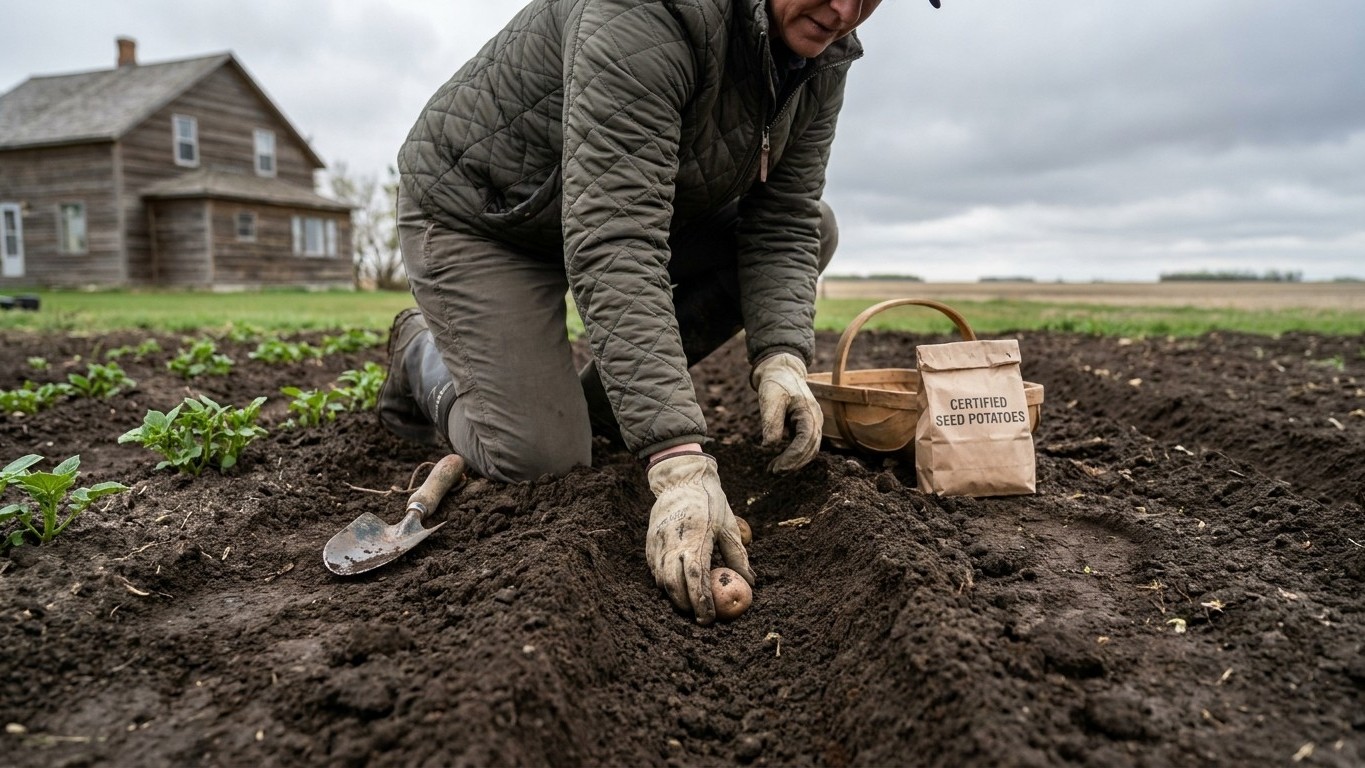

Saskatoon’s climate normals show zero days a year above 90°F, and the province’s average last spring frost falls around May 18. That combination means summer heat is not the threat to potato yields here that it is farther south. The real work is timing the planting window against a frost date that shifts by weeks depending on where in the province you garden, and matching seed and hilling practice to a cool, short season rather than a hot one.
The short answer

Start with the number that decides everything else: Saskatoon’s Canadian Climate Normals for 1981-2010 record 0.0 days a year reaching 90°F or higher. That is not a rounding artifact. Across three decades of records, the reference station essentially never crossed the threshold that Utah State University Extension identifies as the point where potato tuber set and fill shut down. In hot-summer states, that 90°F line forces gardeners to race the calendar, digging a spring crop before soil temperatures climb past the danger zone. In Saskatchewan, that race barely exists.
Pair that with the other governing figure: an average last spring frost of May 18 at the Saskatoon SRC station. Those two numbers together describe a growing climate that is short on frost-free days but almost never punishingly hot. A gardener here is not fighting heat stress in July the way a grower in Texas or Kansas is. The fight instead is against a late-arriving spring and soil that stays cold and wet well into what other regions would call planting season, which is why nailing down When to Plant Potatoes in Saskatchewan matters more here than the heat math alone would suggest.
What that means for variety choice
Because the heat ceiling rarely comes into play, Saskatchewan gardeners have more room to run a full-season crop than the heat math alone would suggest elsewhere. Utah State University Extension and the University of Maine Cooperative Extension both organize potatoes by season class rather than by a fixed number of days, and that classification is the useful one here: early-season types, mid-season types, and late-season types. Early types are the ones to lean on if a short, cool season and a hard fall frost are the bigger worry than heat; they finish before the first freeze without needing a heat-driven rush to dig, though the right call also depends on Harvesting and Storing Potatoes in Saskatchewan once that first freeze is on the horizon. Mid-season and late-season types can work where the frost-free window runs longer, and where storage rather than speed is the goal. For a closer look at which cultivars fit each category, see this guide to Potato Varieties That Suit Saskatchewan.
Both extension sources also describe potatoes by what they are grown for rather than by texture labels. Some varieties are suited to baking, holding a dry, fluffy interior once cooked whole. Others are better for boiling, holding their shape in salads or stews rather than breaking down. Choosing on that basis, the harvest use rather than a marketing term, is the more reliable approach the sources support.
When to plant here
The planting rule from Utah State University Extension and the University of Maine Cooperative Extension is simple: potatoes go in the ground once soil temperature reaches 50°F, and that point typically arrives 14 to 21 days before the last frost date. Saskatchewan’s frost date is not fixed, so the arithmetic has to start from the local figure and work backward.
- Find the reference frost date. At the Saskatoon SRC station, the average last spring frost falls on May 18, based on Environment and Climate Change Canada’s Canadian Climate Normals for 1981-2010.
- Treat it as a midpoint, not a guarantee. A mean date means frost arrives later than May 18 in roughly half of all years on record. Planning around it as a safe cutoff will get a crop frozen back some seasons.
- Count backward 14 to 21 days. Subtracting 14 days from May 18 lands on May 4; subtracting 21 days lands on April 27. That span, late April into the first days of May, is when soil at the Saskatoon reference point typically reaches the 50°F mark potatoes need.
- Check soil, not the calendar. A soil thermometer pushed a few inches down is the only way to confirm 50°F has actually arrived, since a warm week in April or a cold snap in May can shift the real date from the calculated one.
- Redo the math for your own ground. Any gardener outside the Saskatoon area should swap in their own local frost date before subtracting the 14-to-21-day window, since the same formula produces a different planting date in every part of the province.
What the heat does to the crop
The mechanism is the same everywhere potatoes are grown, and it is worth stating plainly: once soil temperature climbs above 90°F, tuber set and fill are inhibited, according to Utah State University Extension and the University of Maine Cooperative Extension. The plant does not simply slow down and catch up later. New tubers stop forming, and the ones already set stop sizing, for as long as the soil stays that hot. Watering more does not reverse the effect, because the problem is heat in the root zone, not a lack of moisture.
Saskatoon’s climate normals put that threat at close to zero for this province. With 0.0 days a year averaging 90°F or higher at the reference station, the soil conditions that trigger the shutdown almost never occur across the growing season. That is a genuinely different situation from a hot-summer state, where gardeners plant early specifically to get a spring crop dug and out of the ground before soil temperatures cross that line for good.
In Saskatchewan, the practical result is that a full-season crop, planted once soil reaches 50°F and left to grow through summer, is a realistic plan rather than a gamble against the heat. The limiting factor shifts instead to the other end of the calendar: the arrival of the first fall frost, and whether a mid-season or late-season variety has enough warm days left to finish bulking before the ground freezes. That is a scheduling problem, solvable by choosing an earlier season class where needed, rather than a heat-stress problem that no amount of irrigation can fix.
It is still worth watching a soil thermometer during any unusually warm stretch, since the 90°F ceiling is a fixed temperature threshold, not a Saskatchewan-specific exemption. A short run of exceptional heat in a warm pocket of the province could, in principle, brush against that line even where the multi-decade average says it essentially never happens. For planning purposes, though, the number from the reference station stands: heat is not the constraint this province’s potato growers need to plan around.
What goes wrong here
- Uncertified seed potatoes can carry viruses that stunt plants and cut yield before the season even gets going, often with no visible sign until the crop underperforms. Certified seed, tested and tagged as disease-free, is the one input worth not skimping on.
- Planting into cold, wet soil invites rot before sprouts ever emerge, especially in Saskatchewan’s clay-heavy soils that hold moisture longer than sandy ground. Checking with a soil thermometer instead of the calendar avoids the loss.
- Skipping the hilling lets tubers develop near the surface, catch sunlight, and turn green with solanine, a compound that makes them unsafe to eat. Mounding soil over the row as plants grow keeps developing tubers covered and out of the light.
- Digging too early sacrifices size and skin set, since the plant is still moving starch into the tubers right up until the vines die back. Waiting for vines to yellow and collapse, rather than digging on a fixed date, gets the full benefit of Saskatchewan’s long, cool-summer window.
Checking this against your own county
Saskatoon’s numbers are a starting point, not a rule that applies unchanged across the province. Elevation, and simple distance north or south, move both the frost date and the length of the frost-free window by weeks. A garden in the province’s southern grain belt can expect a meaningfully earlier last frost than one at similar latitude but higher ground, and northern districts routinely run behind Saskatoon on both ends of the season, with frost returning earlier in fall.
That variation is exactly why the 14-to-21-day countback in the planting section needs a local frost date, not the Saskatoon figure, plugged in before the subtraction happens. Local extension staff and long-time growers in a given municipality are a more reliable source for that number than a province-wide average.
The Saskatchewan Ministry of Agriculture publishes guidance and local contacts for exactly this kind of check, and it is worth consulting before locking in a planting date: Saskatchewan Ministry of Agriculture.
Common questions
Does Saskatchewan get too hot for potatoes?
No. Saskatoon’s climate normals record 0.0 days a year reaching 90°F, the soil temperature threshold where Utah State University Extension says tuber set and fill stop. Heat stress on potatoes is essentially a non-issue in this province, unlike in hot-summer states farther south.
When is the safest time to plant potatoes in Saskatchewan?
Using the Saskatoon SRC station’s average last frost of May 18, and counting back 14 to 21 days for soil to reach 50°F, the calculated window falls between roughly April 27 and May 4. That is a starting estimate; local soil conditions and frost history should confirm it before seed goes in the ground.
Should I choose an early, mid-season, or late variety?
Utah State University Extension and the University of Maine Cooperative Extension classify potatoes by season length rather than a fixed day count. In Saskatchewan, where heat is not the constraint but fall frost eventually is, early-season types offer the widest safety margin, while mid- or late-season types suit gardeners with a longer frost-free window and storage as a goal.
Why did my tubers turn green?
Green tubers form when developing potatoes are exposed to sunlight near the soil surface, producing solanine, which makes them unsafe to eat. Hilling soil over the row as plants grow is the fix, and it needs to happen more than once through the season as the plants push up.