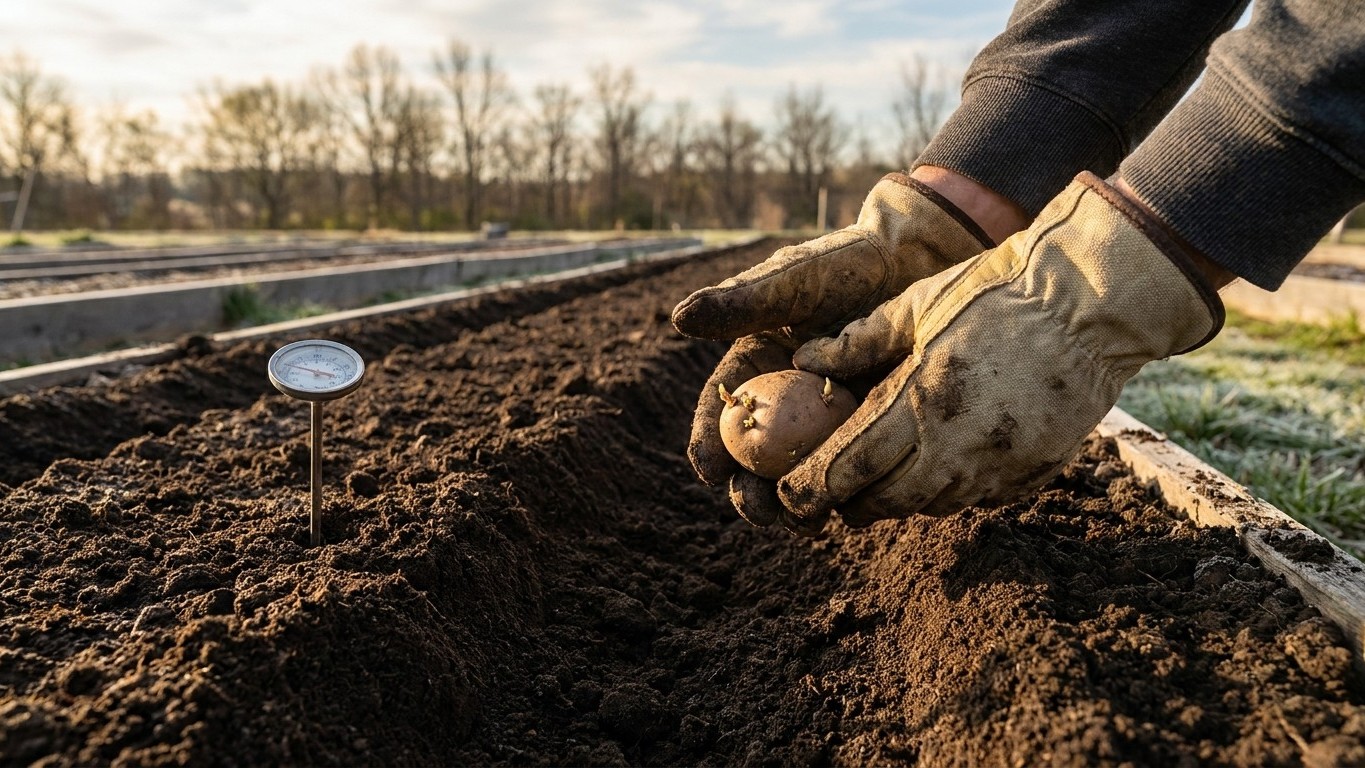

Saskatchewan gardeners get one real answer here: early- and mid-season potato varieties, planted the moment soil hits 50°F, timed against the Saskatoon area’s mean last frost of May 18 (Environment and Climate Change Canada, Canadian Climate Normals 1981-2010, station Saskatoon SRC). Late-season types survive only in the province’s longest-season pockets, and the summer heat ceiling above 90°F soil temperature decides the rest.
The short answer
Start with the number that actually governs the calendar: Saskatoon SRC, the Environment and Climate Change Canada station used for Canadian Climate Normals 1981-2010, puts the mean last spring frost at May 18. That figure is not a safety line. It’s a midpoint. Half the years on record, frost lands after that date, sometimes well after. Treat it as the center of a window, not a green light.
Potatoes don’t wait for frost to clear anyway. Utah State University Extension and the University of Maine Cooperative Extension (Bulletin #2077) both describe the same mechanism: seed potatoes go into the ground once soil temperature reaches 50°F, and that point typically falls 14 to 21 days before the last frost date. Counting back from Saskatoon’s May 18 average puts a soil-ready window somewhere in late April to early May for that reference city, with the same caution attached: a mean date shifts, and so does the planting window built on it.
That short window is why season class matters more in Saskatchewan than variety marketing does. Early-season potatoes bulk their tubers fast and clear the ground before the province’s short summer runs out. Mid-season types trade a bit of that safety margin for higher yield, still finishing well ahead of the heat and cold squeeze on both ends of the calendar. Late-season classes need a longer frost-free stretch than most of the province reliably offers, and they’re the riskiest choice unless a grower is working a warmer river-valley microclimate with a demonstrably longer season than the Saskatoon norm.
None of this is about picking a trendy cultivar. It’s about matching a season class to a real, measured climate window and then getting seed potatoes into ground the moment the soil, not the calendar, says it’s ready. For most home gardens across the province, that means leaning early, watching a soil thermometer instead of a wall calendar, and planning the harvest around the same heat ceiling that decides whether those tubers keep sizing or simply stop.
What actually decides it
The frost window is a mean, not a guarantee
A mean last frost date is an average of many years, which means by definition that roughly half of them ran later. May 18 at Saskatoon SRC is the balance point between years that cleared frost earlier and years that didn’t. A gardener working from that single number, without building in slack, is gambling on the coin-flip half of the record. Anyone north of Saskatoon or at higher elevation should expect that balance point to sit even later; anyone south or in a sheltered valley might see it arrive earlier. The station data describes one location. A province is not one climate.
The heat ceiling that stalls tuber fill
The other half of the mechanism sits at the opposite end of the season. Utah State University Extension and the University of Maine Cooperative Extension both identify soil temperatures above 90°F as the point where tuber set and fill are inhibited. This isn’t a moisture problem, so watering harder during a hot stretch doesn’t reverse it. Once soil crosses that threshold, the plant stops adding size to the tubers already forming underground, and no amount of irrigation restarts that process. A grower reasoning through an unfamiliar patch of ground, sandy soil that heats fast, a south-facing slope, black plastic mulch trapping heat, should read those conditions as ones that push soil temperature toward 90°F sooner, not later.
Season length arithmetic
Put the two mechanisms together and the math does the deciding. A short frost-free window on one end, plus a heat ceiling that can arrive mid-summer on the other, leaves a narrow middle stretch for tubers to bulk. Early-season varieties are built to finish inside that stretch with margin to spare. Mid-season varieties use more of the available window and carry more risk if either end arrives early. Late-season varieties need a middle stretch this province rarely guarantees, which is why they belong only where a grower can show, from their own soil readings and local frost history, that the window runs longer than the provincial reference point suggests.
How to do it
- Start checking soil temperature at planting depth in mid-spring, using a soil thermometer rather than guessing from air temperature or the calendar date.
- Count backward from the mean last frost date for the closest reliable station to confirm whether you’re inside the 14-to-21-day pre-frost planting window that Utah State University Extension and the University of Maine Cooperative Extension both describe.
- Buy certified seed potatoes. Uncertified seed, including tubers saved from a previous home crop or bought at a grocery store, carries virus that certified stock is specifically grown to avoid.
- Choose a season class, early or mid-season for most of the province, based on the actual frost-free stretch available at your site rather than on yield claims alone.
- Plant once soil holds at 50°F, even if that date lands ahead of the mean last frost. Foliage can recover from a light frost; a soil temperature that never reaches 50°F simply delays the whole season.
- Keep tracking soil temperature through the growing season. If readings start climbing toward 90°F, treat that as the signal to plan an earlier dig rather than expecting more tuber fill later in summer.
- Harvest before whichever limit arrives first for your season class and location, the return of fall frost or the soil crossing the heat ceiling that stops tuber growth.
What goes wrong
- Planting by calendar date instead of soil temperature. A fixed date ignores year-to-year swings in how fast soil warms. Use a soil thermometer at planting depth and wait for a steady 50°F reading before putting seed in the ground, regardless of what the date says.
- Treating May 18 as a guaranteed frost-free date. It’s a mean from Saskatoon SRC climate normals, and roughly half of recorded years saw frost land later. Build in a buffer, expect occasional frost damage to early foliage, and know that potato tops generally regrow from a light frost even when the timing runs behind that average.
- Using saved or grocery-store potatoes as seed. Uncertified tubers can carry virus that spreads through the crop and reduces yield without any obvious symptom at planting time. Buy certified seed potatoes instead.
- Choosing a late-season variety for a short prairie window. Late-season classes need more frost-free days than most of the province reliably provides. Match the season class to your measured local window, and default to early or mid-season unless local data clearly supports a longer stretch.
- Watering harder once soil crosses 90°F, expecting tubers to keep sizing. The heat ceiling stalls tuber fill regardless of moisture. Once soil temperature is tracking toward that mark consistently, plan the harvest earlier rather than trying to push the crop through the heat.
Common questions
Can late-season potato varieties still be grown in Saskatchewan?
Only where a grower can confirm, from local soil readings and frost history, a frost-free window longer than the province’s reference point at Saskatoon SRC. Without that confirmation, late-season classes carry more risk than the short prairie season generally allows.
Does the May 18 mean frost date apply across the whole province?
No. It’s specific to the Saskatoon SRC station in the Environment and Climate Change Canada Canadian Climate Normals 1981-2010 dataset. Locations north, at higher elevation, or in different microclimates will run on a different average, later in colder areas, sometimes earlier in sheltered pockets.
Why does soil temperature matter more than air temperature for planting potatoes?
Because the seed piece and the developing tubers sit in soil, not air. Utah State University Extension and the University of Maine Cooperative Extension both tie the planting trigger to a 50°F soil reading, since that’s the temperature the seed piece itself experiences, regardless of what the air temperature reads above ground.
Is certified seed really necessary for a home garden?
Yes. Certified seed potatoes are grown and inspected specifically to limit virus carryover, which uncertified tubers, including ones saved from a previous crop, can carry without visible symptoms. It’s one of the few single choices that protects the whole season’s yield.