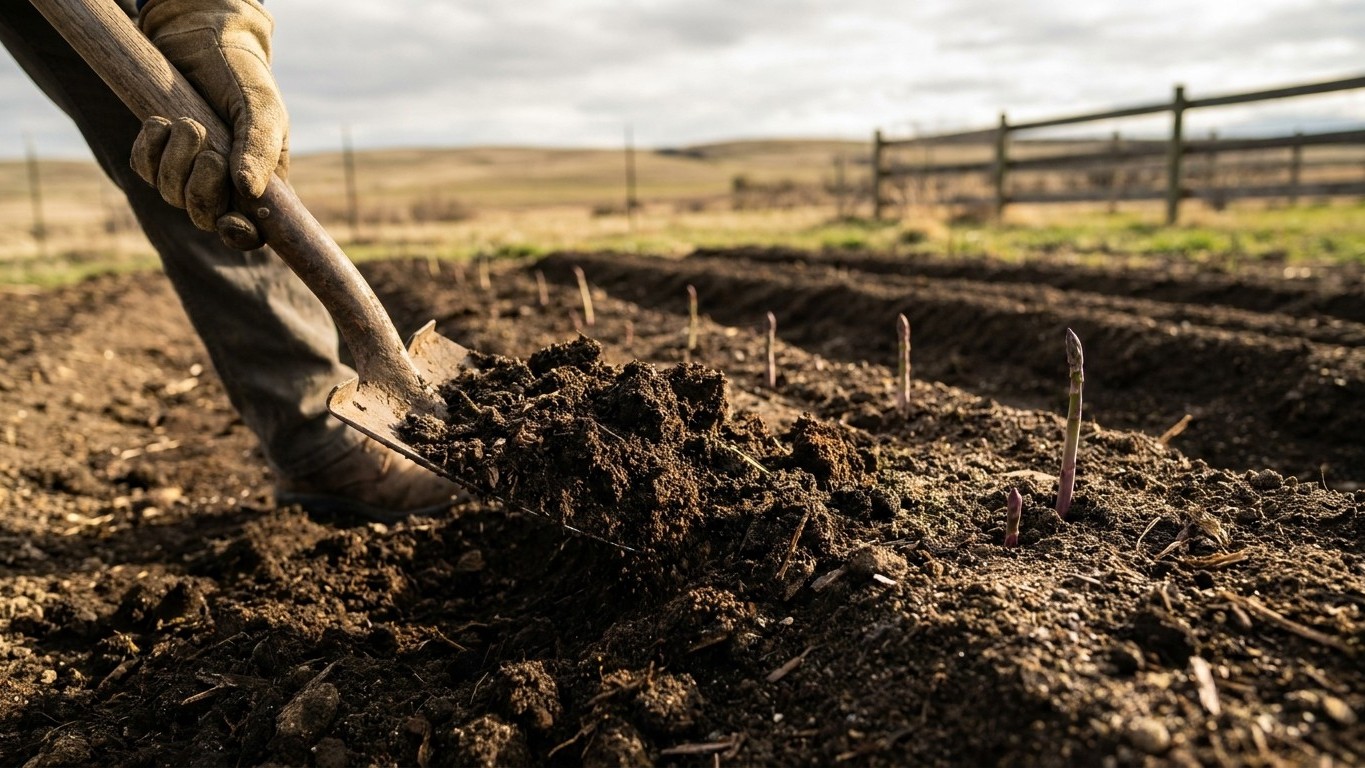

Fifteen years is the outer edge of an asparagus bed’s life, and Arizona’s dominant soil happens to drain well enough to support that kind of commitment. The catch isn’t frost or timing so much as water: the state’s summer rainfall barely dents what the bed needs, and the crowns have to go in with that math already worked out.
The short answer
Asparagus is a crop you plant once and harvest for a decade or more, which changes how much attention the soil deserves before the first crown ever touches ground—and that attention starts with getting When to Plant Asparagus Crowns in Arizona right in the first place. Utah State University Extension puts it plainly: most soils will grow asparagus fine, as long as they drain. That single word carries more weight here than it would for a tomato bed you rework every spring, because a soil that stays soggy after rain isn’t a nuisance you fix next season. It’s a decision baked into the ground for the life of the planting, which raises the real question: Will Arizona Soil Hold an Asparagus Bed for Fifteen Years?
Arizona’s representative soil, the Casa Grande series (an Aridisol that USDA lists as the state’s soil), is sandy at the surface: 64 percent sand, 14 percent clay, 22 percent silt, with organic matter around 0.8 percent. USDA’s own data classifies it as well drained. That’s a reasonable starting point for a lot of low-desert gardens, and it means the drainage requirement asparagus asks for isn’t a fight against the region’s typical ground.
But that’s a state-level average, not a verdict on any one backyard. Soil in a river bottom, a lot with heavy fill, or a spot compacted by past construction can behave nothing like the mapped series. The only way to know is to dig a hole, fill it with water, and watch how long it takes to disappear. If it’s still standing after a few hours, the fix is a raised bed or a mound, not a smaller helping of asparagus crowns.
Once the bed is in, patience is the other cost of entry. There’s no harvest at all in the first two years. Year three allows about four weeks of cutting, year four stretches to six weeks, and by year five the bed can handle roughly eight weeks. After that, the rule for when to stop each season isn’t a date on a calendar: stop cutting once most of the spears coming up are thinner than a pencil. That signal, not a week count, tells you the crown’s energy reserves need to go back into growing fern instead of spears.
Will the summer here water it for you?
An established asparagus bed wants 1 to 2 inches of water every other week for its first two years, then settles into needing that same amount roughly every three weeks. Arizona’s summer doesn’t come close to covering it on its own.
- What the bed asks for: 1-2 inches every two weeks through years one and two, tapering to 1-2 inches every three weeks after that.
- What June, July and August actually deliver: about 1.9 inches combined, per NOAA’s 1991-2020 normals for the reference station used here. June alone averages just 0.02 inches, essentially nothing, with July at 0.91 inches and August at 0.93.
- The gap in June: a single early-summer irrigation cycle likely equals or exceeds the entire month’s expected rainfall, meaning the bed is running on hand-watering or drip irrigation, not the sky.
- The gap in July and August: monsoon storms bring closer to an inch each month, but that rain tends to arrive as short, heavy bursts. On sandy ground like the Casa Grande series, water moves through fast, which limits how much of a single storm actually reaches the crown’s root zone before draining past it.
- What that means for scheduling: treat the every-other-week or every-three-week rule as the baseline the gardener supplies directly, and treat any monsoon rain as a bonus that might let one cycle slide, not as a substitute for the watering plan.
A rain gauge staked next to the bed is the cheapest way to know how much of that baseline the sky covered in a given month, and how much irrigation still has to fill in.
When to put the crowns in
Crowns go into the ground in early spring, set into furrows about 8 inches deep. The furrow isn’t filled all at once. Instead, soil gets pulled back in gradually over the course of the year, about 2 inches added roughly every other month, until the trench is level with the surrounding bed. That staged backfilling gives the emerging shoots room to push upward without being buried under a full furrow’s worth of dirt on day one.
Arizona’s frost pattern makes the timing question almost moot in the low desert. NOAA’s climate normals for the reference station used here list a frost-free season of 365 days in most years, with only 6 of the last 30 springs recording a freeze at all. When a cold snap does show up, it tends to land between late December and mid-January, bringing temperatures around 32°F rather than a hard freeze later in spring. That’s a different climate story than Flagstaff and Arizona’s high country, which do freeze hard and follow their own calendar entirely. For low-desert gardeners, “early spring” is best read as a workable window rather than a date locked to a frost line, since the region’s real limiting factor is summer heat shutting things down for months, not a late freeze nipping new growth. Say “around” for any date pulled from these normals. A mean frost date is an average built from three decades of records, not a guarantee for the coming season.
The alternative to crowns is starting from seed, though it pushes the timeline out further since seedlings need a season of growth before they reach crown size and can go through the same planting process. Utah State University Extension names four varieties by sex only, without publishing flavor, yield, or a reason to prefer one over another:
| Variety | Sex type |
|---|---|
| Jersey Giant | All-male |
| Jersey Knight | All-male |
| UC 157 F1 | Male/female |
| Purple Passion | Male/female |
All-male varieties tend to be favored in home gardens because they don’t produce the volunteer seedlings that female plants drop, but that preference isn’t attached to any published performance data here. Winter chilling requirements and soil pH tolerance for asparagus aren’t addressed in the extension source either, so neither figure should be assumed from the hardiness zone or from the state soil’s own pH reading.
Checking this against your own county
Everything above is built from state-level soil data and a single reference weather station, which makes it a reasonable starting map rather than a reading of any specific yard. Arizona’s own land-grant extension service, the University of Arizona Cooperative Extension, is the resource built to close that gap. Reach it at extension.arizona.edu.
A county office there can point to a local soil test, confirm how the frost pattern plays out at a specific elevation, and flag anything about the local water supply that changes the irrigation math laid out here. Given how long an asparagus bed stays put, that’s a call worth making before the first crown goes in the ground, not after.
Common questions
Can asparagus handle Arizona’s alkaline soil?
The extension source used here doesn’t publish a pH tolerance for asparagus, so no pH range is confirmed for the crop. The state’s representative soil runs alkaline at a surface pH near 8.5, but that’s a state-level figure, not a measurement of any particular garden bed.
Does Arizona’s climate need a specific asparagus variety?
Utah State University Extension names four varieties by their sex type only, all-male Jersey Giant and Jersey Knight, and male/female UC 157 F1 and Purple Passion, without publishing which performs better in any particular region.
How long before the first harvest?
None in the first two years. Year three allows about four weeks of cutting, year four about six weeks, and year five around eight weeks, with harvest ending each season once most spears come up thinner than a pencil rather than on a fixed date.
Does Arizona’s mild winter mean crowns can go in earlier than elsewhere?
The frost-free stretch here is unusually long, with a freeze recorded in only 6 of the last 30 springs at the reference station, but the planting recommendation is still early spring. Local elevation and soil temperature at a specific site are things the University of Arizona Cooperative Extension can weigh in on directly.