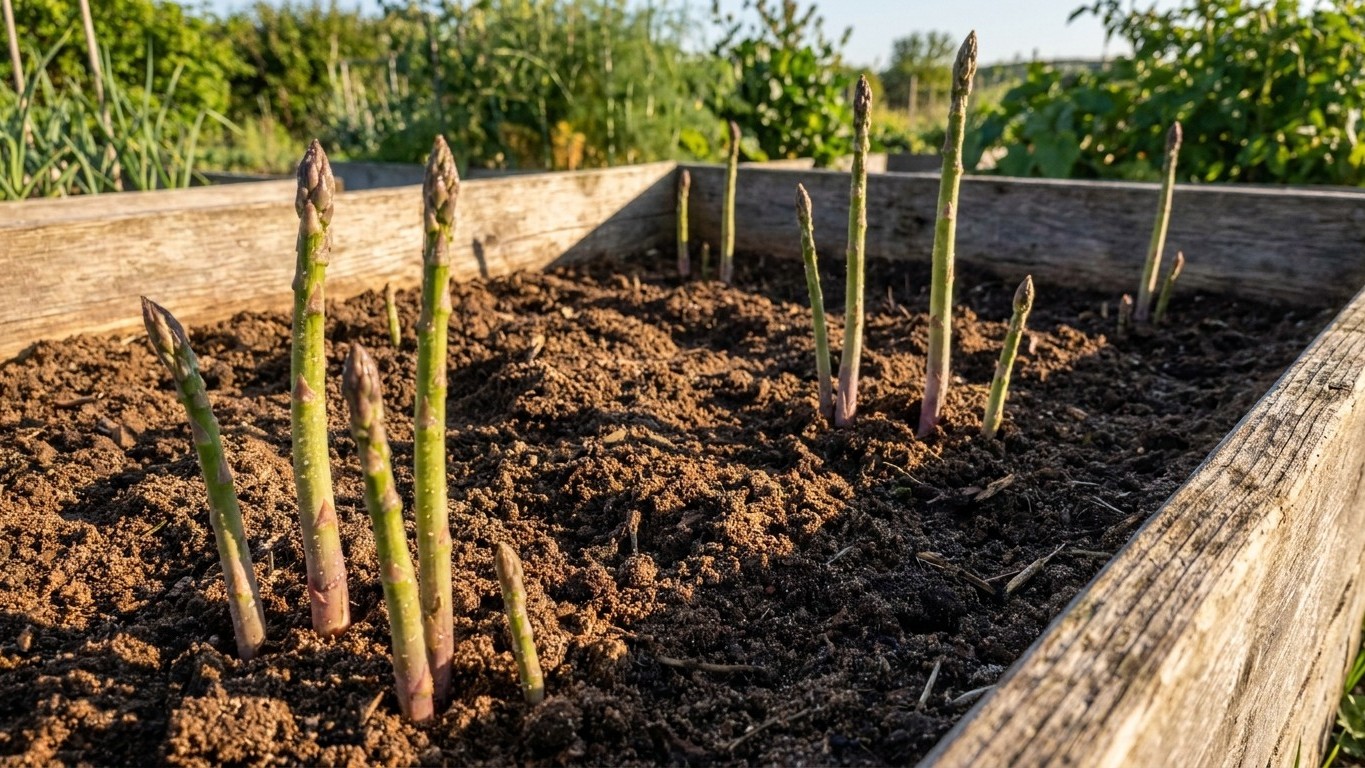

Stop cutting when most of the spears coming up are thinner than a pencil. That is an object, not a calendar date, and it holds in every South Carolina garden. Before the rule applies at all, a new bed gets no harvest until year 3. Then come four weeks of cutting, then six, then eight. Once spears are in your hands, the kitchen target is narrow: 32 to 35°F, with the cut ends in water. The sections below cover the ground and planting that make those harvests possible. For the full overview, start with Growing Asparagus in South Carolina.
The short answer
An asparagus bed is a fifteen-year decision. Utah State University Extension puts the productive life at 10 to 15 years, after a wait of three years before the first cut, and its only soil requirement is that the ground drains. “Most soils will do,” it says, “provided they are well drained.” Nothing else about soil is spelled out there, and I won’t invent a requirement it doesn’t state.
What the state soil tends to do
South Carolina’s state soil is the Bohicket series, and by that one test it fails. USDA records it as an Entisol, a very young soil with almost no profile development. The representative surface layer is 17 percent sand, 35 percent clay and 48 percent silt, with organic matter around 15.0 percent and a surface pH about 7.3, near neutral. The drainage class is the part that matters here: very poorly drained.
Think about what that means for a crop that stays put. A tomato bed on heavy ground is an annual nuisance, and you amend it each season. Asparagus crowns sit in their furrow for a decade or more, so a spot that holds water is a mistake you live with, not one you fix next spring.
This is where the state soil stops being useful. It is the soil USDA lists to represent the state, not the soil in your yard. South Carolina spans hundreds of soil series, and river bottoms, upland hills and any lot a builder has scraped or filled can look nothing like Bohicket. The figures above are representative values for the mapped surface layer, not a measurement of a worked garden bed. Read them as a tendency: heavy ground in this part of the country is more likely to hold water than shed it.
If your spot does not drain
Test the spot before you buy crowns. Dig a hole where the bed will go, fill it with water after a rainy spell, and watch. If water is still standing long after the rain has stopped, that spot is the wrong place for a bed meant to last until your kids are in college. A lab soil test will give you your own numbers for texture and pH, and those are the ones that count, not the 7.3 above.
When the ground fails, there are three honest options. Move the bed to higher or sloping ground on the property. Build a raised bed deep enough to hold an 8-inch furrow with drainage below it. Or give the heavy spot to a one-season crop and put asparagus somewhere it can stay. More on this in Will South Carolina Soil Hold an Asparagus Bed for Fifteen Years?
Will the summer here water it for you?
The bed wants 1 to 2 inches of water every other week for its first two years, then every three weeks. South Carolina summer rain, on paper, covers a lot of that.
- What falls. At the Charleston reference station, NOAA’s most recent 30-year normals show about 19.8 inches of rain across June, July and August, out of 52.5 inches for the whole year. June is the driest summer month at 6.21 inches, then July at 6.6 and August at 6.97.
- What the bed asks for. Watering every other week across a summer of about thirteen weeks means six or seven applications of 1 to 2 inches, or roughly 6 to 13 inches in total. That is my arithmetic, not a published figure, but it shows the average summer outpaces the demand.
- Why the average misleads. Summer rain often comes as a single thunderstorm, and much of a downpour runs off rather than soaking in. Heat also drives evaporation. On sandy ground an inch of rain drains through within the day, so even a wet summer can leave sandy beds dry. On clay the same inch can be held for a week.
- What you add. On heavy ground in a normal summer, very little. Let a gauge decide: if it shows less than an inch over two weeks, make up the difference to bring the total to 1 to 2 inches. On sandy ground, expect to add more, and more often.
- After year two. Stretch the interval to every three weeks and keep using the same gauge test.
Let a gauge settle it
Those rainfall figures are normals for one station over a 30-year span. They are not a forecast, and they are not your yard. The Upstate, a slope, a city lot or a rain shadow will all shift the numbers. A cheap rain gauge on your own plot tells you what actually landed.
On very poorly drained ground, the danger runs the other way. A bed that sits wet through a rainy August is in more trouble than one that missed a watering. If your gauge keeps filling and the furrow keeps holding water, that is the drainage problem from the first section showing up in summer.
When to put the crowns in
Crowns go in during early spring. For South Carolina, anchor that to the last spring freeze, which at the Charleston reference station falls around February 28 to March 17. That span comes from NOAA’s 1991-2020 normals for 32°F freeze probabilities, in the 30 to 70 percent band. A mean date is an average: some springs freeze later, some earlier, so watch your own forecast rather than the calendar.
Those dates are for the airport station. Peninsular Charleston runs milder, and the Upstate runs several weeks tighter at both ends of the season, with a later last freeze and an earlier first one. An Upstate gardener should expect to plant later than the coastal dates suggest.
Planting and the long wait
Crowns go into furrows 8 inches deep. The furrow is not filled in at once. Backfill gradually across the year, 2 inches every other month, until the furrow is level with the surrounding ground.
Then comes the part that tests patience. Nothing is harvested until year 3. Do not soften that into “a few spears” in year two, because the crowns are still building what will feed the bed for a decade. After that first cutting year, the harvest window runs four weeks, then six, then eight. Pests will be waiting for the first spears too, and What Eats Asparagus in South Carolina, and When covers who shows up.
The seed route
Growing from seed is the alternative to buying crowns. The Utah State source is built around crowns and publishes no seed-starting schedule for South Carolina, so I won’t make one up. What follows logically is that seed adds a stage before the bed exists at all, which pushes the whole clock later.
Four varieties are named in that source, with only their sex given:
- Jersey Giant: all-male
- Jersey Knight: all-male
- UC 157 F1: male and female
- Purple Passion: male and female
No flavor notes, no yield figures and no reason to prefer one over another are published. Treat any claim you read elsewhere as unsourced.
Common questions
How do I know when to stop cutting for the season?
Look at the spears, not the calendar. When most of the new spears are thinner than a pencil, stop cutting. There is no week number attached to this rule, and it will land at different times in the Lowcountry and the Upstate.
Can I take a few spears in the first or second year?
No. The source is firm that nothing is harvested until year 3. After that the cutting season is four weeks, then six, then eight.
How should I store cut spears?
Aim for 32 to 35°F with near-saturated air, 95 to 100 percent humidity. Both edges of that window bite. Above 50°F, spears toughen within hours, so a warm kitchen counter is a poor place to leave them. At about 30.9°F or lower they suffer freezing injury, with a water-soaked look that turns extremely soft once thawed. The cut end loses water faster than anything else, so stand the butts in water or wrap them damp. That is the home-kitchen version of high humidity. Put a thermometer in your refrigerator to check where it actually sits.
Which variety should I plant?
The source names Jersey Giant and Jersey Knight (all-male) and UC 157 F1 and Purple Passion (male and female), and publishes nothing else about them. Your drainage will matter far more than your choice among them.