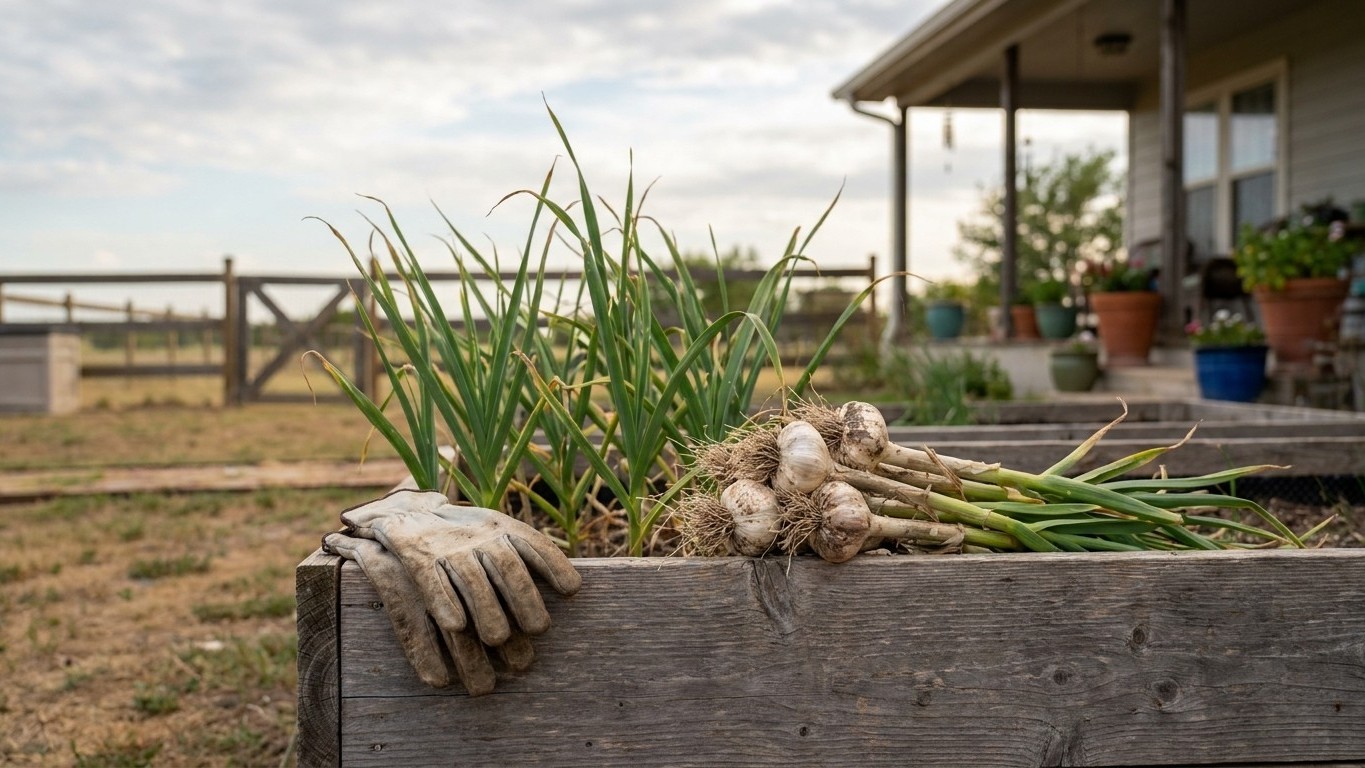

In most of South Carolina, garlic comes out of the ground somewhere between late May and late June, once the bottom third to half of the leaves have browned while the top few stay green. That’s the signal, not a date on the calendar. What changes the answer from year to year is planting date, variety, and how fast the heat builds each spring, which is why two gardeners a county apart can be pulling bulbs two weeks out of sync.
When garlic is ready to lift in South Carolina
Garlic planted in autumn spends winter building roots, then pushes leaf growth hard once soil temperatures climb in early spring. Each leaf corresponds to a wrapper layer around the bulb, so watching foliage is really watching bulb development from the outside. The rule growers lean on: five or six green leaves left standing, with the rest gone brown, means the bulb has stopped adding layers and started tightening its skins.
Softneck types tend to finish a little earlier than hardneck types, and in South Carolina’s warm spring, that gap can matter. A hardneck variety that would still be filling out in a cooler climate may hit maturity here two or three weeks sooner than a seed catalog’s “typical” timeline suggests, because the state’s frost-free stretch and early heat push the whole cycle forward. That’s a real mismatch worth planning around if you’re growing more than one type.
Waiting too long carries its own cost here. South Carolina’s early summer humidity doesn’t just make harvest miserable, it works on the bulb in the ground. Once wrapper leaves start to brown fully and split, the papery layers protecting the cloves degrade, and bulbs left in wet soil past their window can pick up rot before you ever lift them. There isn’t a wide margin between “not quite ready” and “already declining” the way there is in a drier, cooler region.
A test dig beats guessing
When the leaf count looks close, pull one bulb and check it rather than waiting for certainty from the whole bed. A mature bulb shows plump, well-defined cloves with tight skins. If cloves look small or the skins feel loose and unformed, rebury that plant’s neighbors and check again in a few days. Digging is disruptive to a bulb you’re not keeping anyway, so treat it as a sacrifice worth making for the information.
Lift with a garden fork rather than pulling by the neck. Necks snap easily once the plant is drying down, and a bulb yanked free of its roots halfway can bruise, which shortens how long it keeps later. Loosen soil on both sides first, then lift straight up.
Curing it, and where to hang it here
Curing is the step that turns a freshly dug bulb into something that stores for months instead of weeks. It’s drying, essentially, but slow and even drying, done with the wrapper leaves and roots still attached so moisture leaves the bulb gradually rather than all at once from an exposed clove.
Don’t wash the bulbs. Brush off loose soil by hand and leave the rest. Washing introduces moisture right where you’re trying to remove it, and in a humid climate that extra dampness is exactly what invites mold during the first days of curing, before the outer skins have sealed up.
Bunch several plants together and hang them, or lay bulbs in a single layer on a screen or slatted rack so air moves underneath as well as over the top. Either method works. What matters more than the method is the location: shade, good airflow, and protection from rain. A carport, a covered porch with open sides, or a garage with the door cracked and a fan running all do the job. Direct sun is the one thing to avoid outright, since it can scorch bulbs right through the leaves and cook the outer cloves before the inside has finished drying.
South Carolina’s summer air is often heavy enough that a closed, unventilated space won’t cure garlic properly no matter how shaded it is. If the space feels muggy to you standing in it, it’s muggy for the garlic too. A box fan set to keep air moving through the hanging bunches makes a real difference on the state’s stickier weeks, and it’s a cheap fix compared to losing a chunk of the harvest to soft rot at the neck.
Curing generally takes several weeks. You’ll know it’s done when the outer wrapper leaves are fully dry and papery, the neck is tight rather than fleshy, and the roots have shriveled. At that point, trim the roots close and cut the tops down, leaving an inch or two of neck if you plan to store in mesh rather than braid.
Storing it through a South Carolina winter
Once cured, garlic wants the opposite of what South Carolina’s climate offers by default: cool, dry, and dark, with steady conditions rather than swings. A garage or shed that bakes in summer and gets damp in winter isn’t a great long-term spot. A pantry, closet, or spare room inside the conditioned part of the house usually works better than most outbuildings, especially through the humid stretch that runs well into fall.
Mesh bags, loosely woven baskets, or old pantyhose (genuinely a common trick, since it lets air through while keeping bulbs separated) beat any sealed container. Plastic bags and airtight jars trap the small amount of moisture bulbs still release even after curing, and that’s enough to start rot in a bag full of garlic that looked perfectly dry when you put it away.
Softneck varieties typically outlast hardneck varieties in storage, often keeping well for months, while hardneck types tend to soften or start sprouting sooner. If you grew both, use the hardneck garlic first and save softneck for later in the winter.
Saving cloves for next fall’s planting
If part of this year’s harvest is meant to become next season’s seed garlic, it needs to make it through summer and into the fall planting window in good shape. According to NOAA NCEI’s 1991-2020 Climate Normals for station USW00013880, the first fall freeze in this part of South Carolina falls somewhere between November 20 and December 5. That date is a midpoint, not a guarantee. In roughly one year out of two, the first freeze actually arrives later than that window. Coastal areas, including peninsular Charleston, tend to run milder than that airport-based figure, while the Upstate sees both its first frost and last spring frost several weeks tighter on either end. Whatever your local pattern, the practical point is the same: cured garlic held in good storage conditions has plenty of runway to reach planting time without needing to rush the decision.
What goes wrong here
Most storage failures trace back to moisture that never fully left the bulb. Curing in a shaded spot that’s still damp, cutting curing short because the weather turned, or sealing bulbs in plastic before the necks are truly dry all lead to the same result: soft spots and mold showing up weeks later, often after you’ve already moved on and stopped checking the pile.
Harvesting late is the other repeat offender in this climate. Once wrapper leaves split open in the ground, the bulb loses the protective layers that would otherwise carry it through curing and storage. Those bulbs might look fine at harvest but tend to be the first ones to go soft in the pantry a month or two later.
Pests are a smaller factor for garlic specifically than for the rest of a South Carolina vegetable garden, but garlic beds rarely stand alone. Clemson Cooperative Extension Home and Garden Information Center documents a range of pests active in home gardens across the state, including brown and green stink bugs, leaffooted bugs, spotted and striped cucumber beetles, silverleaf whitefly, potato aphid, cabbage looper, diamondback moth, corn earworm, squash vine borer, and tobacco and tomato hornworms. These are general vegetable garden pests rather than ones specific to garlic, but where garlic is interplanted with tomatoes, squash, or brassicas, pressure from that list can stress neighboring beds and indirectly affect how vigorously garlic finishes out its final weeks before harvest. Details and management guidance are available through Clemson’s extension service.
The fix for most of this is patience in two directions: don’t rush the harvest past the leaf signal, and don’t rush the cure past what the bulbs actually need, especially on the state’s more humid weeks.
Common questions
Can I harvest garlic early if heavy rain is coming?
If bulbs are close to the five- or six-green-leaf mark, lifting a day or two early to avoid a soaking is usually better than leaving mature bulbs sitting in waterlogged soil. Pull one to check first if you can spare the time.
How do I know curing is actually finished?
Check the neck, not just the leaves. It should feel dry and papery, with no give or moisture when you press it. Roots should be shriveled and brittle rather than plump.
Should I braid softneck garlic in this humidity?
Braiding works fine once bulbs are fully cured, but braid in a space with good airflow rather than a closed closet, and check the braid occasionally for any bulb that’s gone soft, since one bad bulb can affect its neighbors in a tight braid.
Will stored garlic really last until fall planting?
Softneck garlic held in a cool, dry, dark spot generally holds up well past summer. Set aside the largest, healthiest bulbs specifically for seed early on, rather than picking through what’s left near planting time.