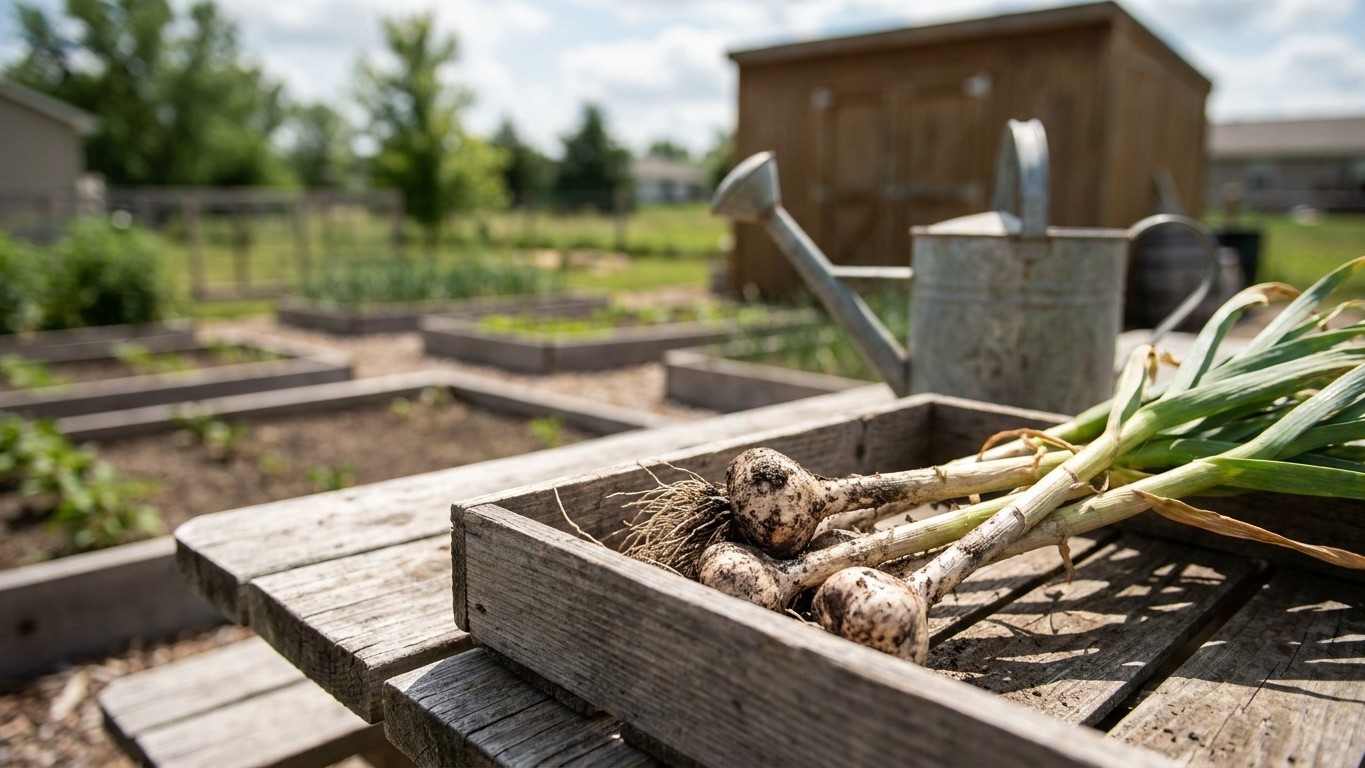

Get your garlic in the ground early September to mid-September — that’s the answer for most of South Dakota. Cloves need bare weeks of root growth before the soil turns cold, and this window gives them enough time without letting frost catch them still bare. So before you pick a week, walk your yard and think about drainage: a raised bed that sheds water fast can wait toward mid-September, but a low spot that stays soggy into fall should get planted on the early end, so roots are moving before cold and wet hit the ground together.
The short answer for South Dakota

If you garden near Sioux Falls, or anywhere in that southeastern corner of the state, plant garlic early September to mid-September. That window is anchored on NOAA’s 1991-2020 normals for the Sioux Falls station, which place the average first fall freeze between September 24 and October 4. Garlic wants to grow roots, not top growth, before winter locks the soil, and that root window is what the planting date is built around.
Every cultivar catalogue lists the same instruction for this region: set cloves out early September to mid-September. That is not a single day. It is a two-to-three-week stretch, and the right week for you depends on how exposed your garden is, how heavy your soil drains, and whether you are planting a hardy hardneck or a softneck type. A raised bed with loose, fast-draining soil can go in on the later end of that window. A low spot that holds water into fall should go earlier, so roots get moving before the soil turns cold and wet at the same time.
Remember that a frost date is a midpoint, not a guarantee. NOAA’s normals describe the range where the freeze probability sits between 30 and 70 percent at that station, which means the actual first frost in any given year falls outside September 24 to October 4 about as often as it falls inside it. Planting on the early side of the window costs you nothing. Planting on the late side and getting an early frost can catch cloves that have barely started to root.
Working it out for your own garden
The arithmetic behind the planting window is simple once you see it laid out. Garlic cloves need a period of root establishment before the ground freezes solid, and that root growth is what the fall planting date is protecting. Counting Back From NOAA’s Sioux Falls frost window of September 24 to October 4, a planting date of early September to mid-September puts cloves in the ground roughly two to five weeks ahead of the average first freeze, depending on exactly where your planting date and that year’s frost fall within their respective ranges.
Why the cold matters more than the calendar
The reason fall planting works at all in this climate comes down to vernalization, the cold exposure that splits a single clove into a full bulb of cloves the following summer. Garlic generally needs six to eight weeks of temperatures below 40°F to complete that process. South Dakota winters run cold enough that this is never the limiting factor: the region averages roughly 30.4 weeks a year with mean air temperatures below 40°F, according to University of Georgia Extension publication C854, which sets out the six-to-eight-week threshold. That is nearly five times what garlic requires, so the planting date is really about root establishment before freeze-up, not about accumulating enough cold afterward.
Elevation and terrain shift the actual date more than the calendar does. A garden several hundred feet higher than the Sioux Falls station, or one sitting in a low frost pocket where cold air drains and pools overnight, will see its first freeze arrive earlier than the reference figure suggests. A site with a large reservoir nearby, such as one of the Missouri River lakes, holds a little more heat into fall and can push the local frost date later than the airport-station normal. None of these effects are quantified for your specific garden anywhere in the public record, so treat the NOAA figure as a starting point and adjust toward “earlier” if your site is exposed, elevated, or in a known cold pocket.
Matching a cultivar to the window
The planting window is the same across the varieties carried for this region, but the choice between them still matters for storage and flavor. For a deeper look at which types handle South Dakota winters best, see Garlic Varieties That Suit South Dakota Winters.
| Variety | Type | Set out |
|---|---|---|
| Early Red Italian | Softneck | Early September to mid-September |
| Inchelium Red | Softneck | Early September to mid-September |
| Italian Late | Softneck | Early September to mid-September |
| Lorz Italian | Softneck | Early September to mid-September |
| Bavarian Purple | Hardneck | Early September to mid-September |
| Blue Music | Hardneck | Early September to mid-September |
| Chesnok Red | Hardneck | Early September to mid-September |
| Duganski | Hardneck | Early September to mid-September |
| Fall Festival | Hardneck | Early September to mid-September |
| Georgian Crystal | Hardneck | Early September to mid-September |
| Georgian Fire | Hardneck | Early September to mid-September |
| German Red | Hardneck | Early September to mid-September |
| German White | Hardneck | Early September to mid-September |
| Ivan | Hardneck | Early September to mid-September |
What changes across South Dakota
The Sioux Falls figure describes the southeastern corner of the state and nowhere else with any precision. Head west into the Black Hills and elevation alone pushes the growing season shorter, since higher ground cools faster in fall and holds cold longer into spring. Gardens up there should expect to plant on the earlier end of any window drawn from a lowland station, and to watch their own local conditions rather than lean on a figure measured hundreds of miles away and thousands of feet lower.
The James River Valley, running north-south through the middle of the state, sits in flatter, more open country than the hills, and cold air tends to settle into its lower stretches on clear, calm nights. A garden in a valley bottom there can see frost arrive earlier than a garden on a nearby ridge just a few miles away, even though both sit at similar latitude. This is the kind of local variation no state-wide date can capture.
Along the Missouri River reservoirs, including the areas around Lake Oahe and Lake Francis Case, the large volume of open water moderates the air nearby into fall, often delaying the first freeze a little compared with drier ground a short drive away. None of this is quantified station by station in the public record, but the pattern is well understood by anyone who has gardened both near open water and in an exposed upland spot in the same county. The practical takeaway is the same everywhere: use the Sioux Falls figure as a reference point, not a rule, and shift earlier if you are elevated, in a valley cold pocket, or far from the moderating effect of a large reservoir.
The mistakes this climate punishes
South Dakota’s cold, consistent winters mean the six-to-eight-week vernalization requirement is never in doubt here. That takes one common garlic mistake off the table. The mistakes that actually cost a crop in this climate are almost all about timing and depth, not about whether the winter gets cold enough.
Planting too late to root
Waiting past mid-September to plant, especially in a year when a warm fall tempts you to delay, risks cloves going into cold, sometimes already-frozen ground with no time to put down roots. A clove that has not rooted before hard freeze is more vulnerable to frost heave and slower to resume growth in spring. If your fall has been mild and your soil is still warm at planting depth, that is not a reason to wait longer. It is a reason to plant on schedule and let the mulch do the insulating.
Planting too shallow, or skipping mulch
Cloves set less than a couple of inches deep, or left unmulched over winter, are far more exposed to the freeze-thaw cycles that heave them partway out of the soil. A heaved clove that refreezes exposed rarely produces a full bulb. A heavy mulch layer, applied after the ground has cooled but before a hard freeze locks it up, buffers the soil against those swings far better than depth alone can.
Disease risk from planting stock, not from the weather
According to the UC IPM Pest Management Guidelines for onion and garlic (UC ANR Publication 3453), several soil-borne pathogens have published temperature ranges worth knowing, even though the figures below are soil temperatures compared against this region’s monthly mean air temperatures, which is an approximation, not a match. Soil lags air by weeks and swings far less than the air above it, and a monthly average hides a wide spread of daily temperatures.
| Disease | Pathogen | Published range | Months inside range (Sept-July, Sioux Falls area) |
|---|---|---|---|
| White rot | Sclerotium cepivorum | 50-75°F | 4 (September, May, June, July) |
| Fusarium basal rot | Fusarium oxysporum f. sp. cepae | 59-90°F | 3 (September, June, July) |
| Southern blight | Sclerotium rolfsii | 86-95°F (optimum) | 0 |
| Pink root | Setophoma terrestris | 75-85°F (optimum) | 0 |
Zero months inside the southern blight and pink root ranges does not mean those diseases cannot show up. Infected seed stock carries a pathogen regardless of climate, and one reference station never describes conditions across the whole state. The practical lesson is to start with clean, certified seed garlic rather than supermarket bulbs, and to avoid replanting cloves from a bed that showed rot or stunted bulbs the year before. That single habit does more for disease control here than any timing adjustment. For bed prep and soil drainage, see Growing Garlic in South Dakota.
Checking this against your county
The Sioux Falls figures come from one NOAA weather station and will not match every county exactly. SDSTATE Extension maintains county-level offices and current guidance across the state, and is the right place to confirm frost timing and planting recommendations for your specific location. Visit SDSTATE Extension and search for your county office, or call in and ask directly. If you garden west of the Missouri River, in the Black Hills, or in a known frost pocket, that local check matters more than anything a state-wide article can tell you.
Common questions
Can I still plant garlic if I missed the September window?
You can plant into early October in a mild year, but you are trading away root establishment time, and a clove that has not rooted before a hard freeze is at higher risk of heaving out of the ground over winter. If you are past mid-September, plant as soon as possible, set cloves a little deeper than usual, and mulch heavily.
Does hardneck or softneck matter more for South Dakota winters?
Both classes handle this climate’s cold winters, since the region’s roughly 30.4 weeks a year below 40°F clears any garlic’s vernalization needs several times over. The choice between hardneck varieties like Duganski or German Red and softneck types like Inchelium Red comes down to flavor, storage length, and whether you want a scape harvest, not winter survival.
What happens if I plant too early, in August?
Garlic planted while soil is still warm can push top growth before winter instead of focusing on roots, which wastes energy the bulb needs later and leaves tender green shoots exposed to the first hard freeze. Early September is early enough for this region’s frost timing.
Do I need to water garlic after fall planting?
Give the bed a deep watering right after planting so cloves make good soil contact and start rooting, then let fall rain take over unless your area turns unusually dry. Waterlogged, poorly drained soil going into winter raises the risk of the rots discussed above, so drainage matters more than extra watering once cloves are in.
If you follow the almanac, here is when to plant garlic by the moon. It is a tradition, not a proven method.