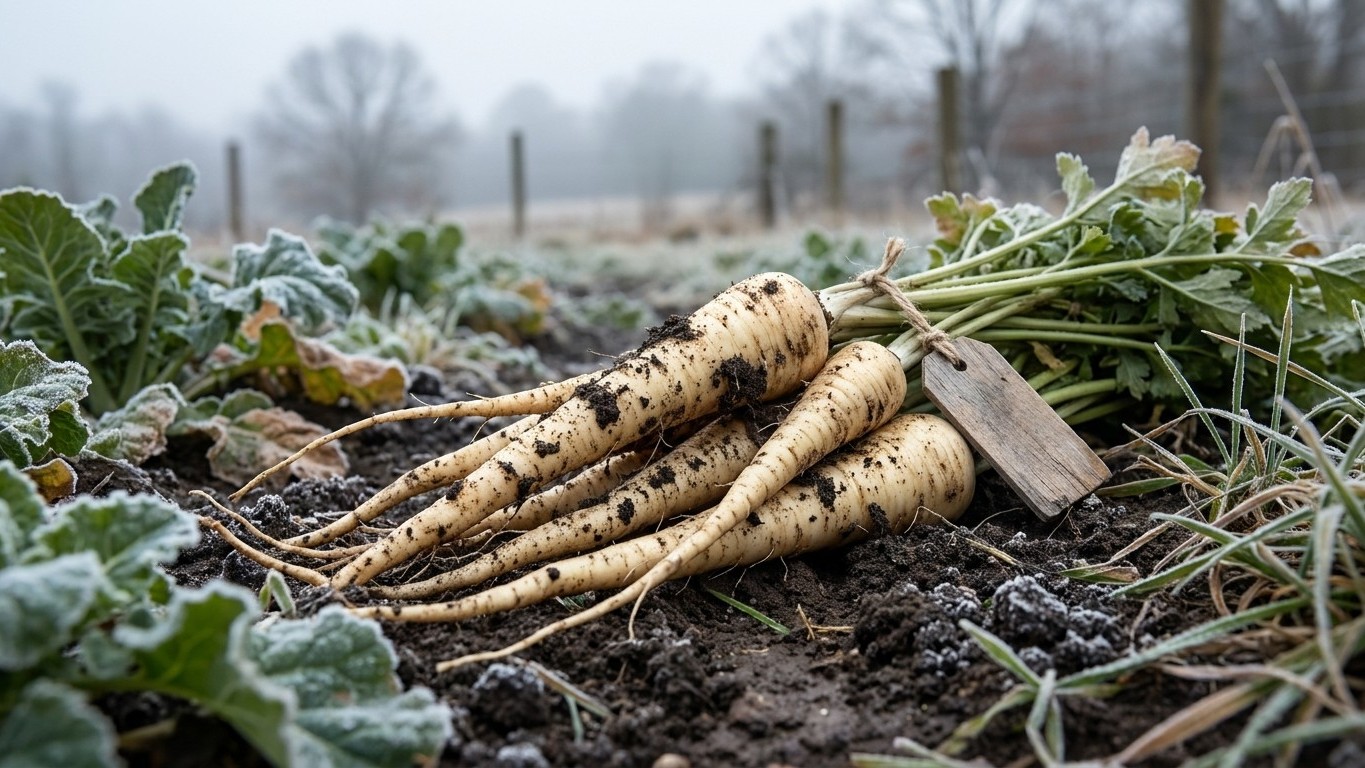

South Carolina’s coldest month brings a mean minimum of 38.9°F at the Charleston reference station, a number that sits nearly seven degrees above freezing. That’s the figure that decides everything here: parsnips sown in South Carolina soil will grow into full-sized roots without much trouble, but the “several weeks of cool, frosty weather” that converts starch into sugar simply isn’t a given in most of the state. Growing parsnips and sweetening parsnips are two different outcomes, and this climate reliably delivers only the first.
The short answer
Does South Carolina deliver several frosty weeks in a row? Based on the Charleston-area normal, the answer leans no. A mean daily minimum of 38.9°F for the coldest month means that on an average night in the depths of winter, the thermometer doesn’t even reach the 32°F mark that triggers the starch-to-sugar conversion in a parsnip root. Some nights will dip below freezing, and a hard cold snap can certainly happen, but “several weeks” of that kind of exposure is a much higher bar than what the coldest month’s average suggests.
This matters because parsnip sweetening isn’t a matter of survival, it’s a matter of accumulated cold exposure. A parsnip left in mild ground all winter will still be edible, still starchy, and firm enough to roast or mash. What it won’t develop is that deep, nutty sweetness that gardeners in colder states brag about after digging roots out of frozen dirt in January. That flavor shift is a chemical response to repeated freezing, not a byproduct of simply surviving winter.
There’s real variation inside the state worth flagging. The Charleston figure represents the Lowcountry, one of the mildest corners of South Carolina. The Upstate, up toward the mountains, runs its frost windows several weeks tighter at both ends, which points to a meaningfully colder winter overall, not just a longer frost season. A gardener in Greenville or Spartanburg is working with a different climate than one in Charleston or Myrtle Beach, even though both are technically “South Carolina.” If sweetening matters to you and you have any choice in location, the colder, higher-elevation parts of the state give you a better shot than the coastal plain.
For most of South Carolina, though, the honest expectation is a parsnip that grows well, stores fine, and cooks up perfectly usable, but one that won’t hit the sugar-sweet mark that the crop is famous for in harsher climates. That’s not a failure of technique. It’s a mismatch between what this crop wants and what this climate typically supplies.
Does the season fit?
Parsnips need 100 to 120 days from seeding to maturity, sown directly in place 2 to 3 weeks before the last spring frost. Lining that requirement up against South Carolina’s frost calendar shows the season itself is not the limiting factor here, even though the sweetening is.
- Start with the frost window. At the reference station, the last spring frost falls somewhere between February 28 and March 17, and the first fall frost arrives between November 20 and December 5. That’s a long frost-free stretch by national standards, roughly eight to nine months depending on exactly where in that window a given year falls.
- Back up to the sowing date. Sowing 2 to 3 weeks before the last frost puts seed in the ground somewhere between early February and early March, depending on how the last-frost date lands that particular year.
- Add the germination lag. Parsnip seed is notoriously slow to sprout, taking 14 to 21 days to germinate. Nothing visible happens above ground for two to three weeks after sowing, which trips up a lot of gardeners who assume the seed failed and dig up bare soil to re-sow. Leave it alone and wait.
- Run out the 100 to 120 days. Counting from that early-to-mid-February sowing, a root sown at the earliest edge of the window reaches maturity by roughly mid-to-late May. A root sown at the later edge, closer to early March, matures anywhere from early June into early July.
- Compare that to the fall frost date. Even the latest-maturing roots finish growing months before the first fall frost in late November. That gap is the whole point: parsnips can sit in the ground, fully grown, waiting for the cold weather that triggers sweetening, without any risk of the growing season simply running out on them.
The arithmetic says the season fits comfortably almost everywhere in the state. The catch, again, isn’t length of season. It’s whether the cold that arrives during that long wait is cold enough, and lasts long enough, to actually do the sweetening work once the roots are sitting there ready for it.
What goes wrong here
- Forked or split roots from heavy, stony ground. Parsnips want deep, loose, sandy soil, and a taproot that hits clay, compacted earth, or buried rocks will split into two or three legs instead of growing straight. Double dig the bed at least a foot down before sowing and pull out anything that could deflect the root, since heavy Piedmont clay in the Upstate and compacted coastal soils both cause this in different ways.
- Forked roots from overwatering. This is a separate cause from bad soil, and it gets confused with it constantly. A taproot that gets too much moisture, especially early on, tends to branch rather than drive straight down. Water deeply but infrequently once seedlings are established, letting the top inch or two of soil dry between waterings, rather than keeping the bed constantly damp.
- A season that runs out before the roots size up. This is a minor risk in South Carolina given the long frost-free window, but it still happens when sowing gets delayed past the ideal window, say into late spring after warm weather has already set in. Sow as close to that 2-to-3-weeks-before-last-frost target as the ground allows, and don’t wait for guaranteed warmth, since parsnip seed tolerates cool soil fine.
- A winter too mild to sweeten. This is the state’s real limiting factor. Roots that mature by early summer and then sit through a Lowcountry winter with a coldest-month mean minimum of 38.9°F simply won’t accumulate enough freezing exposure to convert much starch to sugar. There’s no fix for this beyond location and patience: leave roots in the ground through every cold spell the winter offers, harvest as late as possible, and in the Upstate specifically, expect noticeably better results than the coastal plain, since that region runs its winters several weeks colder at both ends.
Common questions
Can parsnips survive a South Carolina winter left in the ground?
Yes. With a coldest-month mean minimum of 38.9°F, freezing damage to the roots themselves is not a serious risk in most of the state. The issue isn’t survival, it’s whether enough freezing exposure accumulates to sweeten the crop.
Should I harvest Parsnips in South Carolina before the first fall frost?
No, that would defeat the purpose. The window between the first fall frost (November 20 to December 5 at the reference station) and the depth of winter is exactly when sweetening happens. Leaving roots in the ground through as many cold spells as the season delivers gives the best shot at flavor, even if the state’s mild average winter limits how far that sweetening goes.
Is the Upstate a better bet than the Lowcountry for sweet parsnips?
Based on the frost data, likely yes. The Upstate’s frost windows run several weeks tighter at both ends than the coastal reference station, which points to colder overall winter temperatures there. That gives Upstate gardeners a better chance at the sustained freezing exposure that sweetens the roots, compared to the milder Charleston-area climate this page is built on.
Why hasn’t my parsnip seed sprouted after two weeks?
That’s normal and not a sign of failure. Parsnip seed germinates slowly, typically taking 14 to 21 days to show any growth above ground. Resist the urge to dig up the bed or re-sow before that window has fully passed.