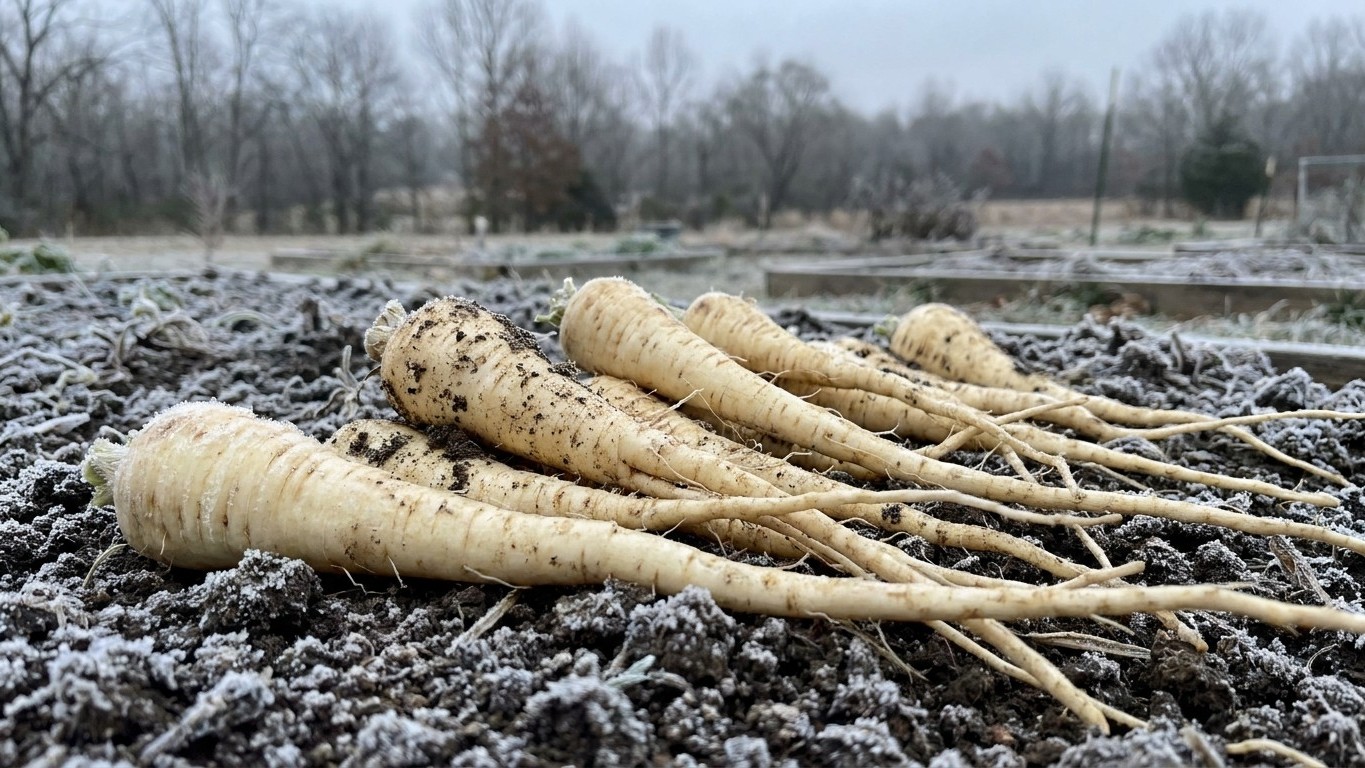

Parsnips will grow across South Carolina without much trouble, but sweetening is a different question. The mean minimum of the coldest month at the Charleston reference station sits at 38.9°F, which tells you winter here rarely drops hard below freezing on an average night. That single number is the whole story: enough cold to matter in the Upstate, not nearly enough on the coast to guarantee the frosty weeks parsnips need to turn starch into sugar.
The short answer
Start with the question that actually decides this, not the one gardeners usually ask. Forget the hardiness zone map for a moment. The thing that converts a parsnip’s stored starch into sugar is direct, repeated exposure to frost while the root sits in the ground, not whether the plant can survive winter where you live. Those are two different measurements, and confusing them is the most common mistake on parsnip advice pages.
The number that matters is the mean minimum of the coldest month. At the Charleston reference station, that figure is 38.9°F. Read that carefully: it’s not the coldest it ever gets, and it’s not a monthly average temperature. It’s the average low on an average night during the coldest month of the year. At 38.9°F, you’re sitting nearly seven degrees above freezing on a typical night, which means frost is a visitor here, not a resident. Some nights will dip below 32°F. Plenty won’t.
What that means for a parsnip left in the ground through December along the coast is inconsistency. You’ll get some frost exposure, enough to nudge the starch-to-sugar conversion along, but not the sustained run of freezing nights that produces the deeply sweet parsnip gardeners in colder states describe pulling in January. Utah State University Extension is specific on this point: parsnips taste best after several weeks of cool, frosty weather. Several weeks, not a night or two scattered through a mild December.
The Upstate changes this calculation. That region runs several weeks tighter on both ends of the frost calendar than the coastal reference station, which in practice means colder nights, more of them, and a better shot at the sustained frost exposure that actually sweetens the root. A gardener in Greenville or Spartanburg is working with a meaningfully different winter than one in Charleston or Myrtle Beach, even though both fall under the same broad regional description.
So the plain answer: parsnips grown in Lowcountry South Carolina will size up fine and will sweeten a little, but not reliably and not deeply, because the region’s coldest month rarely delivers sustained hard frost. Grown in the Upstate, with its colder nights, the odds of getting real sweetening improve. Nowhere in the state should you expect the parsnip performance you’d get from a Vermont or Minnesota garden, where winter frost is the rule rather than the exception.
Does the season fit?
Season length is a separate question from sweetening, and this is where South Carolina actually has an advantage. Here’s the arithmetic, worked through step by step.
- Parsnips are sown as seed directly in the garden bed, never transplanted, and the recommended timing is 2 to 3 weeks before the last spring frost. At the Charleston reference station, that last spring frost falls between February 28 and March 17, so the sowing window opens in mid-to-late February for most of the region.
- Parsnip seed is slow to germinate: 14 to 21 days is normal. That’s worth repeating because it trips people up. Sow in late February, and don’t expect visible rows until well into March. Gardeners who dig around impatiently at day ten are disturbing seed that simply hasn’t sprouted yet.
- From that seeding date, parsnips need 100 to 120 days to reach full size. Counting forward from a mid-to-late-February sowing, the 100-day mark lands around late May to early June, and the 120-day mark lands closer to late June.
- The first fall frost at the reference station arrives between November 20 and December 5. That’s the earliest point at which sweetening-grade cold typically begins.
- Between the earliest realistic maturity date (late May or June) and the first fall frost (late November), there are roughly five months of open ground. Parsnips don’t need to be harvested the moment they mature; they can sit in the soil, essentially in storage, until cold arrives.
- Put together, the season length itself is not the limiting factor in South Carolina. The 100 to 120 day requirement fits comfortably, with months of slack on either side, unlike short-season northern climates where sowing dates are squeezed against a late spring and an early fall frost.
The tight part of the calendar isn’t the growing season. It’s the frost exposure at the back end, and that circles back to the same point made above: plenty of time, not necessarily enough cold.
What goes wrong here
- Forked roots from heavy or stony ground. Parsnips push a long taproot straight down, and anything that deflects it (clay, compacted subsoil, rocks) splits the root into forks. Utah State University Extension recommends deep, sandy soil for this reason, and says heavy soil must be double dug before sowing, loosened well beyond the depth of a single spade to give the root a clear path.
- Forked roots from overwatering. This is a separate cause from soil texture, not a variation on it. Consistently soggy soil encourages the root to branch rather than drive down as a single taproot. The fix is watering on a schedule that keeps soil evenly moist without staying saturated, particularly in the weeks right after germination when the taproot is establishing its path downward.
- A season that outruns the calendar. Sowing too late, after the recommended 2-to-3-week pre-last-frost window closes, pushes the 100-to-120-day maturity date later into the year than the soil temperature and daylight really support. The remedy is simple: treat the last spring frost date for your specific county as a hard deadline, not a rough guideline, and sow on time.
- A winter too mild to sweeten. This is the coastal-zone version of the problem described above. Roots grow full-sized and edible, but the starch-to-sugar conversion stays incomplete because the ground never sees several consecutive weeks of frost. There’s no soil fix for this one; it’s a function of the region’s mild winter, and it’s most pronounced closer to the coast than inland.
Before any of this becomes a taste question, it’s a skin question. North Carolina Extension Gardener Plant Toolbox states it plainly: “All parts of this plant contain furocoumarins which can make skin sensitive to light causing burns so be sure to wear gloves, long sleeves and long pants when dealing with it.” All parts, not just the foliage. The root, the leaves, the stems.
The mechanism is what makes this surprising rather than obvious. The burn doesn’t come from the sap alone. It comes from sap on the skin combined with sunlight. That’s why it tends to show up after a bright afternoon spent pulling tops or harvesting roots, and why the reaction often doesn’t appear until hours later, once the skin has been exposed to UV light. It also explains why the standard advice is to cover up before you start, not to wash off after you’re done. Once sap and sunlight have both hit the skin, the reaction is already set in motion. Gloves, long sleeves, and long pants during harvest are the actual protection, not a rinse afterward.
Checking this against your own county
Everything above is built on a single reference station near Charleston, and the caution attached to it matters: peninsular Charleston runs milder than the airport station used for these normals, and the Upstate runs several weeks tighter on both the spring and fall frost dates. That’s a meaningful spread across one state. A gardener in Aiken, Rock Hill, or Anderson is not gardening on the same frost calendar as one in Beaufort or Hilton Head.
For a reading specific to your own county, the county office of Clemson Cooperative Extension is the resource built for exactly this. They can supply local frost date guidance and soil recommendations tuned to your part of the state rather than a single coastal station.
Common questions
Can parsnips be transplanted instead of direct-sown?
No. Parsnips develop a single long taproot that doesn’t tolerate disturbance well, which is why they’re always sown as seed directly in the garden bed rather than started indoors and moved.
How long does parsnip seed take to sprout?
Germination runs 14 to 21 days. That’s slow compared to most garden vegetables, and it’s a common reason gardeners assume their seed failed when it simply hasn’t come up yet.
Does leaving parsnips in the ground longer always make them sweeter?
Only if the ground is actually getting cold. Time in the soil matters only insofar as it includes several weeks of frost exposure. In a mild winter with little sustained freezing, extra weeks in the ground won’t add sweetness the cold itself never delivered.
Is the hardiness zone the right way to judge whether parsnips will sweeten?
No. Hardiness zone describes whether a plant survives winter where you live. Sweetening depends on frost exposure, specifically several weeks of cold weather while the root is in the ground. A comfortable hardiness zone and a frosty winter are not the same thing, and one shouldn’t be used to predict the other.