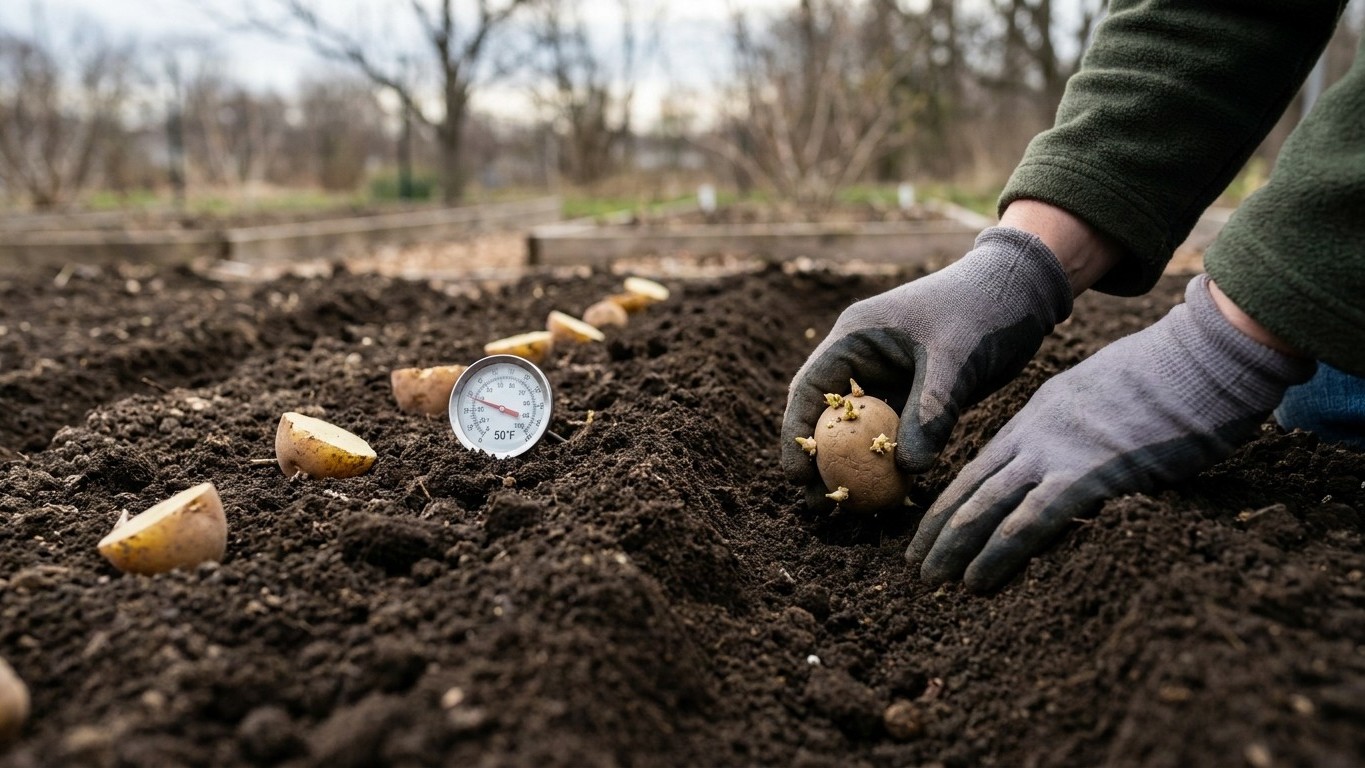

Plant potatoes in South Carolina 14 to 21 days before your last spring frost date, once the soil itself reaches 50°F. For the Charleston area, NOAA NCEI’s 1991-2020 Climate Normals put that last frost between February 28 and March 17, which puts the seed-potato window somewhere in early to mid-February for coastal gardens and later into February or early March for spots with a later frost.
The short answer
The number that matters here comes from NOAA’s National Centers for Environmental Information, using the 1991-2020 Climate Normals for station USW00013880. That station’s 30 to 70 percent freeze-probability window runs from February 28 to March 17. That’s not a single date. It’s a range, and it exists because a freeze isn’t a light switch. Some years the last 32°F morning shows up at the end of February, other years it lingers past mid-March. The range is the honest answer, not a rounded-off guess.
Now count backward. Potatoes go in the ground 14 to 21 days before that last frost date, according to University of Maine Cooperative Extension guidance, because the crop needs soil at 50°F to break dormancy and start growing, and that soil temperature threshold typically arrives before the air has fully cleared of frost risk. If your local last frost lands on the early side of the range, February 28, you’re looking at a planting window around February 7 to February 14. If your frost date runs to the late side, March 17, the planting window shifts to roughly February 24 through March 3.
Here’s the catch nobody puts on a seed packet: that February 28 to March 17 range comes from an airport station, not from downtown Charleston and not from Greenville or Spartanburg. Peninsular Charleston, sitting closer to the harbor and buffered by water, runs milder than the airport reading. Upstate South Carolina runs the opposite direction, with both the spring frost and the first fall frost arriving weeks tighter than what this station shows. A gardener in Anderson or Oconee County working from a Charleston-area frost date is planting on the wrong calendar entirely.
So the real short answer isn’t a date. It’s a method: find your own local last-frost window from NOAA data for your nearest station, subtract 14 to 21 days, and start checking soil temperature instead of watching the sky.
What actually decides it
The soil-temperature trigger
Potatoes don’t respond to the calendar. They respond to soil temperature, and Utah State University Extension’s potato fact sheet is direct about the threshold: seed potatoes go in the ground once the soil hits 50°F, not before. Below that, the seed piece sits in cold, wet soil doing nothing useful, and it becomes an easy target for rot. The reason the 14 to 21 day countback works as a rule of thumb is that in most years, soil in a prepared bed warms to 50°F somewhat ahead of the last air frost, since a few frosty mornings on the surface don’t necessarily chill the soil four to six inches down where the seed piece sits. That’s the whole mechanism behind counting backward from frost date rather than planting on frost date itself: the soil is usually ready for the crop before the air is fully safe, and the crop can tolerate a light frost on emerging foliage better than it can tolerate cold, wet soil around the seed piece.
The heat ceiling that caps the harvest
The other half of this decision has nothing to do with frost at all. It’s about the far end of the season. Both Utah State and University of Maine Extension describe the same ceiling: once soil temperatures climb above 90°F, tuber set and tuber fill are inhibited. This isn’t a slowdown that watering solves. The plant simply stops sizing tubers efficiently in soil that hot, regardless of how much irrigation you apply. In much of South Carolina, particularly the Midlands and Lowcountry, soil temperatures pass that 90°F mark well before summer ends. That single fact is what turns “when to plant” into “when to plant early.” A gardener who plants late, hoping to stretch a crop into summer, isn’t fighting bad luck. They’re fighting a physiological ceiling that shuts tuber growth down no matter what else goes right. The whole logic of counting back from frost, rather than picking a date deep into spring, exists because of this ceiling on the other end of the calendar.
How to do it
- Find your local last-frost window using NOAA NCEI climate normals for the station nearest you, not a state-wide average, since Charleston peninsula, the airport corridor, and the Upstate all run on different clocks.
- Subtract 14 to 21 days from that last-frost date to establish your target planting window, per University of Maine Cooperative Extension guidance.
- Buy certified seed potatoes rather than grocery-store potatoes or leftovers from last season’s bin. Uncertified seed carries viruses that don’t show up until the crop is already failing, and there’s no fixing that mid-season.
- Check actual soil temperature with a soil thermometer inserted four to six inches deep in the planting bed, rather than guessing from air temperature or the calendar date.
- Cut seed potatoes into pieces with at least one eye each, and let the cut surfaces callus for a day or two before planting, reducing rot risk in cool soil.
- Plant once soil reads 50°F and you’re inside your 14-to-21-day pre-frost window, setting seed pieces four inches deep in well-drained soil.
- Hill soil around the stems as plants grow, covering emerging foliage if a light frost threatens after planting.
- Track soil temperature again as the season progresses, watching for the approach of 90°F, since that’s the point where tuber sizing stalls regardless of watering.
- Dig the crop before soil temperatures hold consistently above that 90°F ceiling, rather than trying to nurse plants through a Carolina summer.
What goes wrong
- Planting by calendar date instead of soil temperature. A gardener sees “mid-February” on a chart and plants regardless of conditions. Remedy: use an actual soil thermometer and wait for 50°F, even if that pushes planting a week or two past your original target.
- Using uncertified seed potatoes. Grocery-store potatoes or last year’s saved tubers often carry viruses invisible at planting time. Remedy: buy certified seed potatoes each season, since certification is the only real safeguard against virus carryover.
- Trying to push a crop through summer heat. Once soil passes 90°F, tuber set and fill stop, and no amount of irrigation reverses it. Remedy: treat South Carolina as a spring-crop state, planting early enough to dig before the heat ceiling arrives, rather than expecting a summer harvest.
- Applying one state-wide frost date to the whole state. A gardener in the Upstate using a Charleston-area frost date plants too early and risks a hard freeze on tender growth; a coastal gardener using an inland date plants too late and loses weeks of the pre-heat window. Remedy: pull frost data from the station nearest your own garden, not a generic statewide figure.
- Missing the 14-to-21-day countback entirely and planting right at the last frost date. This delays planting past the point where soil has usually warmed to 50°F, and it shortens the runway before summer heat sets the tuber-set ceiling. Remedy: count backward deliberately, using the window rather than the single date.
Common questions
Can I plant potatoes I bought at the grocery store?
It’s not recommended. Grocery-store potatoes aren’t certified seed, and certified seed is the safeguard against viruses that can undermine a crop without any visible warning until it’s too late to correct.
What if my soil still hasn’t reached 50°F when the calendar says it’s time?
Wait. The soil temperature threshold, not the countback date, is what University of Maine Cooperative Extension identifies as the actual trigger for planting. A week or two of extra waiting for the soil to warm costs far less than planting into cold, wet ground.
Is there a second potato-planting window later in the year for South Carolina?
That’s not addressed by the sources used on this page. What both Utah State and University of Maine Extension do make clear is the mechanism that matters most for this state: soil above 90°F inhibits tuber set and fill, which is why South Carolina growing generally centers on getting a crop planted early enough to dig before summer heat sets in.
How do I choose between an early, mid-season, or late variety?
Extension sources publish season class, not a days-to-maturity count, and they describe intended use rather than texture labels. Choose based on what the variety is published as being for, baking or boiling, and match the season class to how much runway you have before your local soil crosses that 90°F ceiling.