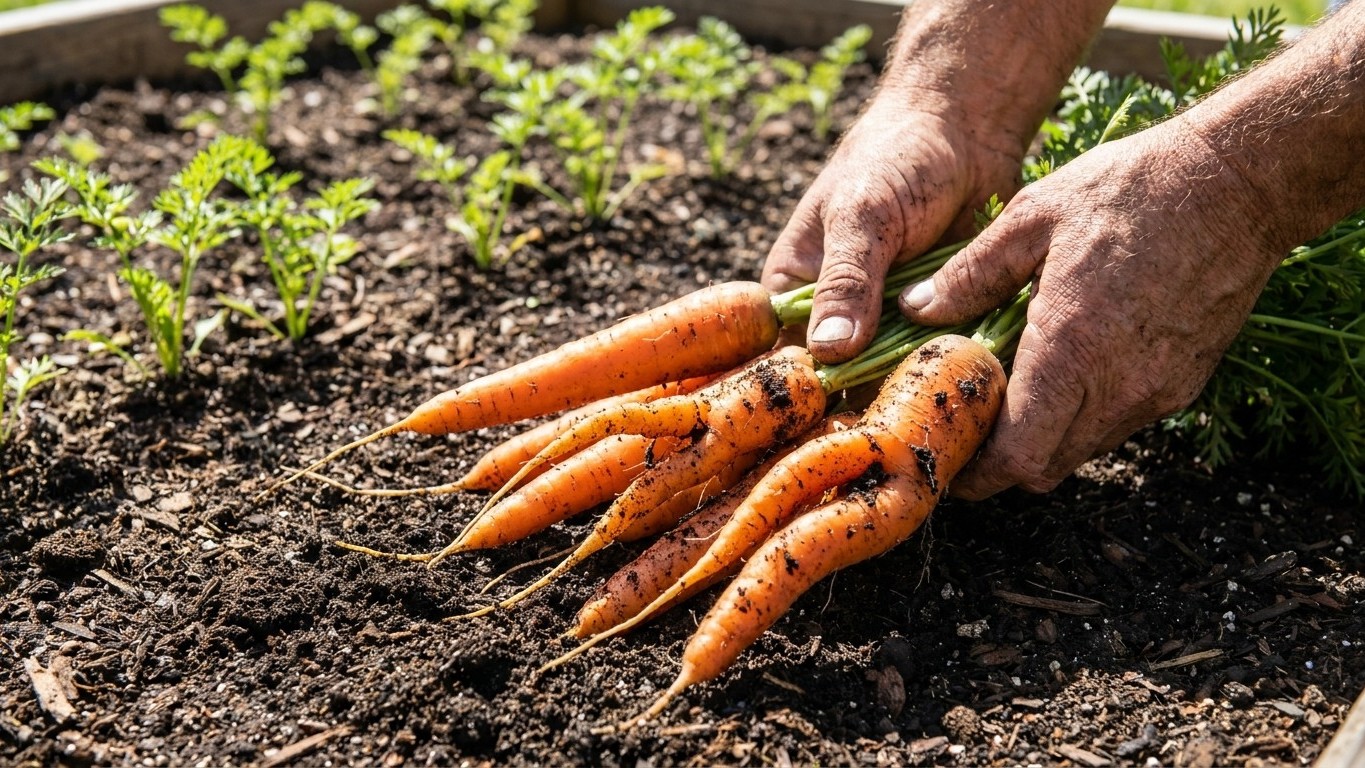

South Dakota gardeners can sow carrot seed directly into the garden bed as soon as the soil can be worked in spring, because carrot seed germinates in cool ground and young carrot plants tolerate a light frost without harm. Count 70 to 100 days from that seeding date to harvest, never from a transplant date, since carrots go into the ground once and stay there. No specific last-frost date for South Dakota appears among the sources behind this guide, so check your own local frost record before counting backward from it.
The short answer
South Dakota’s official state soil, set by state law, is the Houdek series, a Mollisol: the deep, dark prairie soil that built the Corn Belt’s reputation for good ground. USDA’s Soil Data Access records the surface horizon of the series’ major components at a loam-to-silt texture, 38 percent sand, 22 percent clay, 40 percent silt, with organic matter around 3.0 percent, a surface pH near 6.7, and a well-drained rating.
Will a carrot fork in Houdek soil?
Utah State University Extension is blunt about what carrots want: deep, sandy, well-drained soil rich in organic matter. Heavy or rocky ground forks the root, splitting one straight taproot into two or three crooked legs. Measured against the Houdek numbers, the picture leans favorable. At 22 percent clay and 40 percent silt, this loam sits well short of the heavy clay that typically causes forking, and “well drained” is exactly the drainage class carrots ask for. The organic matter figure, about 3.0 percent, is a workable baseline, and a surface pH near 6.7 sits close to neutral, which root vegetables generally tolerate without complaint.
That does not mean every South Dakota carrot bed grows straight roots without effort. The Houdek profile built up dark and deep over thousands of years under native prairie grass, not under a backyard that’s been graded, filled, or driven over by construction equipment. A homesite where fill dirt came in from somewhere else, a lot near a creek bottom, or ground compacted during a home build can look nothing like the surface horizon USDA measured for this series. Where the ground underfoot runs heavier or drains slower than that, Utah State’s remedy holds either way: work in plenty of compost and double dig the bed before sowing, loosening the soil to a full spade’s depth so no compacted layer stops the taproot partway down. On ground that stays soggy or compacts no matter how much organic matter goes in, a raised bed sidesteps the problem outright, since the gardener controls the fill from the start rather than fighting what’s already there.
South Dakota spans hundreds of mapped soil series, and Houdek is the one state law picked to represent it, not a survey of every backyard within its borders. Treat these numbers as a starting point for what the region’s ground tends to do, then confirm what’s actually under your own feet before you plant.
The test that settles it in your own garden
The Houdek numbers describe the state’s official soil, not the bed behind your house. Settling the fork risk and the drainage question for your own garden takes about twenty minutes with a shovel, a jar of water, and a garden hose.
- Dig a hole about a foot deep where you plan to sow. Note how far down the dark, workable topsoil runs before it changes color, turns pale, or gets noticeably denser. A shallow topsoil layer over a hard subsoil is exactly what stops a carrot taproot partway down and forces it to fork or curl.
- Sift the soil for stones and rocks by hand at several depths in that same hole. A carrot seedling’s root tip will fork or bend around anything solid in its path, so a handful of pea gravel eight inches down matters just as much as a boulder at two.
- Feel the texture by squeezing a moist handful into a ball. Soil that ribbons out smoothly between your fingers runs heavy in clay. Soil that crumbles apart and feels grainy runs sandy. Something in between that holds a loose shape and looks dark is closer to a workable loam.
- Watch how water drains. Dig a separate hole roughly a foot wide and a foot deep, fill it with water, and time how long it takes to disappear. Refill it once more and time the second drain. Water that stands for hours points to poor drainage, the same condition that keeps roots wet, encourages forking, and can rot seed before it germinates.
- Repeat the dig in more than one spot. Soil can change texture and depth within the same yard, especially near foundations, driveways, or low spots where runoff collects, so one good hole near the porch doesn’t guarantee the same ground twenty feet away.
What goes wrong here
Failures rooted in the ground
- Forking roots in heavy or compacted ground. A taproot meeting dense clay, a hardpan layer, or buried rocks splits into two or three legs instead of growing straight down. Work in plenty of compost and double dig the bed to loosen it a full spade’s depth before sowing, or build a raised bed filled with soil you control from the start.
- Stunted, curled roots in shallow topsoil. Where the workable layer runs thin over a hard subsoil, the taproot hits resistance early and curls sideways instead of lengthening. Deepen the bed by double digging or raise it above the problem layer entirely.
Failures rooted in the weather
- Poor germination during a hot, dry spell. Carrot seed is tiny and sits just under the surface, so a run of hot weather right after sowing can crust the top inch of soil and stop sprouting before it starts. Keep that top inch consistently moist with light, frequent watering, and consider a thin cover of straw or damp burlap over the row until seedlings appear, removed as soon as they show.
- Splitting roots from uneven watering. Roots that go dry for a stretch and then get flooded swell faster on the inside than the skin can stretch, cracking the root along its length. A steady watering schedule, rather than letting the bed dry out and then soaking it, keeps growth even and the skin intact.
Common questions
Can I start carrot seed indoors and transplant it later in South Dakota?
No. Carrots are sown directly in the garden bed where they will grow. Utah State University Extension’s guidance on carrot growth applies from that seeding date forward; disturbing the taproot with a transplant is one of the more reliable ways to cause forking.
How many days from seed to harvest should I plan for?
Utah State University Extension puts carrots at 70 to 100 days from seeding to harvest, counted from the day the seed goes into the ground, not from any later date.
Does the Houdek series pH of 6.7 mean my soil is near neutral too?
It means South Dakota’s officially designated soil measures near neutral at the surface, per USDA’s records for that series. Your own garden may sit on a different mapped soil entirely, so a home or lab soil test is the only way to know your actual number.
My yard was graded and filled during construction. Does the state soil data still apply?
Not reliably. USDA’s figures describe the surface horizon of the Houdek series as mapped under natural conditions, not ground that’s been scraped, filled, or compacted by equipment. Run the dig-and-drain test on your own bed before deciding how much compost or raised-bed depth you actually need.