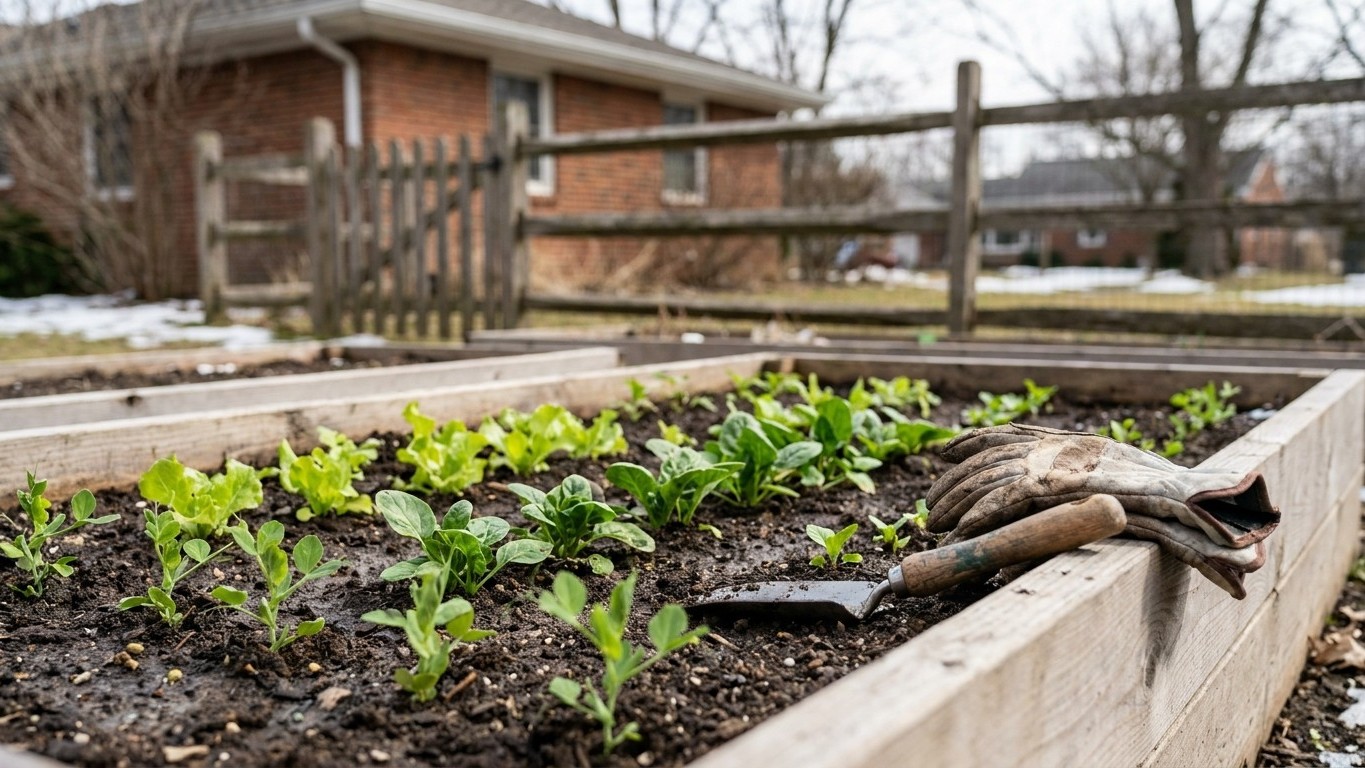

Across most of South Dakota, March lands six to nine weeks before the ground is reliably frost-free, so the honest answer is that almost nothing goes into open soil yet. What’s safe this month is narrow: dormant plantings, cold-frame greens, and indoor seed starts timed off the last-frost window rather than the calendar.
What goes in the ground in March

The calendar says March, but the soil doesn’t care what the calendar says. What decides whether a seed or a root survives is soil temperature and how far the date sits from the last spring frost, not the name of the month. At the reference station used by NOAA for South Dakota climate data (station USW00014944), the last spring frost falls between April 29 and May 9. March sits weeks ahead of that window, and in most counties the ground itself is still frozen solid for at least part of the month, or thawing unevenly where snow lingers on north-facing slopes and shady beds.
For the bulk of the state, nothing goes into open, unprotected ground in March. That’s not a failure of gardening skill, it’s physics: seeds sown into soil that’s still near freezing simply rot or sit dormant, and transplants set out now will be killed by the next hard freeze, which is still on the calendar for weeks.
What can move forward is narrower but real. Garlic and shallots that missed their fall planting window can still go in as soon as a patch of ground thaws enough to work with a trowel, though fall-planted cloves will always outperform a March scramble. Bare-root fruit trees, cane fruits like raspberries, and asparagus crowns can be planted dormant, as soon as the hole can be dug without fighting frozen clay. Rhubarb divisions follow the same rule.
What a cold frame or low tunnel buys you
A cold frame or low tunnel warms the soil underneath it faster than the open garden, sometimes by several degrees, which can let spinach, lettuce, and peas go in under cover while the exposed beds nearby are still locked up.
| Crop | Cold tolerance | March feasibility outdoors |
|---|---|---|
| Garlic/shallots | Very high | Yes, once ground is workable |
| Spinach, peas | High | Only under a cold frame or low tunnel |
| Lettuce | Moderate | Under cover only |
| Tomatoes, peppers, squash | None | No, weeks away |
Forcing rhubarb or chicory indoors is another March option worth knowing about: dug roots, kept dark and warm in a bucket or box, will push tender stalks or leaves in a few weeks, giving a harvest while the outdoor garden is still bare.
What to start under cover
Indoor seed starting in March should be counted backward from that April 29 to May 9 frost window, not forward from today’s date. The arithmetic is simple once you know each crop’s lead time. Tomatoes generally want six to eight weeks of indoor growth before they go outside, which means a mid-March start lines up with transplanting right around the frost window closing in early May. Peppers and eggplant run longer, eight to ten weeks, so a March start pushes their outdoor transplant date later into May or asks for a longer indoor stretch than ideal. Onions from seed need ten to twelve weeks, which makes March a late but workable start if it happens in the first half of the month.
Cole crops like broccoli and cabbage are more forgiving, needing six to eight weeks before they can go out, first under a cold frame and later into open beds once the hardest frosts have passed.
Two mistakes show up every year at this stage. Starting too early means tomatoes and peppers sitting in small trays for weeks past when they should have moved to bigger pots, turning leggy and rootbound before the ground is even warm enough to take them. Starting too late, especially with long-lead crops like onions or peppers, means undersized transplants that never catch up over a short growing season. The fix for both is the same: pick the transplant date first, using the frost window as the anchor, then count backward.
What is ready to pick
Outdoors, March offers little to nothing in most of South Dakota. That’s the plain truth, and it’s worth saying rather than dressing up. But a household with a fall garden and a root cellar still has food coming from storage and from a few protected corners.
Kale and leeks left in the ground under mulch or snow cover often survive the winter and can be dug as soon as the soil softens enough to get a shovel in, usually sweeter after the cold than they were in fall. Cold-frame plantings of spinach, mache, or arugula that went in the previous autumn frequently resume growth as daylight lengthens, giving a few pickings well before anything in the open garden stirs.
Indoors, sprouts and microgreens are the fastest payoff of the month, ready in days rather than weeks and needing nothing more than a sunny windowsill or a grow light.
The other job this month is checking what’s already in storage. Squash, potatoes, and onions held in a cellar or cool basement should get a hand-check now: soft spots on squash, green sprouting or wrinkling on potatoes, and sprouting necks on onions all mean that item needs to be used or composted before it drags down the rest of the batch.
The jobs that matter this month

March is a working month even where nothing gets planted, and skipping these tasks costs real ground later in the season.
Dormant pruning of fruit trees, grapevines, and cane fruits belongs here, done before buds swell and while the plant’s structure is easy to see without leaves in the way. Wait too long and pruning cuts into the season’s fruit production instead of shaping it.
Seed ordering is a deadline job, not a someday job: the most popular varieties, especially of tomatoes and peppers, sell out of seed racks and online stores well before planting season arrives.
Soil testing and amending pays off precisely because it takes time to work. Lime, sulfur, and compost need weeks to change soil chemistry, so applying them in March gives the ground time to respond before anything goes in.
- Turn and check the compost pile, adding material if it stalled over winter
- Clean and sharpen pruners, loppers, and shovels before the rush
- Repair raised beds, trellises, and fencing while beds are still empty
- Sketch out this season’s crop rotation before seed orders lock it in
Every one of these tasks has a natural deadline attached to it, whether that’s bud break, a shipping cutoff on seed orders, or the point at which a soil amendment stops having time to work before planting.
What not to do in March
The classic March mistake in South Dakota is trusting a warm afternoon over a soil thermometer. A 55-degree day feels like spring, but air temperature and soil temperature move at different speeds, and the soil several inches down can still be near freezing days after the air warms up. Direct-sowing warm-season crops, or setting out tender transplants, because the air felt right is the single most common way a March garden gets wiped out by the next cold snap.
A close relative of that mistake is pulling mulch or row cover off beds too early after a mild stretch. The last-frost window at the reference station doesn’t close until sometime between April 29 and May 9, and a week of pleasant weather in March says nothing about what late April will bring. Mulch removed too soon exposes overwintered crowns, garlic shoots, and perennial roots to a freeze they were otherwise protected against.
Nitrogen timing trips people up too. Feeding a broad dose of nitrogen fertilizer across dormant beds in March, before anything is actively growing, tends to either wash away before roots can use it or push soft, early top growth on perennials that then gets hit by a later freeze. Better to hold off and side-dress with nitrogen once plants are actually growing and can use it.
Starting every seed tray at once is the last habit worth breaking. Tomatoes, peppers, and onions all have different lead times, and starting them on the same day guarantees at least one of them is either leggy or undersized by transplant time.
Checking this against your own county
Every figure above comes from one weather station, and South Dakota is too large and too varied in elevation for a single date to apply everywhere. The Black Hills sit at higher elevation and run colder and later than the river valleys of the southeast, and a low spot that collects cold air can lag a nearby ridge by a week or more. Treat the April 29 to May 9 frost window as a starting point, then adjust for your own site.
The most reliable way to narrow that down is to check with South Dakota State University Extension, which tracks local frost data and planting guidance specific to conditions across the state.
Gardeners who plant by the Moon can check the March 2027 moon planting calendar, a tradition rather than a proven method.
Common questions
Can I plant grass seed in South Dakota in March?
Most lawns need soil temperatures reliably above 50°F for grass seed to germinate well, and South Dakota soil in March is typically still too cold. Grass seeding usually waits until April or later, depending on the county.
Is it too early to start tomato seeds in March in South Dakota?
Not if timed correctly. Tomatoes need six to eight weeks indoors before transplanting, and with the last frost falling between April 29 and May 9, a start in the first half of March lines up well for an early-May move outside.
What vegetables can survive a South Dakota frost?
Spinach, kale, peas, and garlic all tolerate frost and light freezes better than most garden crops, which is why they’re the exceptions that can go under cover or into workable ground before the last frost passes.
When should I direct sow peas in South Dakota?
As soon as the soil can be worked and isn’t waterlogged, which in most of the state means later in the March-to-April stretch rather than early March, when ground is still frozen or barely thawed in many counties.