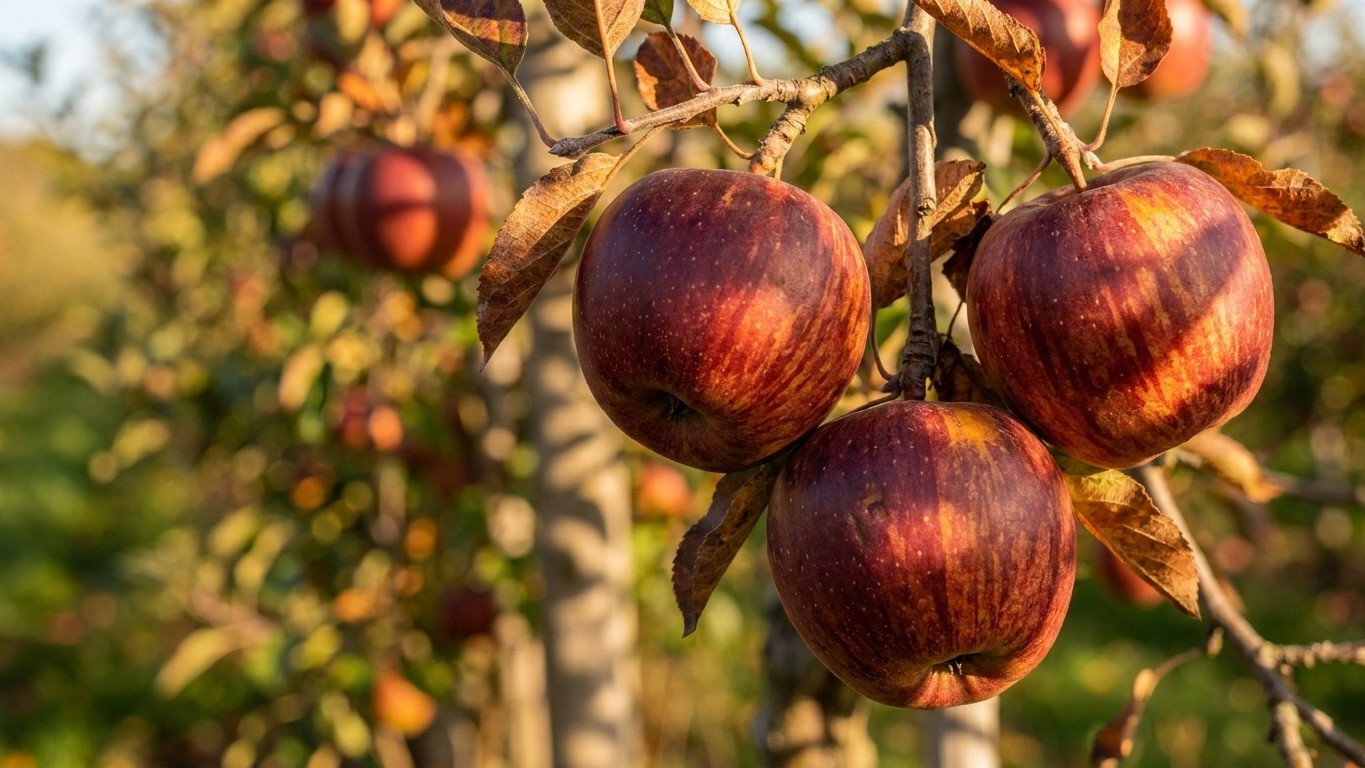

In Middle Tennessee, apple harvest runs roughly from mid-August through late October, depending on variety, and that timing shifts later the higher you climb into East Tennessee or the Cumberland Plateau. What decides the actual pick date isn’t the calendar. It’s fruit stage, seed color, and how the apple separates from the spur when you twist it. Storage life then splits sharply: some varieties last two weeks on a counter, others hold for months in a cold, humid space.
When apples are ready to pick in Tennessee
Harvest date is a function of variety and season length, not a fixed week on the calendar. An early apple like Lodi or Ginger Gold can be ready by mid-to-late August. Mid-season varieties such as Gala or Jonathan typically come off the tree in September. Late-season, dense-flesh apples, Fuji, Arkansas Black, Golden Delicious, often hang until October, sometimes into the first days of that month’s cooler stretch.
What anchors all of this locally is bloom timing, and bloom timing is set by frost risk. At the reference station used by NOAA’s National Centers for Environmental Information (station USW00013897), the last spring frost typically falls somewhere between March 31 and April 12. Bloom generally happens after that window closes, once the tree has enough confidence in warm nights to open flowers without losing them. Push bloom later than that window, and the tree is simply running behind for the whole season, which pushes harvest later too.
On the other end, the first fall frost at that same station arrives between October 28 and November 8. Late varieties need essentially the full stretch between those two frost windows to finish ripening, so growers holding out for a fully mature Arkansas Black or Fuji are watching that fall frost date closely. Fruit still on the tree when a hard freeze moves through can suffer chilling injury in the flesh, even if the skin looks fine.
Why East Tennessee runs later
Nashville’s frost dates aren’t universal across the state. Higher elevations in East Tennessee and especially the Cumberland Plateau stay cooler in spring and cool off faster in fall, so both bloom and harvest lag behind what a Middle Tennessee orchard sees. A grower on the Plateau picking the same variety as one near Nashville should expect the pick date to land one to two weeks later, sometimes more depending on elevation and local exposure. No statewide chart substitutes for watching the tree itself: seed color turning brown, background skin color shifting from green to yellow, and fruit that releases from the spur with an upward twist and no stem tear are the actual signals, wherever in the state the tree stands.
Which ones keep, and which must be eaten
Not every apple is built for the pantry. Early-season varieties tend to have thin skins, higher water content, and softer flesh, which is exactly why they taste so good fresh off the tree in August, and exactly why they don’t last. Most early apples should be eaten, cooked, or processed within a couple of weeks of picking. Leave them in a bowl on the counter past that window and they go mealy or start showing soft spots.
Late-season varieties are built differently. Denser flesh, higher acid, and thicker skin let them hold their texture for months in the right conditions. This is the entire logic behind “keeper” apples: they were bred and selected, sometimes over centuries, specifically to survive a Tennessee winter or an Appalachian root cellar without refrigeration technology.
| Harvest timing | Typical varieties | Realistic keeping time |
|---|---|---|
| Early (mid-August to early September) | Lodi, Ginger Gold | Days to about two weeks |
| Mid-season (September) | Gala, Jonathan | Several weeks with cold storage |
| Late season (late September into October) | Golden Delicious, Fuji, Arkansas Black | Multiple months in cold, humid storage |
The mild-winter trade-off
Nashville’s coldest month averages a daily minimum of 30.1°F, according to NOAA’s 1991-2020 Climate Normals. That’s a mild reading for a temperate apple-growing region, and it matters for a specific reason: low-chill varieties, the ones bred to satisfy their winter dormancy requirement on relatively little accumulated cold, break dormancy and flower earlier in spring than standard varieties do. Earlier flowering sounds like an advantage until you line it up against the last spring frost window of March 31 to April 12. A tree that blooms ahead of that window is blooming directly into frost risk, and a hard freeze on open blossoms can wipe out the year’s crop before a single apple sets.
For most of Tennessee, standard-chill varieties with a moderate bloom time are the safer bet over the earliest-blooming low-chill selections marketed for milder Southern climates. The risk worth taking here isn’t earlier bloom for a slightly earlier harvest. It’s accepting a bloom date that lands after the region’s typical last frost, even if that means a shorter effective growing window before the first fall frost in late October to early November.
Storing them through a Tennessee winter
Cold, humid, and dark is the formula, and Tennessee’s own winter climate gets growers partway there without any equipment. With Nashville’s coldest month averaging a daily minimum of 30.1°F, an unheated but insulated garage, breezeway, or root cellar can sit close to ideal apple storage range on a typical winter night, though it won’t hold that steadily through warm spells or a sudden thaw. That’s the gap a refrigerator or a dedicated cold room fills: consistency the outdoor air can’t guarantee.
Apples themselves release ethylene gas as they ripen, which speeds up softening in whatever is stored nearby, including other apples. Spreading fruit in a single layer, rather than piling it several apples deep, cuts down on bruising and slows the spread of rot from one soft spot to its neighbors. Perforated plastic bags or vented crates hold in humidity while still letting air move, which matters because apples stored in dry air shrivel even at the right temperature.
Checking on stored fruit
A weekly check is worth the five minutes. One apple with a soft brown spot or fungal fuzz can take down an entire crate if it sits against sound fruit for a couple of weeks. Pull anything questionable immediately rather than waiting for the next check-in.
Storage life still traces back to variety. Early apples picked in August simply won’t make it to Thanksgiving no matter how carefully they’re stored, since their cell structure breaks down on its own timeline. Late, dense-flesh varieties like Arkansas Black are the ones worth setting aside in a cold room specifically because they’re built to go the distance. For anyone canning, drying, or pressing cider as a way to use up an early-season glut instead of storing it, the University of Tennessee Extension publishes preservation guidance suited to home kitchens.
What goes wrong here
The most common failure isn’t storage. It’s frost timing at bloom. When a warm stretch in March coaxes blossoms open ahead of schedule, a freeze arriving within the region’s documented last-frost window of March 31 to April 12 can damage or destroy the flowers outright, and a tree with no viable blossoms produces no apples that year regardless of how well it was pruned or fed. This is the single biggest argument for choosing bloom timing over bloom earliness when selecting a variety for planting.
On the storage side, the usual mistake is picking too early or too soggy fingers. Fruit pulled before it separates cleanly from the spur, or before seed color has turned, often looks ripe but hasn’t finished developing the sugars and acids that let it store well. It softens faster and tastes flatter than fruit left on the tree to full maturity. The opposite mistake, waiting too long, runs the fruit into the first fall frost window of October 28 to November 8, and freeze-damaged apples bruise easily and break down fast once picked, even if they were still on the tree just days before a hard freeze.
Bruising during harvest itself causes more spoilage than most people expect. An apple dropped into a bucket from even a foot or two develops internal bruising that doesn’t show on the skin for a day or two, then turns brown from the inside out in storage. Handling fruit like eggs, not like potatoes, at picking time pays off weeks later in the cold room.
For disease pressure specific to a given county, or for a spray schedule tuned to local conditions, the state’s own extension service is the resource built for that, since general national guidance doesn’t account for Tennessee’s particular mix of humidity and elevation.
Common questions
When should I pick apples in Tennessee?
Timing depends on variety: early types like Lodi or Ginger Gold are typically ready by mid-to-late August, mid-season varieties like Gala in September, and late keepers like Fuji or Arkansas Black often into October. Read the fruit’s stage (seed color, ease of separation from the spur) rather than a fixed date, and expect East Tennessee and Cumberland Plateau harvests to run one to two weeks behind Middle Tennessee.
Can apples be grown in cold parts of Tennessee like the Cumberland Plateau?
Yes. The Plateau simply runs a cooler, later season than Nashville, with bloom and harvest shifted later in the calendar. Standard-chill varieties suited to a moderate bloom time perform well there; no local source in this brief documents Plateau-specific frost dates, so growers there should watch the tree’s own stage rather than a Middle Tennessee calendar.
How long do Tennessee apples keep in storage?
It splits by variety. Early apples picked in August generally last only days to about two weeks. Mid-season varieties hold several weeks under cold storage. Late-season, dense-flesh varieties like Arkansas Black or Golden Delicious can keep for multiple months in a cold, humid space kept close to the low-30s to low-40s Fahrenheit range.
Should I worry about frost damaging my apple trees?
Mainly at bloom, not at harvest. The region’s last spring frost typically falls between March 31 and April 12, so blossoms opening before that window closes are at real risk of freeze damage, which can eliminate that year’s crop. Choosing a variety with a moderate, rather than very early, bloom time is the main way to manage that risk here.