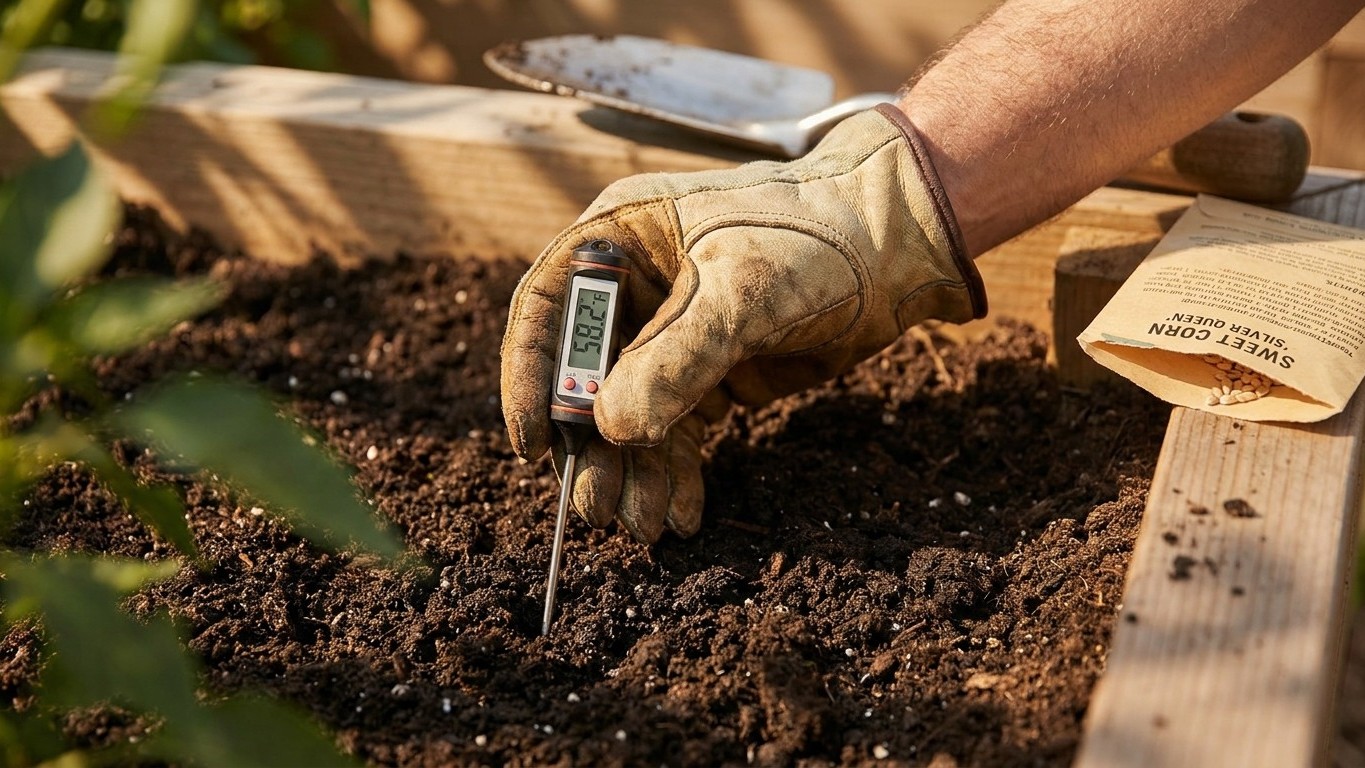

Sweet corn goes into Tennessee soil once that soil holds above 60°F, not on the date of the last frost. For most of the state that threshold arrives weeks after the frost risk clears in late March or early April, and a 60- to 90-day variety planted then finishes well ahead of the first fall frost in late October or early November. The exact week still depends on your soil, your site, and which maturity length you’ve picked.
The short answer
Soil doesn’t warm at the same pace as air. Across Middle Tennessee, NOAA’s 1991-2020 climate normals for station USW00013897 put the last spring frost somewhere between March 31 and April 12 in most years. But sweet corn seed sitting in soil colder than 60°F rots or germinates unevenly, according to Utah State University Extension’s guidance on growing sweet corn. That 60°F threshold, not the frost date, is the real starting gun, and it lands later, since the ground has to shed the last of winter’s chill and then keep climbing, a process that lags behind the day air temperatures stop dropping to freezing.
That gap matters more than most gardeners assume. Two years with an identical last-frost date can produce very different soil-warming speed depending on rainfall, cloud cover, and whether the bed is shaded or exposed. A sunny, well-drained plot crosses 60°F noticeably sooner than heavy clay in a low spot. Gardeners who plant by the frost date alone, instead of checking soil temperature directly with a simple soil thermometer, are usually the ones who lose an early planting to rot.
Once the soil clears that bar, the clock genuinely starts. Utah State University Extension puts sweet corn maturity at 60 to 90 days from planting, a window wide enough to cover everything from the fastest varieties to the longer-season ones. The question for Tennessee gardeners is whether that window closes before fall frost arrives, and for most of the state the answer is yes, with real margin. NOAA’s climate normals put the first fall freeze at the same reference station between October 28 and November 8. Even a planting held back until the ground is thoroughly warm still has months of clear runway before that date.
Summer heat is the other variable worth weighing, and it has nothing to do with the frost calendar. The reference station averages 40.0 days a year at or above 90°F, a heat load that stresses pollination if tasseling lands during the hottest stretch of July. That argues for getting seed in as soon as soil conditions allow, rather than pushing planting later just because the frost math leaves room to spare.
East Tennessee and the Cumberland Plateau change this picture. Those areas run cooler and later in spring than the Nashville-area reference station, so soil there crosses 60°F later too, shortening the runway before fall frost even though the same 60-to-90-day rule applies everywhere in the state.
Does a late variety fit here?
A 60-day variety
A variety that matures in 60 days from planting is the easiest fit anywhere in Tennessee. Even if soil doesn’t hold at 60°F until well into spring, adding 60 days lands harvest in mid-summer, months ahead of the October 28 to November 8 fall frost window. There’s enough slack to plant a second block three or four weeks after the first and still bring it to harvest before frost, useful for anyone who wants a steady supply rather than one big harvest all at once. The tighter constraint on a 60-day variety isn’t fall frost at all; it’s summer heat. A planting timed so tasseling falls during the stretch of days reaching 90°F or hotter, and the reference station averages 40.0 such days a year, risks poor pollination no matter how much season is left afterward.
A 90-day variety
A 90-day variety asks more of the calendar, but the frost data still leaves room across most of the state. Even a planting held back until soil is thoroughly warm, then given the full 90 days, generally finishes well before the October 28 to November 8 fall frost window closes. The margin shrinks, though, and shrinks further the later the soil takes to warm.
That’s where geography changes the answer. NOAA’s records show East Tennessee and the Cumberland Plateau running cooler and later in spring than the Nashville-area reference station, which means soil there is slower to hold above 60°F. A 90-day variety planted late in one of those cooler pockets, after a spring that dragged on longer than usual, has less cushion before fall frost than the same variety planted the same calendar week near Nashville. It doesn’t fail everywhere in the state, but the margin for error is thin enough that gardeners in the cooler, higher parts of Tennessee are better served planting the moment soil conditions allow, and checking a soil thermometer instead of guessing.
What goes wrong here
Most sweet corn problems in Tennessee gardens trace back to one of three mistakes, and only one of them has anything to do with the weather calendar.
- Seed goes in while soil is still below 60°F. The seed sits, rots, or comes up thin and patchy because it germinated unevenly in cold ground. The remedy is simple: check soil temperature directly with a thermometer pushed a few inches into the bed rather than counting days from the last frost, and wait until it holds above 60°F before planting.
- A 90-day variety planted late in a cool pocket. In the Cumberland Plateau or East Tennessee, a spring that runs long pushes planting later, and a 90-day variety started at that point has little cushion before the October 28 to November 8 fall frost. The remedy is to plant as soon as soil conditions allow rather than waiting, or to lean toward the shorter end of the 60-to-90-day range in those cooler areas.
- Two types tasseling at the same time. Sweetness has nothing to do with frost or heat; it’s decided by pollen. Utah State University Extension is clear that su, se, and sh2 types lose their sweetness if they tassel together, and each type needs to be grown in blocks of three or more rows for reliable pollination. The remedy is timing, not distance: stagger plantings of different types so their tasseling windows don’t overlap, or grow only one type per season if the garden is small.
Common questions
Can I plant sweet corn before the last frost in Tennessee?
No. Even setting the frost date aside, seed sitting in soil below 60°F germinates poorly or rots outright, according to Utah State University Extension. The frost date between March 31 and April 12 is only the first marker; the soil temperature threshold is the one that actually matters for planting.
How do I know my soil has actually reached 60°F?
The only reliable way is a direct reading with a soil thermometer, pushed a few inches into the bed at the same time each day for several days in a row, rather than counting weeks from the last frost or trusting the calendar alone.
Does East Tennessee need a different planting schedule than Middle Tennessee?
Yes, generally a later one. NOAA’s climate data shows East Tennessee and the Cumberland Plateau running cooler and later in spring than the Nashville-area reference station, which delays both the last frost and the point at which soil holds above 60°F.
How soon after tasseling is sweet corn ready to pick?
That’s a separate clock from the 60-to-90-day planting-to-maturity figure. Once silks appear, ears are typically ready roughly 17 to 24 days later. Rather than picking by date alone, check for three signs together: dry brown silks, husks that are still moist and green, and milky juice from a punctured kernel.