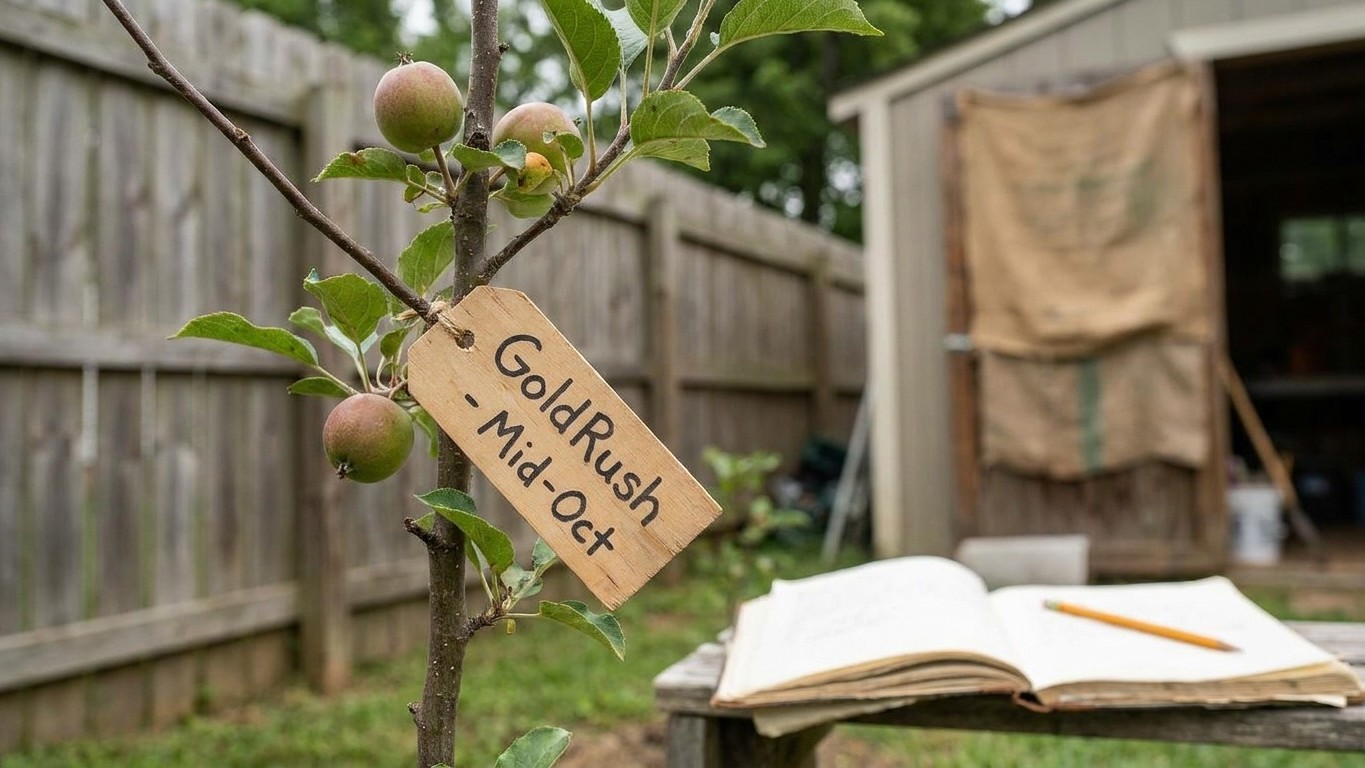

Tennessee can grow you a real apple crop, but only if you match the variety to your part of the state instead of trusting one statewide list. Memphis, Nashville, and the Cumberland Plateau each hand a tree a different winter, and a variety that thrives in one spot can bloom thin and patchy in another even though it survives just fine. The tree living isn’t the question; the tree fruiting well is. Before you buy anything, find your region’s chill-hour range and pick a variety bred to match it, and use The Tennessee Apple Calendar, Stage by Stage to see how that timing plays out month by month.
Can you grow apples in Tennessee
Apples are a workable crop from the Mississippi bottomlands near Memphis to the ridgelines above Knoxville. The state’s USDA range of 5b to 8a covers the winter-hardiness needs of nearly every apple variety a nursery sells, and Nashville’s coldest-month average minimum of 28.4°F, as measured by NOAA’s National Centers for Environmental Information, is well inside the dormancy tolerance apple trees are bred for. A freeze that cold does not threaten a dormant apple tree. What it does is confirm that Middle Tennessee gets enough winter chill to satisfy most commercial varieties, which matters more for fruiting than for survival.
The catch is that Tennessee is not one climate. West Tennessee, around Memphis, sits at the warm end of the state’s zone range, closer to 7b-8a, with a shorter, milder winter. Middle Tennessee, represented by the Nashville normals above, runs solidly zone 6b-7a in most of the basin. East Tennessee and the Cumberland Plateau climb into zone 5b-6a in the higher valleys and ridgetops, with colder minimums and a longer dormant season. None of these regions rules out apples. They do rule out treating a single statewide recommendation as accurate for your address.
What this means for site selection
Elevation and air drainage matter as much as the zone number. A backyard at the bottom of a hollow in the Cumberland Plateau can sit several degrees colder on a still spring night than a slope thirty feet higher, because cold air is heavier and pools in low ground. Plant on a slope or a rise where cold air can drain away, not in the lowest corner of the property, and the same variety that struggles in a frost pocket often does fine a short walk uphill. This is a bigger factor in apple success here than the state-level hardiness zone.
Which varieties suit this climate

Hardiness zone tells you whether a tree survives winter. It says nothing about whether it flowers well, and that second filter, winter chill, is the one most general planting guides skip when covering Tennessee apple Best varieties. Apple trees need a minimum number of hours below about 45°F during dormancy to break bud evenly the following spring. Too little chill and a tree blooms late, thin, and over several weeks instead of in one flush, which cuts pollination and yield even though the tree itself is perfectly healthy.
Tennessee’s spread of zones puts most of the state in the moderate-chill band, roughly 600 to 800 hours, with the warmer pockets of West Tennessee trending toward the lower end and the Cumberland Plateau and higher East Tennessee valleys toward the upper end. A variety bred for the Deep South’s short, mild winters can underperform in the cooler east, and a variety bred for New England’s long winters can bloom raggedly in the warmer western counties. Growers just across the state line face the same trade-off; the piece on Growing Apples in Virginia: Varieties, Timing and Frost Risk walks through a similar zone spread and the pairings that work there.
Among varieties whose published hardiness range covers most of Tennessee: ‘Liberty’ (USDA zones 4-8), bred to be immune to apple scab and resistant to fire blight and cedar apple rust, useful given the state’s humid summers; ‘Enterprise’ (zones 5-8), also scab-immune with good fire blight resistance, ripening later in the fall; ‘Gala’ (zones 5-8), an earlier-ripening, lower-chill selection that suits the warmer western counties; ‘Golden Delicious’ (zones 5-8), a reliable, moderate-chill variety and a strong pollen source for other trees; and ‘Arkansas Black’ (zones 5-8), a heat-tolerant Southern heirloom that stores well into winter. ‘Honeycrisp’, by contrast, is published at zones 3-6 and carries a higher chill requirement, which makes it a better fit for the Cumberland Plateau’s cooler valleys than for the warm end of West Tennessee.
| Variety | USDA zones | Approx. chill hours | Bloom timing | Disease resistance |
|---|---|---|---|---|
| ‘Liberty’ | 4-8 | ~800 | Mid-season | Scab immune, resistant to fire blight and cedar apple rust |
| ‘Enterprise’ | 5-8 | ~800 | Mid to late | Scab immune, good fire blight resistance |
| ‘Gala’ | 5-8 | ~500-600 | Early to mid | Moderate; benefits from a spray program in humid summers |
| ‘Golden Delicious’ | 5-8 | ~600-700 | Mid-season | Moderate; susceptible to scab without treatment |
| ‘Arkansas Black’ | 5-8 | ~600 | Late | Moderate; good heat tolerance |
Tennessee Extension does not publish a single statewide variety recommendation, because chill accumulation and frost timing shift so much from Memphis to the Plateau. Treat the table above as a starting shortlist and confirm regional performance with your county extension office before committing to an orchard-scale planting.
Planting a pair that works here
Nearly every apple variety needs a second, genetically different apple tree blooming at the same time nearby to set fruit, and at least one of the two needs to produce fertile pollen. Skip this and you get a tree that flowers beautifully and drops most of its blossoms unfertilized. Given the varieties that suit Tennessee’s zone and chill range, a reliable pairing is ‘Liberty’ with ‘Enterprise’: both are diploid with normal fertile pollen, both bloom mid to late season within days of each other, and both carry the scab resistance that matters in a humid climate. ‘Gala’ and ‘Golden Delicious’ make another workable pair for the warmer, lower-chill counties, since their bloom windows overlap and ‘Golden Delicious’ is a dependable pollen source.
The variety to watch for is the triploid, a category that includes some well-known heirlooms like ‘Stayman’ and ‘Winesap’. Triploid varieties produce sterile pollen, so they cannot pollinate a neighboring tree even though they need a pollinizer themselves. Plant one of these expecting it to double as its own partner and neither tree fruits well. If you want ‘Stayman’ or ‘Winesap’ in the orchard, pair it with a fertile diploid such as ‘Liberty’ or ‘Enterprise’, or plant three trees so the triploid always has a fertile neighbor within range.
Bloom overlap matters more than variety name matching. Two trees that flower three weeks apart are not a functioning pair, whatever the catalog says about “universal pollinizers.” Order from a nursery that publishes bloom-period data (early, mid, or late season) for each cultivar, and match periods rather than assuming any two apple trees will do the job.
The frost that costs a crop here

Around Nashville, NOAA’s 1991-2020 climate normals put the 30-70% probability window for the last 32°F freeze at March 31 to April 12, based on station USW00013897. East Tennessee and the Cumberland Plateau run later than this window, sometimes by a couple of weeks, so a grower on the plateau should treat the Nashville range as an early estimate rather than a local one.
The detail that catches new growers off guard is that a frost after the buds have opened to the pink stage does not kill the tree. It kills the flowers. The wood, the leaf buds, and next year’s growth are unaffected, so the tree looks completely healthy through summer while producing little or no fruit that season. There is no rescue spray or treatment that reverses frost damage to open blossoms once it has happened. Commercial growers use overhead irrigation or wind machines to hold orchard temperatures up on a frost night, but for a backyard planting the only real safeguards are choosing a site that drains cold air away and choosing a variety that blooms late enough to dodge the risk in the first place.
This is where a late-blooming variety earns its place in a Tennessee planting, particularly on the Cumberland Plateau or in East Tennessee’s higher valleys where the frost window itself runs later than Nashville’s. Growers dealing with a colder, later frost pattern than Tennessee’s, such as in New Hampshire, face this same trade-off in a more extreme form; see Growing Apples in New Hampshire: Varieties, Timing and Frost Risk for how a much later last-frost date reshapes variety choice there. In Tennessee, the practical takeaway is smaller: a variety that reaches pink and bloom a week or two after the earliest bloomers gives the local frost window a better chance of being over by the time the flowers are vulnerable.
The apple year in Tennessee
Dormancy through green tip
From leaf drop through late winter the tree needs no attention beyond dormant pruning and a check for winter damage. Green tip, when the first green growth pushes through the bud scales, typically arrives well before Nashville’s last-frost window of March 31 to April 12, and cold at this stage rarely does serious harm since the exposed tissue is still small and hardy.
Pink through bloom
The pink stage, when unopened flower buds show color, is the point where frost risk becomes real. This stage and full bloom often fall close to or inside the Nashville area’s last-frost window, which is exactly why the timing above matters more than a calendar date. On the Cumberland Plateau, where the frost window runs later, bloom is correspondingly later too, so the exposure period simply shifts rather than shortens.
Petal fall through fruit set
Once petals drop, check for fertilized fruitlets forming at the base of each flower cluster. This is the stage to thin, removing extra fruitlets so the tree isn’t carrying more apples than it can size well, usually down to one fruit per cluster spaced several inches apart on the branch.
Harvest
Harvest timing depends on variety rather than a fixed date, running from late summer for early selections like ‘Gala’ into October and even early November for late keepers like ‘Arkansas Black’, comfortably ahead of the first fall frost that NOAA’s normals put at October 28 to November 8 for the Nashville area.
Local help
For a variety list matched to your specific county, current spray timing, and disease pressure updates through the season, the University of Tennessee Extension is the right first call. Extension agents can also tell you whether fire blight or cedar apple rust has been active in your area recently, which should factor into which resistant varieties you prioritize from the shortlist above.
Common questions
Can one apple tree produce fruit on its own?
Most varieties cannot. Apples are largely self-incompatible, meaning a tree’s own pollen does not fertilize its own flowers well, so you need a second, different variety blooming at the same time nearby. A few varieties, including ‘Golden Delicious’, set a partial crop alone, but yields improve substantially with a true pollinizer.
Can I grow apples in Memphis where it gets hot and humid?
Yes, but lean toward the lower end of the chill range and prioritize disease resistance. Varieties like ‘Gala’ and ‘Arkansas Black’ handle West Tennessee’s heat and shorter winter better than a high-chill northern selection, and scab-resistant choices like ‘Liberty’ or ‘Enterprise’ cut down on the fungal pressure that comes with humid summers.
My tree bloomed but a late freeze hit right after. Will it still fruit this year?
Not from that bloom. Once frost kills open flowers, that year’s crop from those blossoms is gone, though the tree itself is undamaged and will bloom normally again next spring. Some varieties produce a light secondary bloom later in the same flush, but it rarely makes up the lost crop.
How many years before a new apple tree bears fruit?
It depends mostly on rootstock. Standard, full-size trees typically take longer to bear than dwarf or semi-dwarf trees on size-controlling rootstock, which can produce a first meaningful crop sooner. Ask the nursery what rootstock a given tree is grafted onto before you plant, since it affects both bearing age and eventual tree size.
Should I plant on a hillside or down in a valley?
Choose the hillside or a rise, not the low ground. Cold air drains downhill on clear, still nights and pools in valleys and hollows, which is why a frost pocket at the bottom of a property can be several degrees colder than a slope thirty feet higher, even within the same county’s official frost window.