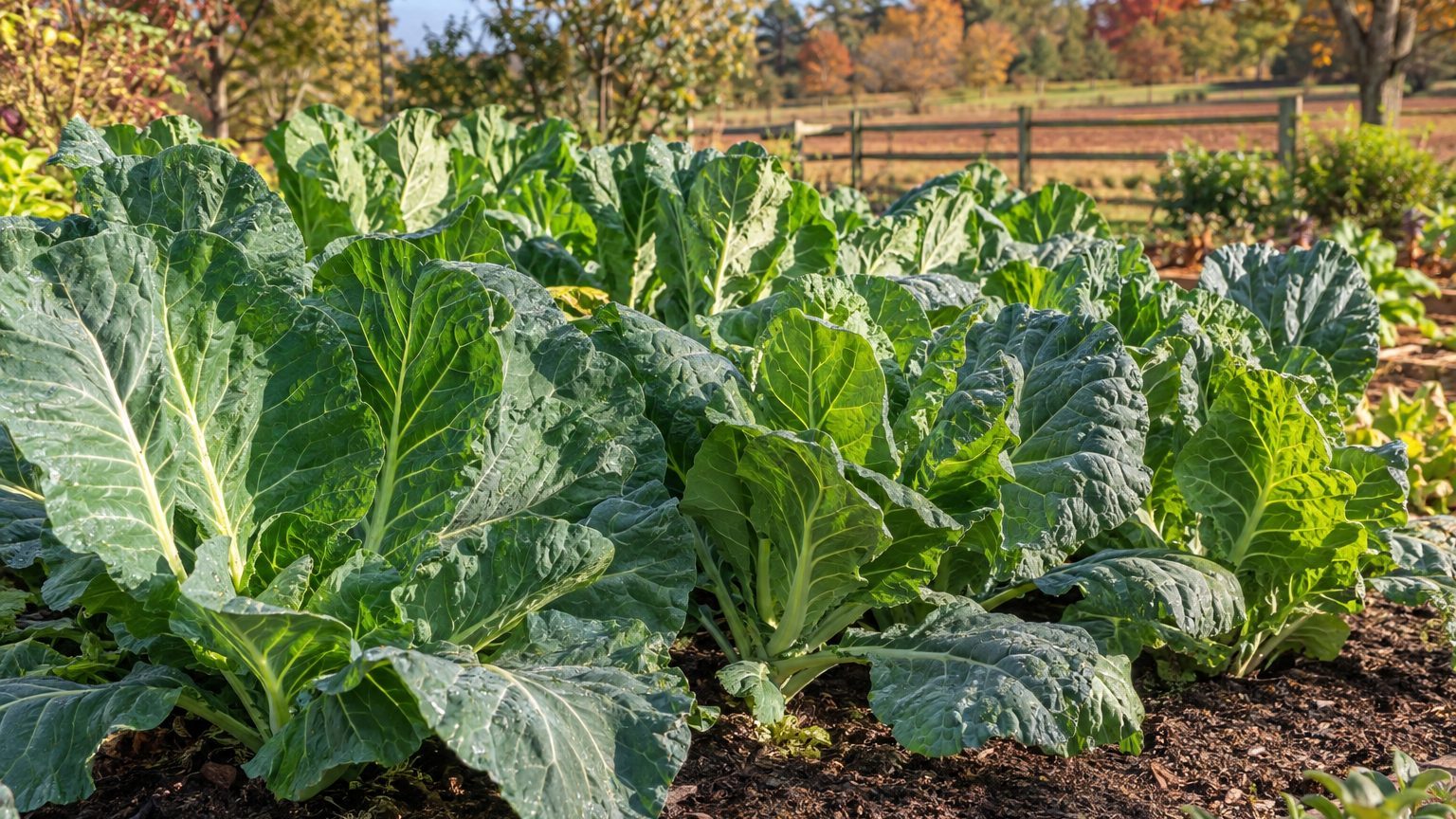

Open-leaf, non-heading collards are the safe main crop across Tennessee, and the fall planting is the one that pays off. Quick-maturing types suit spring, while slower ones earn their keep after frost sweetens the leaves. Mustard, turnip greens and kale fill the gaps. The dates below come from Nashville, and Tennessee is much bigger than Nashville.
The short answer for Tennessee
Choose by type: a standard open-leaf collard as your anchor, a faster-maturing collard for spring, and mustard, turnip or kale wherever you want leaves sooner. At the Nashville reference station, the last spring freeze (32°F) falls between March 31 and April 12, and the first fall freeze arrives between October 28 and November 8. Those are probabilities, not promises: the range marks where the chance of a 32°F freeze sits between 30 and 70 percent.
Spring: speed matters more than size
A spring collard is racing the calendar. It goes in around the last-freeze window and has to size up before warm weather pushes it to flower and turn bitter. Quick types win that race. The big, slow, leafy plants that look best in a catalog tend to lose it. This page has no Tennessee summer temperature or rainfall figures, so it can’t say when the race ends in your yard. The When to Plant Collards in Tennessee page covers sowing windows in detail.
Fall: where slow types earn their place
Fall is the better season. Plants set out in summer grow into cooling weather, then meet frost with a full canopy, and cold turns their starches to sugar. Work backward from the fall freeze window, using the days-to-maturity number on the seed packet, and pick a type that finishes before growth slows.
| Type | Best season | Role in a Tennessee garden |
|---|---|---|
| Standard open-leaf collards | Fall, with a spring option | Main crop, harvested leaf by leaf |
| Quick-maturing collards | Spring | Beats the heat when the season is short |
| Mustard greens | Spring and fall | Fast, sharp-flavored, bolts early in warm weather |
| Turnip greens | Spring and fall | Quick fill-in, with a root as a bonus |
| Kale | Fall into winter | Cold-tolerant, milder than collards |
What will not work here
A slow collard sown late in summer fails first. The fall freeze band starts October 28 at the Nashville station, and a plant that is still small when growth-stopping cold arrives will sit in the bed as a seedling all winter. Frost doesn’t kill collards. Being undersized when frost comes is the problem.
Planting spring collards after the last-freeze window has closed fails the other way. Seedlings set out in May, well after that March 31 to April 12 band, have little time before the weather turns hard on a cool-season crop. Expect flower stalks, tough leaves and a bumper crop of aphids and cabbage worms.
Counting on winter to be the enemy is a mistake, too. The mean daily minimum of the coldest month at the Nashville reference station is 30.1°F. That is an average night, not the record low, so a hard cold snap will go well below it. But it tells you a typical Middle Tennessee winter sits right around freezing, which collards handle. Row cover is cheap insurance for the coldest nights, and a gardener in a colder pocket of the state should plan on it.
Crowding is the quiet failure. The page carries no humidity or rainfall numbers for Tennessee, so this one rests on general practice rather than a figure: plants spaced tightly stay wet after rain or dew, and wet leaves invite leaf spot and rot. Give each plant room for air to move. Watering lightly every week is a related trap. Deep, less frequent soaking builds roots that ride out a dry stretch, while a weekly sprinkle keeps roots shallow.
The last failure is treating one set of dates as the whole state. That is what the Growing Collards in Tennessee guide keeps returning to: the numbers here describe one station, and gardeners elsewhere will find them off by days or weeks.
What changes across Tennessee
The USDA Plant Hardiness Zone Map (2023 edition, built on 1991-2020 normals) puts Tennessee in zones 5b to 8a. That is a wide spread for one state, and it means there is no single answer for the whole territory. The zone system rests on one variable, the average annual extreme minimum temperature, so it says how cold the worst nights get, not how long your season runs.
The frost dates on this page belong to Nashville. East Tennessee and the Cumberland Plateau are cooler and run later in spring, so a gardener there should push spring sowing back and not assume the March 31 to April 12 band applies. The Nashville fall window is a ceiling, not a floor, for cooler ground. Start the fall crop with margin.
Altitude works the same way. A plateau or mountain garden favors the quick-maturing collards in spring and cold-hardy kale in fall. In the warmer parts of the state the standard open-leaf types have more room to grow, and winter row cover matters less.
Look up your own zone on the USDA map by ZIP code rather than trusting a neighbor’s guess or a state average. Neighboring counties can sit in different zones, and a hillside can differ from the valley beneath it. Once you have your zone, read this page’s Nashville dates as a reference point and shift them earlier or later to match.
Where to check this for your own county
The University of Tennessee’s extension service is the right next stop: https://utia.tennessee.edu/extension/. Every county has an office, and its staff know the local frost pattern, soil and pests in a way no state-level article can. A county recommendation beats a state one, and this page is the state one.
Two things are worth asking for. The first is the local planting calendar for vegetables, with dates for spring and fall greens in your county. The second is which varieties have been trialled nearby, since a collard that thrives on the Cumberland Plateau may not be the one that does well in the western part of the state. Extension staff often know which cultivars held up and which bolted or sulked.
This page has no Tennessee extension calendar for collards to cite. The reference calendars it was built with cover lawns in another state, so citing them here would be misleading. That gap is one more reason to make the call: ask for the county’s fall greens planting dates and write them next to the Nashville window from this page. Where the two disagree, go with the county.
Checking this against your own garden
Your own yard outranks every date here, and three things will tell you how it differs from the Nashville reference.
Soil warmth comes first, and you can judge it by feel. Push a hand into the bed on a spring morning. Cold, clammy ground that clumps means seeds will sit and sulk, while soil that crumbles and feels neutral against your skin is ready. A bed that warms early sits in a sheltered spot, and one that stays cold is likely shaded or low.
The first true leaves are next. A seedling’s first pair are seed leaves, and the leaves that follow are the real ones. Note when they appear after sowing. If they come slowly, the bed is cooler than the seed packet assumes and your timing should shift later. If they come fast, you may be able to sow earlier next year.
The third sign is the first flower stalk on any overwintered collard, kale or mustard. That is your signal that spring warmth has won and the cool-season window is closing. If it shows up early, your yard runs warm, and a sunny bed against a south wall may bolt weeks before a shaded one across the yard.
Frost works as a fourth clue if you’re patient. Notice which corner of the yard frosts first on a clear autumn morning, since that low spot is where cold air settles. Write down the date each of these appears, and after one season you’ll have a calendar more accurate than any state page.
Common questions
Which collard variety is best for Tennessee?
No single named variety fits the whole state. Choose by type: standard open-leaf collards for fall, quick-maturing types for spring. Then check which cultivars your county extension office has seen perform well locally.
Can collards survive a Tennessee winter?
Often, yes. The mean daily minimum of the coldest month at the Nashville reference station is 30.1°F, and collards tolerate frost. A hard snap will go below that average, and colder parts of the state fall in zones as low as 5b, so cover plants there.
Should I plant collards in spring or fall?
Fall is the stronger season, because plants mature into cool weather and frost improves flavor. Spring works with a quick-maturing type planted early enough to size up before it turns warm.
Which greens grow well alongside collards?
Mustard, turnip greens and kale all fit the same cool-season windows. Mustard and turnips are quicker, and kale is the most cold-tolerant, so a mixed bed gives you leaves over a longer stretch.