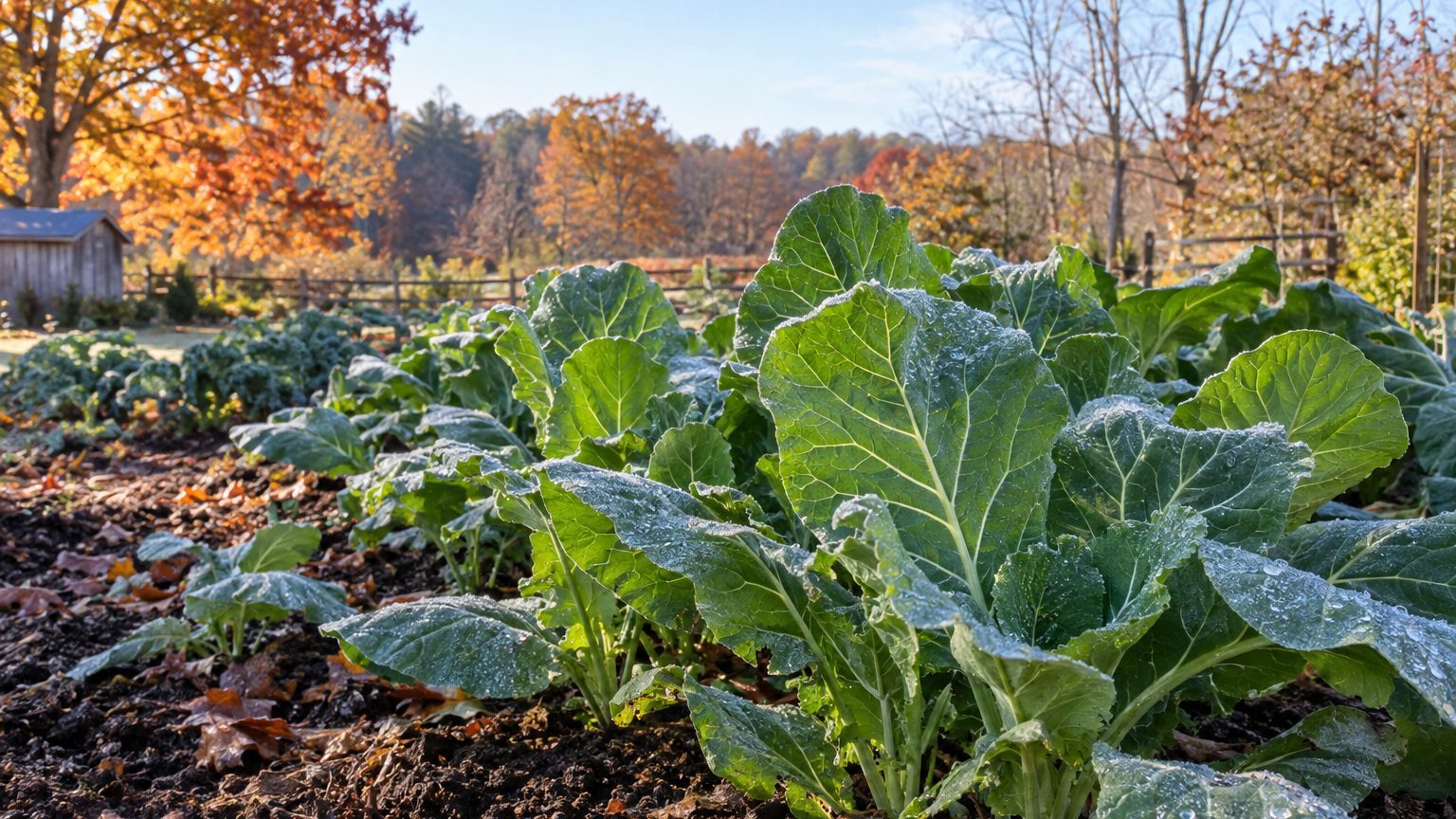

Collards give Tennessee gardeners two planting seasons instead of one, and both hang on the same kind of number: the point at which a 32°F freeze becomes likely or unlikely. The dates here come from Nashville’s official climate normals. Use them as a reference point, then adjust for your own county and your own yard.
The short answer for Tennessee
Spring sowing
Sow spring collards outdoors in the weeks around the last-freeze window of March 31 to April 12, and time the fall crop so the plants are well grown before the first-freeze window of October 28 to November 8. Those two windows bracket the whole season.
Both windows come from the NOAA NCEI 1991-2020 Climate Normals for the Nashville station (USW00013897). They are probabilities of a 32°F freeze, not calendar guarantees. March 31 to April 12 is the band in which the chance of still seeing a freeze runs between 30 and 70 percent. So a freeze after March 31 in Nashville is close to a coin flip, not a freak event. The fall band, October 28 to November 8, works the same way: the odds of that first freeze arriving sit between 30 and 70 percent.
Collards shrug off light frost better than most garden crops, which is why spring sowing does not have to wait for the far end of the window. Seedlings that have just emerged are a different matter, and a hard freeze can set them back. Keep an old sheet or a piece of row cover handy until the window closes.
Fall sowing
The fall crop is where most Tennessee gardeners get the timing wrong, mostly by starting too late. Read the days-to-maturity figure on your seed packet and count backward from the October 28 to November 8 window. That gives you your own sowing date. Cool weather sweetens collard leaves, and a plant that is already large when the first freeze arrives can keep producing well past it.
Which variety you pick changes that count. A faster type gives you more room to start late, while a slow one needs an early start. The Best Collards and Greens for Tennessee compares them, and Growing Collards in Tennessee covers the rest of the season, from bed prep to harvest.
What will not work here
Treating a frost band as a promise
The most common mistake is reading April 12 as the day frost ends. It is the far edge of a band, and the band is built on a 30 to 70 percent probability. A gardener who sets out tender seedlings on April 13 and walks away is gambling on the remaining odds. Collards themselves are tough, but the gamble is not worth it when a sheet on a cold night costs nothing.
The opposite mistake also fails. Winter itself is rarely what stops collards in Nashville. The mean daily minimum of the coldest month there is 30.1°F, just under freezing, which is a mild winter by national standards. Timing is what defeats the crop here, not the cold. That gets less true as you move toward the colder parts of the state, covered in the next section.
Slow varieties, late starts, and tight rows
A slow-maturing collard sown late in summer runs out of runway. The plant is still small when the October 28 to November 8 window arrives, and a small plant gives you a few leaves instead of a productive row. If you are behind schedule, choose a faster variety or accept a lighter harvest. Do not hope the fall stays warm.
Spring sowing has its own trap. Start too late and the crop heads straight into a humid Tennessee summer, when plants stress, bolt, and attract pests. Crowding makes it worse. Tight spacing keeps the leaf canopy damp, and humid air plus wet leaves is an invitation to fungal disease and to cabbage worms hidden in the crowd. Give each plant room for air to move through, even if the row looks sparse in April.
The simplest rule for fall: count back from October 28 using the packet’s days to maturity, and sow on or before that date, not after.
What changes across Tennessee
Tennessee is not one garden. The USDA Plant Hardiness Zone Map (2023 edition, built on 1991-2020 normals) places the state anywhere from 5b to 8a. That is roughly two and a half zones, so there is no single Tennessee answer. Zone is built on one variable, the average annual extreme minimum temperature, so it tells you how cold the worst nights get. It says less about how early the ground warms in spring.
The Nashville dates on this page sit in the middle of that spread. East Tennessee and the Cumberland Plateau are cooler and run later in spring. A gardener on the Plateau should expect the last-freeze window to arrive later than March 31 to April 12, and should push spring sowing back to match. The same cooler air generally means fall cold arrives sooner, so the count-back for the fall crop gets shorter. Anyone at elevation is dealing with both effects at once.
Which zone you are in is not something this page can tell you, and guessing from a county name is unreliable in hilly country. Look up your own address on the USDA map, then compare your zone with Nashville’s. A colder zone means shifting your dates in the direction of a shorter season on both ends.
Where to check this for your own county
The University of Tennessee’s extension service is the place to check, at https://utia.tennessee.edu/extension/. Every county has an extension office, and the staff know local frost patterns, soil, and pests in a way no state page can. This page has no Tennessee-published collard calendar behind it. The dates here come from NOAA frost normals, not from an extension table, and it is worth knowing the difference.
Two things are worth looking for. The first is the local vegetable planting calendar, which will often sort cool-season crops such as collards into spring and fall windows for your part of the state. The second is any list of varieties trialled in your county. A variety that performed well in one county trial is more useful than a variety that sounds good on paper, and county staff can tell you which ones handled local disease pressure and heat.
A county recommendation beats a state one, and this page is the state one. If the two disagree, go with the county. When you call or write, ask for the fall vegetable planting dates for your county, since that is the window most people miss.
Checking this against your own garden
Dates get you close. Your own observations get you the rest, and they cost nothing. Three are worth watching.
- Soil by feel. Squeeze a handful in early spring. If it crumbles, it is workable. If it stays cold and clumped, wait. A bed that dries and warms before your neighbor’s tells you your yard runs ahead of the average.
- First true leaves. The first leaves on a seedling are seed leaves. The real leaves that follow tell you the plant is established and ready for thinning or transplanting. If they show up later than the packet suggests, your bed is running cool.
- Frost on the grass. Watch for the last morning you see it. Low spots hold cold air and frost longer than slopes, so the same yard can have two different last-freeze dates.
Write those dates in a notebook or on the calendar. After a season or two, your own record will outrank any table, including this one, and you can adjust the Nashville window to fit your yard.
Common questions
What is the last frost date in Tennessee?
There is no single date. For the Nashville reference station, the 32°F last-freeze band runs from March 31 to April 12, with a 30 to 70 percent chance of a freeze inside it. East Tennessee and the Cumberland Plateau run later.
Can I plant collards in the fall in Tennessee?
Yes, and many gardeners prefer it. The first-freeze band for Nashville is October 28 to November 8. Count backward from that window using your variety’s days to maturity, and sow before that date.
Will collards survive a Tennessee winter?
At the Nashville reference station, the mean daily minimum of the coldest month is 30.1°F. Collards are among the hardier garden greens, but the state ranges from zone 5b to 8a, so colder areas may see harder nights. Check the USDA map for your address.
Should I start collards indoors or sow them directly?
Either works. Transplants give spring plantings a head start, while fall crops are often sown directly into the garden. Whichever you choose, the frost windows above are what set your timing.