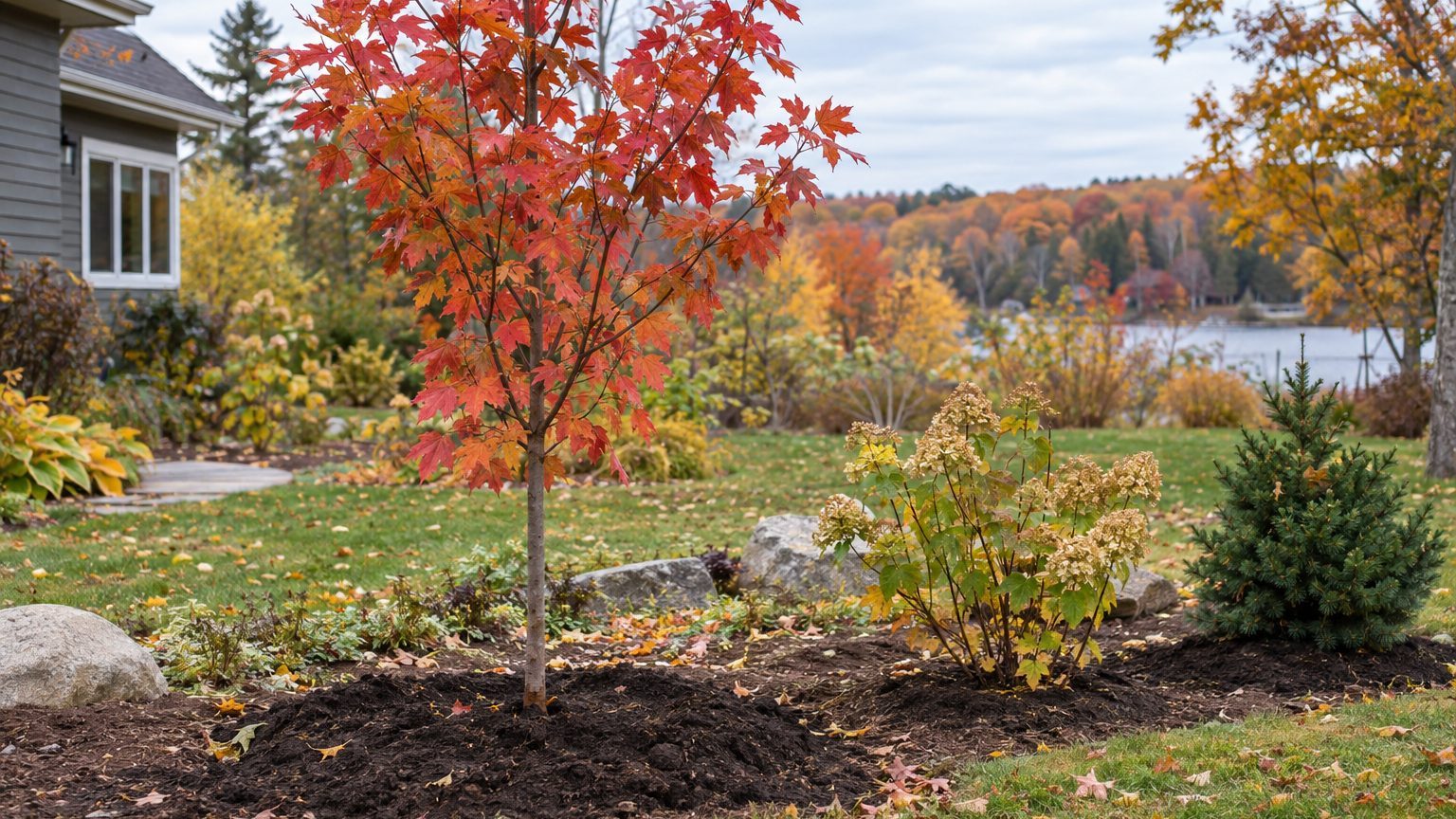

In Tennessee, the safe target for planting trees and shrubs in fall is September 16 to September 27, six weeks before the first fall frost. NOAA’s 1991-2020 normals put that frost at October 28 to November 8 for Nashville. It is the conservative date, not the last possible one. Hardy container-grown and balled plants set out after it can still root in, as long as the soil is workable and the plant suits the site. The details below decide which side of the line your plant lands on.
The deadline in Tennessee
Air and soil run on different clocks. Leaves and buds react to a frost within hours, but roots answer to the ground, which holds summer’s heat long after nights turn cold. Roots keep growing while the soil is workable and above freezing. That gap is why fall planting works so well: a tree set out in autumn spends its first cool months building roots instead of fighting heat and drought.
The rule most gardeners lean on comes from Cornell Cooperative Extension in Orleans County: “Fall is an excellent time for transplanting, provided you get them to their new home at least 6 weeks before the ground freezes, allowing them time to establish roots before winter dormancy.” The countdown starts at the moment the ground freezes, not at the first frost.
Ground freezing is hard to predict for a backyard, and it lags behind the first frost. So the cautious move is to count back from the frost instead. NOAA’s 1991-2020 Climate Normals for the Nashville station (the 30-70% probability band for a 32°F freeze) put the first fall frost at October 28 to November 8. Six weeks earlier is the window to write down: September 16 to September 27. Treat it as the safe target, the date by which a plant has had its full head start.
Why the real limit falls later
Because the ground freezes after the air does, the true limit usually lands later than that September window. A hardy shrub planted in mid-October in Nashville is not doomed. It simply has less time than the ideal. What you give up by planting after the safe window is margin: less root growth before dormancy, and less forgiveness if winter turns harsh early or the fall runs dry.
NOAA’s figure for the coldest month in Nashville helps explain the stakes. The mean daily minimum in the coldest month is 30.1°F. That is the average overnight low, not a record, and it sits just under freezing. Winters here are cold enough that the deadline is real, yet mild enough that it is not the hard wall it is in northern states. Planting in early November is a gamble you can sometimes win. Planting into frozen soil is not a gamble worth taking.
Colder parts of the state
Those dates belong to Nashville. East Tennessee and the Cumberland Plateau run cooler, with later springs and earlier autumns, so the first fall frost arrives sooner there and the whole planting window moves earlier. If you garden on the Plateau or at elevation in the east, aim for the early part of the September range, or ahead of it. For a closer read on your own county, the First and Last Frost Dates in Tennessee page gives the spring and fall picture in more detail.
What to plant late, and what to wait on
Winter hardiness is a separate question from timing, and it matters more the later you plant. The USDA Plant Hardiness Zone Map 2023, built on a single variable (the average annual extreme minimum temperature), covers Tennessee with a range from 5b to 8a. That range is statewide, so a Nashville gardener and a Plateau gardener can read very different numbers off the same map. Look up your own location before trusting a plant tag.
A container-grown or balled-and-burlapped plant that is fully hardy where you live is the safest candidate for late planting. Its roots arrive mostly intact, so there is less shock to recover from, and a dormant deciduous tree has no leaves to keep hydrated. These plants can keep rooting in cool soil well after the safe window has passed. Bare-root stock is a spring job, since it travels with almost no soil and needs a full growing season to recover.
Borderline plants are the ones to hold back. If a shrub’s rating sits close to the cold limit for your spot, a first winter with young roots leaves it little protection. Waiting until spring gives it a full season of growth before it meets its first hard cold. Evergreens deserve the same caution. Their foliage keeps losing water through the winter, and a plant that has not finished rooting cannot replace it.
| Plant type | Late-fall outlook | Reason |
|---|---|---|
| Hardy deciduous trees and shrubs, container or balled | Good | Dormant tops, roots keep working in cool soil |
| Evergreens, broadleaf or needled | Riskier | Foliage loses water all winter while roots settle |
| Plants rated near the cold limit for your location | Wait for spring | Young roots give little protection against a hard winter |
The rule worth writing on the seed-catalog margin is simple: after the safe window, plant only hardy container or balled stock, and put borderline plants and evergreens off until spring. A spring planting loses nothing but a few months. A fall planting that fails costs the plant. For the mechanics of the hole, the root flare, and aftercare, see Planting and Caring for Trees, Shrubs and Perennials.
Evergreens are not off limits in fall. The ones planted in September, inside the window, have time to put down roots before the cold. The ones planted in November are the ones to worry about.
Watering and mulch until the ground freezes
Fall rain can fool you. A shower that wets the top of the soil rarely reaches a new root ball, and a new plant has very little root to draw from. Water slowly and deeply, so the moisture soaks below the root ball and into the soil around it, instead of running off. Then let the surface dry slightly before the next soaking. Keep this up through any stretch of fall without a good rain, and stop when the ground freezes.
Why the first winter is about roots
A newly planted tree puts on almost nothing above ground in its first winter, and that is how it should be. Top growth stops with dormancy, while roots continue to extend into unfrozen soil. Everything the plant does in those months is about anchoring and reaching water. This is why pruning, fertilizing, and fussing over the top are the wrong moves. Fertilizer in particular pushes tender new growth just when frost is coming. The tree’s job in year one is to establish a root system, and everything above ground can wait.
Mulch in a ring, not a volcano
Mulch helps by evening out soil moisture and temperature, which is exactly what young roots need. NC State Extension’s Gardener Handbook, in the woody ornamentals chapter, gives the depth in two places. On weeds: “A 2-inch to 3-inch layer of mulch suppresses most annual weed seeds and makes it easy to hand-pull any that do germinate.” And on trees: “Provide a 3-inch layer of mulch to reduce water loss and maintain uniform soil moisture and temperature around roots.”
Both sentences point to the same depth, and neither says more is better. The shape matters as much as the depth. Spread the mulch in a wide, flat ring and pull it back from the trunk so the root flare stays visible. Mounded mulch piled against the bark, the so-called volcano, holds moisture against the trunk and invites rot and pests. Mulching Without Killing the Plant covers the details. Mulch after planting and watering, not before, so the water reaches the soil instead of sitting on the mulch.
Water deeply until the ground freezes, and lay mulch in a flat ring at the 2-inch to 3-inch depth, with a clear gap around the trunk.
What goes wrong
The most common failure is planting too late for the local climate. A plant set into cold soil has no time to root before the ground locks up, and then it sits through winter on a root ball that never reached beyond its container. Because East Tennessee and the Cumberland Plateau reach frost sooner, the same mistake costs more there. If you miss the September 16 to September 27 window, plant only while the soil is still workable, and keep watering. Do not plant into frozen ground.
Winter burn is the second problem, and it hits evergreens hardest. Needles and leaves keep losing water on cold, windy, sunny days, while the roots, in cold or dry soil, cannot replace it. The leaves turn brown at the tips or on the windward side, and the damage shows up in late winter. Deep watering before freeze-up helps, and so does planting evergreens early or leaving them for spring.
Heaving is the third. Tennessee winters swing between freezing nights and mild days, and each cycle can push a shallow, loosely set root ball upward. A plant that rises out of the ground loses root contact with soil, and its roots dry out. A steady layer of mulch moderates the swings, and a firmly planted root ball at the right depth resists the push. Check new plants after a hard freeze and press the soil back down if one has lifted.
Dry falls make everything worse. A stretch without rain in October or November can leave a new root ball bone dry while the tree looks fine above ground. Gardeners in drier climates face a sharper version of the same problem, as How Late Can You Plant Trees and Shrubs in Fall in Nevada? shows. In Tennessee, the fix is to check the soil with a finger or trowel rather than trusting the sky.
Common questions
Is it too late to plant trees in November in Tennessee?
November is past the safe window, but it is not automatically too late. In Nashville the first fall frost arrives October 28 to November 8, and the ground freezes later than the air does. A hardy container or balled tree can still go in while the soil is workable, if you water it well. Wait for spring if the ground is frozen, or if the plant is an evergreen or borderline for your zone.
Does the six-week rule count from the first frost or from the ground freezing?
Cornell Cooperative Extension counts from when the ground freezes. Since the ground freezes after the first frost, counting six weeks back from the frost gives a conservative date: September 16 to September 27 for Nashville. Your actual limit is somewhat later, but the earlier date gives the plant its full head start.
Do East Tennessee and the Cumberland Plateau use the same dates?
No. Both are cooler than Nashville, so the first frost comes earlier and the planting window moves earlier with it. Use the Nashville range as a reference and shift toward the front of it, or ahead of it, as you go up in elevation. More local timing lives in the Tennessee guides.
How deep should the mulch be around a newly planted tree?
NC State Extension gives “a 2-inch to 3-inch layer” for weed suppression and “a 3-inch layer” for moisture around tree roots. Stay in that range and keep it in a flat ring away from the trunk. Piling it higher does not protect roots better, and deep mounds against the bark are how a ring turns into a volcano.