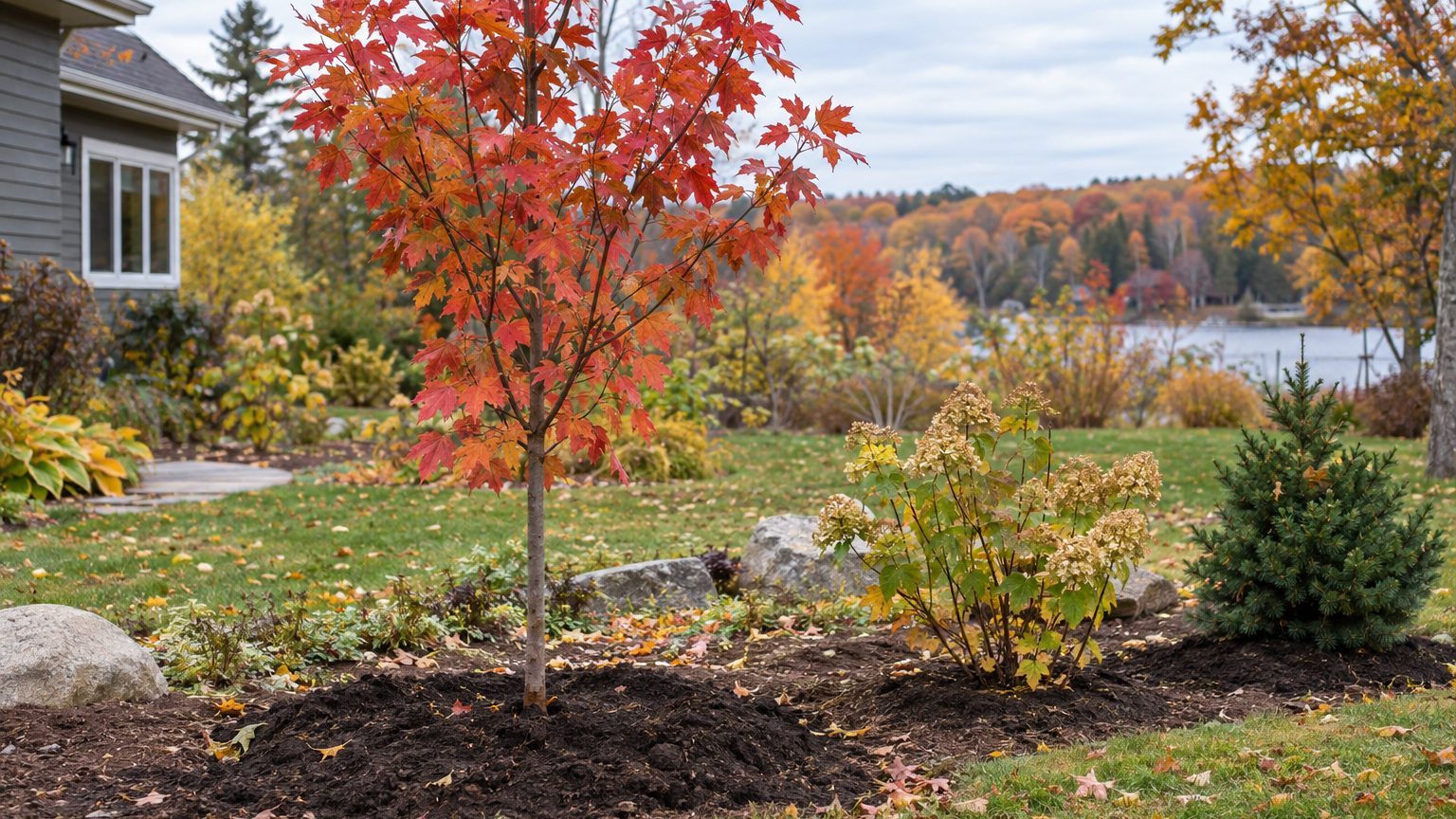

The safe target in Nevada is to have trees and shrubs in the ground six weeks before the first fall frost. Run that rule on NOAA’s Las Vegas airport normals and you get October 27 to November 11. Those dates describe a desert city at its warmest, though. Reno, Carson City and anywhere at elevation get frost months earlier, so their deadline lands earlier too. In the Las Vegas area, where the ground does not freeze, fall and even winter are the best planting months of the year.
The deadline in Nevada
Roots do not follow the air thermometer. When nights turn cold, leaves drop and top growth stops. Roots keep pushing outward as long as the soil is workable and above freezing, often for weeks after the first frost has blackened the tomatoes. That lag is the whole reason fall planting works. A tree set out early enough spends autumn and winter building a root system, then meets its first Nevada summer with roots already reaching into native soil instead of a nursery pot’s worth of potting mix.
Cornell Cooperative Extension states the rule this way: “Fall is an excellent time for transplanting, provided you get them to their new home at least 6 weeks before the ground freezes, allowing them time to establish roots before winter dormancy.” Look closely at what it counts back from. It is not the first frost, which is an air temperature. It is the day the ground freezes, and that day comes later. Counting from the first frost instead gives you a cushion, which is why the date below is a conservative target and not the true limit.
Working the date from the first frost
The NOAA NCEI U.S. Climate Normals for 1991-2020 put the first fall 32°F freeze at the Las Vegas airport station between December 8 and December 23, using the band where the odds of a freeze run from 30 to 70 percent. Count six weeks back from that range and the conservative planting deadline is October 27 to November 11. The rule is Cornell’s, and the frost range is NOAA’s. Because the ground freezes after the first frost, the real limit usually falls later than that range.
The practical takeaway for anywhere in the state: count back six weeks from your own local first fall frost, and treat that range as the date to write down.
Why Las Vegas numbers can’t stand in for the state
The Las Vegas airport reading is a desert urban-heat-island extreme. Reno, Carson City and anywhere at elevation see frost months earlier in fall and months later in spring, so the colder you go (farther north, higher up), the earlier your deadline falls. The USDA Plant Hardiness Zone Map 2023, which is built on a single variable, the average annual extreme minimum temperature, shows how wide the spread is: Nevada runs from 4a to 10a. No single planting calendar can cover that. Your county extension office can give you the first-fall-frost range for your own town, and the First and Last Frost Dates in Nevada page is a good place to see how much it shifts around the state. Subtract six weeks from your range and you have your deadline.
In the warm part of the state, the calculation changes. NOAA’s 1991-2020 normals for the Las Vegas reference station show a mean daily minimum of 39.6°F in the coldest month. That number stays above 32°F, which means the ground does not freeze there, and the six-week deadline does not apply. Fall and winter are the best time to plant in the Las Vegas area, plain and simple. The average is not a guarantee against every cold night (the freeze probabilities above show 32°F nights do arrive in December), so tender plants still deserve a frost cloth on a clear, still evening. But the roots will keep working all winter.
What to plant late, and what to wait on
The safe bets
Container-grown and balled-and-burlapped trees and shrubs that are fully hardy in your zone are the plants that handle late planting best. Container plants arrive with their root systems intact, and balled plants bring a chunk of their original soil, so the shock of moving is smaller. Deciduous types have the extra advantage of having already shed their leaves, so there is no foliage losing water while the roots get settled. Shade trees, flowering shrubs and deciduous fruit trees all fall in this camp.
“Fully hardy” is a statement about your zone, so look yours up before you shop. The USDA Plant Hardiness Zone Map 2023 (built from 1991-2020 normals) lets you search by ZIP code, and the Nevada range of 4a to 10a is wide enough that a plant that is perfectly safe in one county can be a gamble in the next. A plant rated for your zone with room to spare is a safe bet. One rated exactly at your zone’s edge is not.
The risky ones
Borderline plants are the first to wait on. A shrub that is only marginally hardy for your zone needs all the root growth it can get before its first winter, and a late planting shortens that. In colder parts of Nevada, wait until spring for anything rated at the edge of your zone. In the Las Vegas area, the 39.6°F coldest-month minimum from NOAA is the number that decides winter hardiness, and it is mild enough that many plants considered tender elsewhere do fine. The occasional freezing night still arrives, so keep frost cloth handy for the youngest ones.
Evergreens are the other group that needs care. Pines, junipers and broadleaf evergreens keep their foliage through winter, and foliage keeps losing water. In Reno, Carson City and other cold places, the soil can freeze while the needles are still transpiring, and the roots cannot replace what the wind and sun pull out. Those plants belong early in your window or in spring. In the Las Vegas area, where the soil stays unfrozen, evergreens planted in fall settle in just fine as long as you keep them watered.
| Plant type | Colder Nevada (Reno, Carson City, elevation) | Las Vegas area |
|---|---|---|
| Fully hardy deciduous trees and shrubs, container-grown | Plant before your six-week mark | Plant through fall and winter |
| Fully hardy balled-and-burlapped plants | Plant before your six-week mark | Plant through fall and winter |
| Borderline hardy plants | Wait for spring | Fall is fine; cover on frosty nights |
| Evergreens | Early in the window, or wait for spring | Fall and winter, kept watered |
Watering and mulch until the ground freezes
Water deeply, and keep going
Nevada is the driest state in the country, and a dry fall is the norm. Freshly planted trees and shrubs depend entirely on you, because their roots have not yet reached beyond the planting area. Soak the root ball and the soil around it slowly, with a hose trickle or drip line, so the water goes down instead of running off. Deep, less frequent watering pulls roots downward, while a quick sprinkle keeps them near the surface where they are most exposed. To check, push a long screwdriver into the soil next to the root ball. If it slides in easily, there is moisture down there. If it stops, it is time to water.
In colder parts of the state, keep this up until the ground freezes. Water a final time deeply just before the freeze, because frozen soil cannot take any water in. In the Las Vegas area the ground never locks up, so the watering never officially ends. It just slows down. Check the soil every couple of weeks through winter and water whenever it is dry, especially for evergreens.
Mulch in a ring, not a volcano
Mulch does two jobs here: it holds moisture in the soil, and it evens out soil temperature. The NC State Extension Gardener Handbook gives depths for both purposes. For weeds: “A 2-inch to 3-inch layer of mulch suppresses most annual weed seeds and makes it easy to hand-pull any that do germinate.” For trees: “Provide a 3-inch layer of mulch to reduce water loss and maintain uniform soil moisture and temperature around roots.” The two sentences point to the same order of depth, so spread a ring of mulch in the 2-inch to 3-inch range and stop there. More is not better. Piled against the trunk in a cone, mulch holds moisture against the bark and invites rot, and that is how a ring turns into a volcano. Leave the trunk collar open to the air, and let the ring extend outward over the root zone. The Mulching Without Killing the Plant page covers the details, including what to do with old mulch from last year.
The first winter is about roots, not growth
Do not expect a new tree to look any different through the cold months, and do not try to force it. Fertilizing or pruning heavily in fall can coax out tender new growth that the first hard cold will kill. Everything the plant does that winter happens below ground. A container-grown tree arrives with roots shaped like its pot, and the first season is spent turning that into a system wide enough to feed a full-size canopy. The visible growth comes later, once the roots have caught up. Basic aftercare for the first year is laid out in Planting and Caring for Trees, Shrubs and Perennials.
What goes wrong
Timing and winter exposure
The most common failure in the colder parts of Nevada is planting too late. A nursery sale in November is tempting, but if your first fall frost range arrives months before Las Vegas’s December 8 to December 23, the six-week deadline from that range has probably already passed. A tree planted after it gets only a few weeks of root growth before the soil locks up, and it heads into winter with a root system that has barely left the root ball.
Winter burn is the second problem, and it belongs to evergreens in cold places. Sun and wind pull water from needles and leaves, and frozen soil blocks the roots from replacing it. The damage shows up in late winter or spring as brown tips or whole browned branches, and it is easy to mistake for cold damage. A deep watering just before the freeze, a ring of mulch and an early planting date are the best defenses.
Heaving and drying out
Where the ground freezes and thaws repeatedly, shallow root balls can heave. Alternating freeze and thaw pushes the loose soil of a fresh planting upward and can leave the top of the root ball exposed to air. Mulch helps by keeping soil temperature steadier, as NC State’s “uniform soil moisture and temperature” language suggests. Recheck every new planting after each thaw and each windstorm, and press any lifted root ball back into the soil. None of this applies in the Las Vegas area, where the ground does not freeze.
Drying out is the one problem that applies everywhere in the state, Las Vegas included. A dry fall means no rain to do your work for you, and roots that have not yet spread cannot reach deeper moisture. More new trees die from quiet thirst than from any cold snap, so keep the screwdriver test going until the ground freezes, or all winter where it never does.
Common questions
Can I plant trees in Las Vegas in December or January?
Yes. NOAA’s 1991-2020 normals for the Las Vegas reference station show a coldest-month mean daily minimum of 39.6°F, which stays above 32°F, so the ground does not freeze and the six-week deadline does not apply. Winter planting works as long as the soil is workable and you keep the plant watered. Cover tender plants on the occasional frosty night.
Is October 27 to November 11 a good deadline for Reno or Carson City?
No. That range comes from Las Vegas airport data, which is a desert urban-heat-island extreme. Reno, Carson City and higher places see their first fall frost months earlier, so their six-week deadline falls earlier too. Ask your county extension office for the first-fall-frost range for your town and count back six weeks from it. The other Nevada guides are useful for seeing how much conditions change across the state.
Does the six-week rule start from the first frost or from frozen ground?
Cornell Cooperative Extension counts six weeks back from when the ground freezes. Because the ground freezes after the first frost of the air, counting from the first frost builds in extra time, and that is why it works as the safe target. The true limit usually falls later. For a look at the same rule in another climate, see How Late Can You Plant Trees and Shrubs in Fall in Tennessee?
What if I miss the deadline in a colder part of Nevada?
If the soil is still workable, a hardy container-grown deciduous plant can still go in, though it carries more risk. Water deeply, mulch, and check it after thaws. For borderline plants and evergreens, keep them in their pots in a sheltered spot, water them as needed, and plant in spring. A pot above ground gets colder than soil does, so a spot against a wall or fence on the sunny side helps.