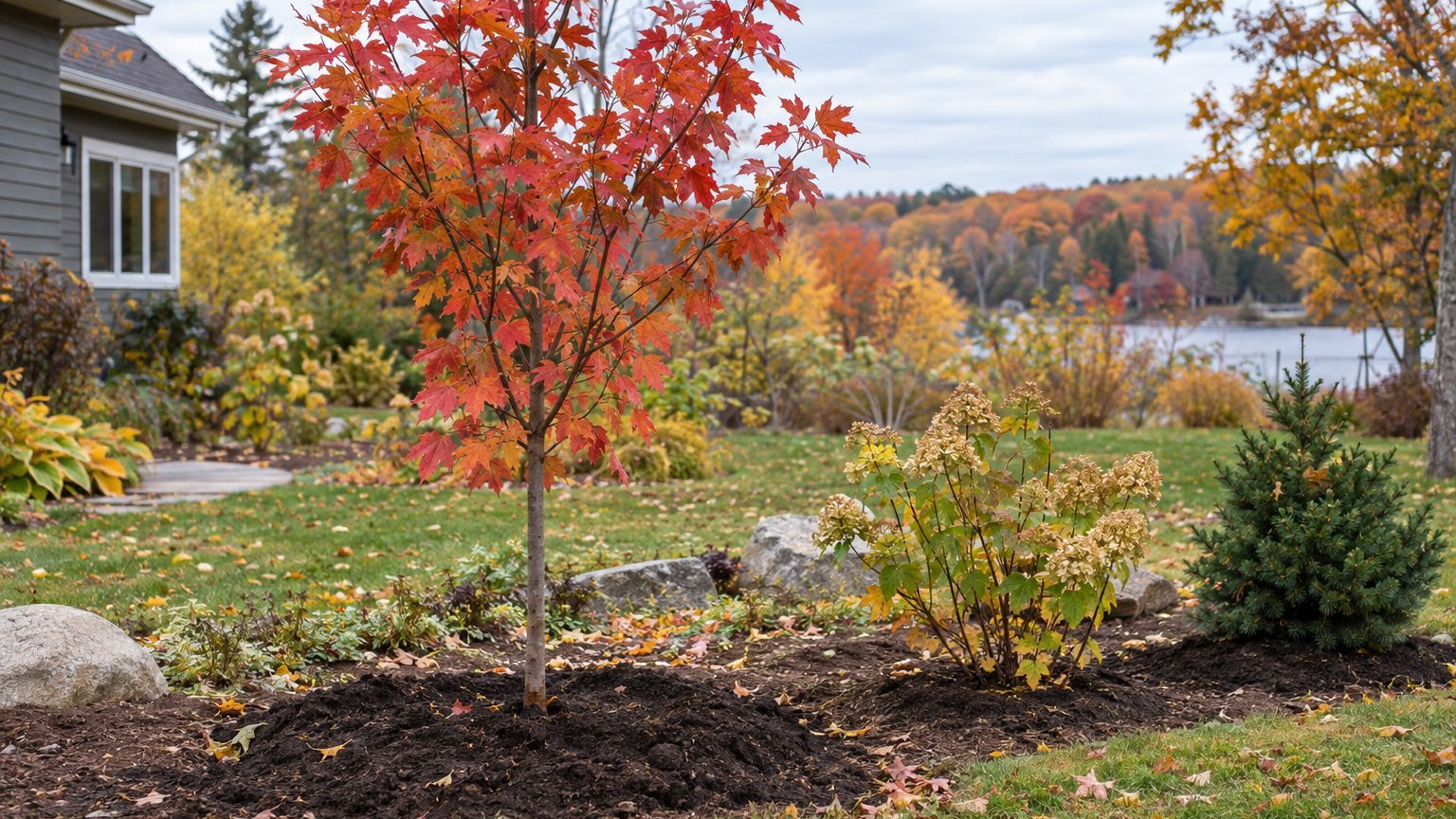

The safe deadline for planting trees and shrubs in fall in Virginia is September 29 to October 13, counted as six weeks before the first fall frost. NOAA puts that frost between November 10 and November 24 at the NAS Oceana station. Treat that as a conservative target, not a wall. Roots keep working after the leaves drop, and the ground freezes later than the air does. On the coast, a late planting can still work. In the mountains, the clock runs out sooner.
The deadline in Virginia
Why the count starts from the ground, not the air
A tree doesn’t shut down the night the first frost touches the lawn. The top goes dormant, but the roots keep growing for as long as the soil is workable and above freezing. Soil holds summer heat and gives it up slowly, so the root zone stays active for weeks after the air has turned cold. That gap is the whole reason fall planting works.
Cornell Cooperative Extension (Orleans County) states the rule this way: “Fall is an excellent time for transplanting, provided you get them to their new home at least 6 weeks before the ground freezes, allowing them time to establish roots before winter dormancy.” The catch is that almost nobody tracks the day the ground freezes. It shifts from year to year, and no weather service publishes it for your backyard. First-frost dates, on the other hand, are well documented.
So the practical move is to count back from the first frost. NOAA’s 1991-2020 Climate Normals for NAS Oceana, based on the band where the chance of a 32°F freeze runs between 30 and 70 percent, put Virginia’s first fall frost at November 10 to November 24. Subtract six weeks and you land on September 29 to October 13. Because the ground freezes after the air does, the true limit falls later than that range. Think of it as the date with a cushion built in.
As of early October, the front edge of that window is open right now, and it closes within about the next two weeks.
Where the deadline bends
The Oceana station sits in coastal Virginia Beach, the mild end of the state. NOAA’s normals give the coldest month there a mean daily minimum of 31.6°F, barely under freezing. Winter nights on the coast hover near the freezing line instead of plunging far below it, so the soil usually stays workable deep into the season. For hardy plants, fall and even early winter are the best time to plant on the coast, and the September 29 to October 13 range is a safe target, not a cutoff.
Move inland and uphill, and the math changes. The Blue Ridge and southwest Virginia run weeks later in spring and earlier in fall, so their first frost arrives sooner and their planting deadline moves earlier by the same amount. Look up your own first-frost range in First and Last Frost Dates in Virginia, then count six weeks back from it. Gardeners across the border face the same arithmetic with different numbers, as How Late Can You Plant Trees and Shrubs in Fall in Tennessee? lays out for that state. For other seasonal timing around the state, the Virginia guides cover the rest of the calendar.
What to plant late, and what to wait on
The plants that handle a late start
Container-grown and balled-and-burlapped plants that are fully hardy in your zone are the safest bets as the window narrows. A container plant brings its entire root system with it, so it loses little to the move. A balled plant carries a good share of its roots in the ball, and the cool, damp weeks of late fall give those roots time to reach into native soil. Deciduous trees and shrubs have the extra advantage of dropping their leaves, which removes the biggest source of water loss.
Hardiness here means the USDA Plant Hardiness Zone Map 2023, which is built on one number: the average annual extreme minimum temperature. Virginia spans 5a to 8b on that map, so the zone in your yard may differ from the coast’s. Check your own zone before you buy. At the coastal reference station, the coldest month’s mean daily low is 31.6°F, but a hardiness zone tracks the harshest nights of the year, not the typical ones, so the zone label matters more than that average.
The ones worth holding until spring
Two groups get riskier as fall runs out. Borderline plants, the ones rated right at the edge of your zone, haven’t built the root mass to ride out a hard winter. Evergreens, both broadleaf and needled, keep their foliage all winter and keep losing water through it, even when the soil is cold and the roots are slow to replace it. A newly planted holly or pine is working with a thin supply line.
| Plant type | Late-fall outlook | Reason |
|---|---|---|
| Hardy deciduous trees and shrubs, container-grown | Good | Intact roots, no leaves to lose water |
| Hardy balled-and-burlapped plants | Good, if planted inside the window | Roots in the ball extend into native soil during cool weeks |
| Plants rated at the edge of your zone | Wait | Little root growth before the hardest cold |
| Evergreens that hold foliage all winter | Earlier is better; otherwise wait | Foliage keeps losing water while roots lag |
The rule of thumb for borderline and evergreen plants: if the safe window has closed, wait until spring and plant them then. They will settle in without a winter to survive first. For hole depth, root-ball handling and aftercare that apply to everything on this list, see Planting and Caring for Trees, Shrubs and Perennials.
Watering and mulch until the ground freezes
Why the first winter is about roots
A new tree has a modest root system trying to support a full crown. Everything it does in its first year goes toward closing that gap. Top growth can wait, and in fall it should. Cornell’s line says it directly: the point of early planting is “allowing them time to establish roots before winter dormancy.” While the branches sit still, the roots are anchoring the plant and learning to pull water from the surrounding soil.
That makes water the main job. Soak the root zone slowly and deeply rather than sprinkling the surface, and do it again whenever the soil dries out. Fall can run dry in Virginia, and rain that doesn’t reach the root ball doesn’t count. Dig a small test hole beside the planting with a trowel; if the soil there is dry, the roots are dry. Keep going until the ground freezes, and keep watering through a dry fall even after the leaves are gone.
Skip the fertilizer at planting time. Feeding pushes soft new shoots that the first hard freeze will burn, and it spends energy the plant should be putting underground.
Mulch in a ring, not a volcano
Mulch does two jobs for a late planting. It holds moisture in the soil, and it evens out the temperature swings that stress young roots. NC State Extension’s Gardener Handbook (chapter 11, Woody Ornamentals) gives the depth for each purpose. For weed control: “A 2-inch to 3-inch layer of mulch suppresses most annual weed seeds and makes it easy to hand-pull any that do germinate.” For trees: “Provide a 3-inch layer of mulch to reduce water loss and maintain uniform soil moisture and temperature around roots.”
Both land in the same range, and the number is a ceiling as much as a target. Spread the mulch in a wide, flat ring that covers the root zone, with a clear gap around the trunk so the base stays visible and dry. Piling it up against the bark makes a volcano, which keeps the trunk damp and invites rot. More is not better. Deep mulch works against the roots you are trying to protect. The full details on depth, spacing and materials are in Mulching Without Killing the Plant.
What goes wrong
Planting too late for your climate
The most common failure is simple: the plant goes in after the roots have run out of time. The September 29 to October 13 range comes from a coastal station. A gardener in the Blue Ridge or southwest Virginia who borrows it unchanged may be planting after the cold has already slowed the roots, because the first frost arrives earlier there. The fix is to count six weeks back from your own first fall frost, not the coastal one.
The opposite mistake happens too. A gardener on the coast sees October 13 pass and decides the season is over. That is usually too cautious. With a coldest-month mean daily minimum of 31.6°F, the coastal soil often stays workable for weeks beyond that date, and hardy plants put in later still have a decent chance. Just give them more water and hold off on anything borderline or evergreen.
Winter burn, heaving and dry soil
Evergreens can lose more moisture on a windy, sunny winter day than cold roots can replace. The result is brown, scorched foliage by late winter, which is why evergreens are the group to plant earliest or leave for spring. Watering well before the ground freezes helps, as does placing them out of the harshest wind.
Heaving is the other late-season hazard, and it hits shallow root balls hardest. Repeated freezing and thawing pushes a poorly anchored plant up out of the soil, exposing roots. It matters most inland and at elevation, where winters bite harder than on the coast. After a thaw, check each new planting, press any lifted root ball back into place by hand, and top up the mulch.
Finally, a dry fall can undo everything else. Newly planted roots can’t reach far for water, so a month without rain does real damage even in cool weather. This is the easiest problem to prevent and the one most often missed.
Common questions
Can I still plant a tree in Virginia in November?
You will be past the conservative target, but not necessarily out of options. NOAA puts the first fall frost at November 10 to November 24 at the Oceana station, and the ground freezes after that. On the coast, a hardy container tree planted in early November and watered well has a fair chance. Inland, where frost comes earlier, it is a bigger gamble. If the ground is already frozen or too hard to dig, wait for spring.
What changes in the Blue Ridge or southwest Virginia?
Everything moves earlier. Those regions run weeks later in spring and earlier in fall than the coast, so the first frost and the six-week count both come sooner. Find your local first-frost range, subtract six weeks, and treat the result as your deadline. Evergreens and borderline plants deserve the most caution in the colder parts of the state.
Is fall or spring better for evergreens?
Fall works if the evergreen goes in early enough to root before the hardest cold. A planting made at the back end of the window is a weaker bet, because the foliage keeps losing water all winter. In that case, spring is the safer choice. A spring planting gets a full growing season to root before its first winter.
Does Cornell’s six-week rule apply in Virginia?
The rule comes from a New York extension office, but it rests on how roots behave, which doesn’t change at the state line. What changes is the date the ground freezes, and that comes later in Virginia, especially on the coast. Counting from the first frost instead gives a conservative, easy-to-find date. One nuance: the November 10 to November 24 range marks where the chance of a 32°F freeze sits between 30 and 70 percent, so in some years the first freeze arrives before that range, and a buffer is worth having.