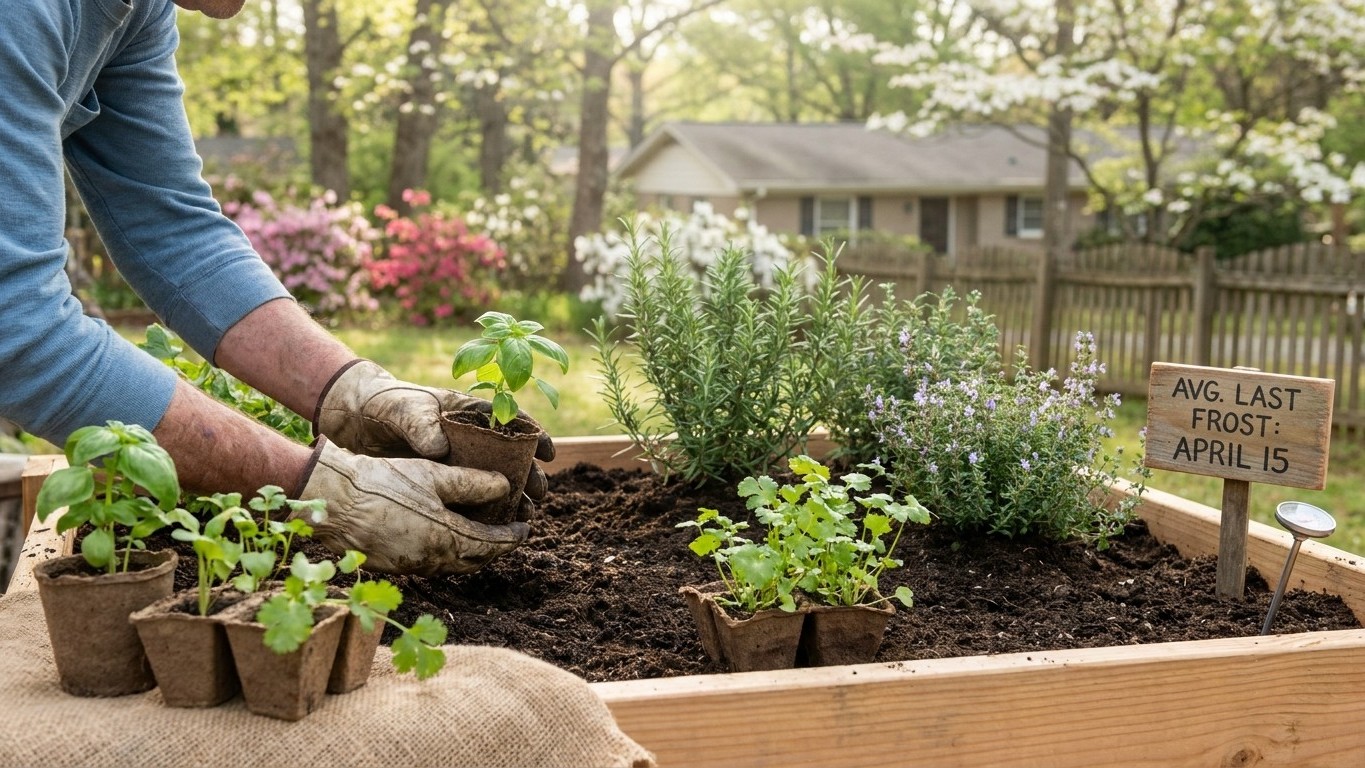

The safe sowing window for tender herbs in Tennessee runs from mid-April through late October, bracketed by a last spring frost that falls between March 31 and April 12 and a first fall frost arriving October 28 to November 8. Those dates are not a fixed calendar. They are a probability band, and that distinction changes how you should actually use them.
The short answer for Tennessee
NOAA’s frost dates come from a 30-70% probability band, built from 1991-2020 climate normals at a Nashville-area reference station. That means on the early end of the spring window, March 31, there is still roughly a 70% chance of a freeze happening after that date somewhere in a typical year. By April 12, the odds have flipped: about 30% chance of a freeze still coming. Neither date is a guarantee. They’re the range where the coin flip shifts.
For tender annual herbs, basil, cilantro grown as a warm-season crop, and any dill you’re direct-seeding for a full-season harvest, wait until you’re past the April 12 end of that band before moving seedlings outside without protection. Basil in particular sulks and yellows if soil and night air stay in the 40s, so pushing the early edge of the window buys you nothing.
Hardier herbs, parsley, cool-season cilantro, chervil, can go in the ground closer to the March 31 mark, since a light frost won’t set them back much. On the fall side, plan your last outdoor harvest of tender herbs around the October 28 early edge of the fall frost band, and treat November 8 as the point past which frost has almost certainly arrived.
Perennial herbs (thyme, sage, oregano, chives) follow a different logic entirely, governed less by frost dates and more by whether they survive winter where they’re planted. That depends on the coldest month’s mean minimum temperature, which at the Nashville reference point sits at 30.1°F. That’s not a record low; it’s the average nightly floor across the coldest month, and it’s the number that actually decides whether a perennial herb’s roots make it through winter.
| Metric | Value | What it governs |
|---|---|---|
| Last spring frost (30-70% band) | March 31 to April 12 | When to move tender herb starts outside |
| First fall frost (30-70% band) | October 28 to November 8 | Last safe outdoor harvest window |
| Coldest month mean minimum | 30.1°F (Nashville reference) | Whether perennial herbs overwinter in place |
| USDA Hardiness Zone | 5b to 8a | Which perennial herbs are winter-safe at all |
What will not work here
Rosemary is the herb most often planted in Tennessee gardens and most often lost over winter, and the coldest-month number explains why. Rosemary is reliably winter-hardy only from about zone 7b upward. Tennessee’s own hardiness range runs from 5b to 8a, so a rosemary bush planted in the cooler third of the state, the Cumberland Plateau or the higher ridges of East Tennessee, is sitting well below its comfort zone. A mean nightly low of 30.1°F at the milder Nashville reference point is already borderline; in the colder pockets it’s a losing bet without heavy mulch or a container you can move indoors.
Slow-maturing herbs run into a different wall: the calendar itself. Even using the most generous frost dates, the frost-free stretch tops out around 210 days in the mildest parts of the state and shrinks fast at higher elevation. A tender herb that needs 90-100 days to bulk up before flowering, like a full-size basil crop grown for seed rather than leaf, has to be started right at the edge of that April window to finish before the October frost band closes in. Push the start date later, or garden at altitude where spring lags, and there simply isn’t enough season left.
Tennessee’s humidity is the third failure point, and it’s easy to underestimate. Basil and other tender-leaved herbs planted at tight spacing in a state with muggy summers invite fungal leaf spot and downy mildew, especially once nights stay warm and dew sits on foliage for hours. The fix isn’t a different watering schedule so much as wider spacing and airflow, but gardeners who plant the way a seed packet suggests for a drier climate often watch basil collapse by August here regardless of how carefully they water.
None of these are exotic problems. They’re the direct result of a wide hardiness range, a humid summer, and a season length that isn’t as generous as the mild spring dates might suggest.
What changes across Tennessee
A hardiness range of 5b to 8a is not a rounding error, it’s close to the full span the USDA map uses for most of the eastern United States outside the Deep South and the far North. That spread means the growing conditions in the Cumberland Plateau or the mountains of East Tennessee can differ from those along the Mississippi River bottomlands in the west by several weeks of frost risk and a meaningful jump in winter cold.
The frost dates given here (March 31 to April 12 for spring, October 28 to November 8 for fall) come from a reference station tied to the milder end of that range. East Tennessee and the Cumberland Plateau run cooler and later in spring, which means a gardener there should treat the later end of the spring band, and possibly push a week or two past it, as the safer target for tender herbs. The same caution applies in reverse come fall: expect frost to arrive on the earlier side of the fall band, not the later one.
Winter hardiness swings even more sharply than frost timing. A rosemary or a marginally hardy sage variety that overwinters without trouble in the western third of the state, where conditions edge toward zone 8a, may need protection or container culture in the higher, colder stretches near zone 5b. There’s no single answer for “when” or “what survives winter” that covers the whole state accurately.
The USDA Plant Hardiness Zone Map lets you check by ZIP code, and that’s the right next step before you commit a perennial herb bed to a spot you haven’t verified.
Where to check this for your own county
Everything above is a state-level picture, useful for spotting the big patterns but not fine enough to plant by. The University of Tennessee Institute of Agriculture Extension, at utia.tennessee.edu/extension/, runs county offices across the state, and that’s where the state-level dates get replaced by numbers that actually apply to your soil and your microclimate.
Two things are worth asking your county office for specifically. Second, ask what herb varieties have actually been trialled in your county. Extension programs frequently test cultivars, particularly cold-hardy rosemary selections and mildew-resistant basil types, under local conditions before recommending them, which matters far more than a seed catalog’s generic hardiness claim.
A county recommendation will beat this page every time, because it accounts for elevation, local frost pockets, and soil type in a way a statewide range simply can’t. This article gives you the mechanism behind the dates, the probability bands, the coldest-month figure, the hardiness spread, so that when your county office gives you a different number, you understand why it’s likely more accurate for your yard rather than treating it as a contradiction.
Some gardeners also time this by the Moon: when to plant herbs by the moon, as almanac tradition rather than fact.
Checking this against your own garden
Dates and averages get you in the right neighborhood, but your own garden will tell you more than any calendar once you know what to look for. Three signs are worth checking before you trust a planting date over what’s actually happening in your soil.
Soil warmth by feel is the simplest. Push a finger a couple of inches into the bed in the morning; if it feels cool and slightly damp rather than cold, most herb seeds are ready to germinate. Basil and other heat-loving herbs want soil that feels closer to warm bathwater than to refrigerator temperature, and that often lags a week or more behind the calendar date in a shaded or heavy-clay bed.
Watch existing perennial herbs for their first flush of new growth. If last year’s thyme, sage, or chives are already pushing fresh green shoots from the base, that’s a better sign that your particular spot has cleared its cold risk than any date on a chart, since perennials respond to soil and air conditions right where they’re rooted.
Finally, look for the first true leaves on anything you’ve started indoors or direct-seeded early. The first rounded seed leaves don’t mean much, but the second set, the ones with the actual shape of the mature herb, tell you the plant has settled in and is growing rather than just surviving. If those show up well before your area’s typical frost-free date and a late cold snap is forecast, that’s your cue to cover the bed rather than assume the calendar has your back.