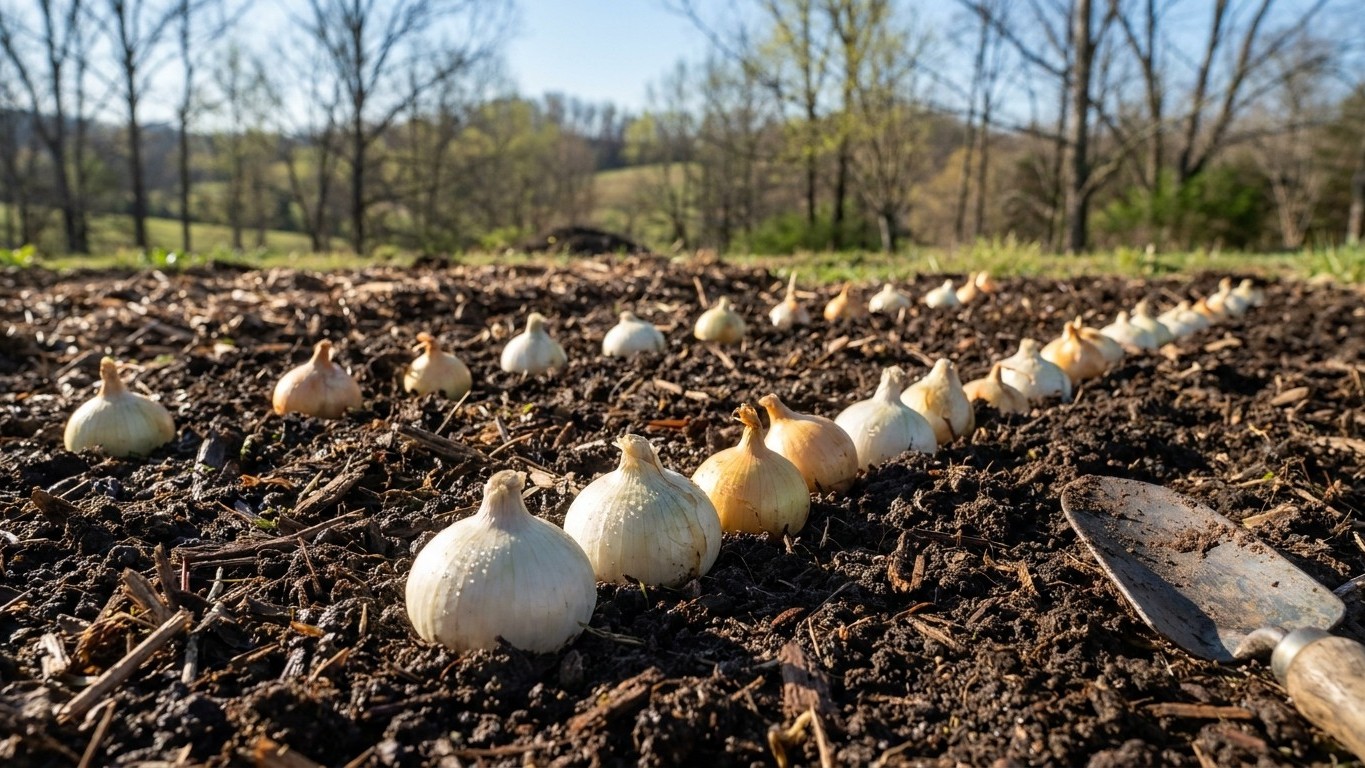

Planting calendar onions Tennessee comes down to two numbers: 36.12 degrees north, the latitude of the reference station near Nashville, and 14 hours 28 minutes of daylight on the summer solstice there. Those two figures decide which onions can even form a bulb in this state, and they push most Tennessee gardens toward a late-winter to early-spring planting window rather than a fall one.
The short answer for Tennessee

Onions don’t bulb because the weather warms up. They bulb because the day gets long enough, and that threshold is set by latitude, not by the calendar on your kitchen wall. At 36.12 degrees north, the longest day of the year delivers 14 hours 28 minutes of daylight. That places Tennessee squarely in intermediate-day territory: not far enough south for short-day onions to make sense as a first choice, not far enough north for most long-day types to ever get the daylight they’re waiting for.
That day-length position is exactly why planting timing matters here. Onions need to build a certain amount of leaf growth before the trigger day length arrives in late spring, because the size of the plant when bulbing starts is roughly the size of the bulb you’ll harvest. Miss the early growth window and the plant simply hasn’t built enough leaf mass by the time the day length says “stop growing leaves, start growing a bulb.”
In the Deep South, where winters barely dip below freezing, gardeners plant onions in the fall and let them sit through winter as small, established plants, ready to explode into growth the moment days lengthen in spring. Tennessee doesn’t get that luxury statewide. Winter here is cold enough, especially in the eastern third of the state, that fall-planted onion sets or transplants risk freeze damage or outright winterkill before spring even arrives. That’s why the practical answer for most of Tennessee is late winter to early spring, typically once the soil can be worked and the worst hard freezes have passed, rather than the autumn planting that works in Georgia or Florida.
The trade-off is real: plant too early and a hard freeze can set young onions back; plant too late and the bulbing trigger arrives before the plant has grown enough leaves to make a decent-sized onion. Late winter to early spring threads that needle for most of Tennessee, giving transplants or sets roughly two to three months of cool-season leaf growth before the June daylight peak forces the switch to bulbing.
What will not work here
Planting an onion too late in Tennessee doesn’t push the harvest back a few weeks the way a late tomato planting might. It shrinks the harvest, permanently. Bulbing starts on a day-length schedule that doesn’t care how big your onion plants are. Whatever size the plant has reached when the trigger day length hits is the size the bulb will be. A transplant put in the ground six weeks late doesn’t catch up later in summer; it just makes a smaller onion, because the plant runs out of time to build leaves before bulbing takes over.
The other way to lose the crop entirely is choosing a variety whose day-length requirement never arrives here. Long-day onions need 14 to 16 hours of daylight before they’ll bulb, and some published ranges start well north of Tennessee’s 36.12-degree reference latitude. Plant one of these in Tennessee and the day never gets long enough to flip the switch. The plant keeps making leaves all summer, then the leaves die back with cool weather in fall, and the “bulb” you dig up is barely more than a swollen stem, already starting to rot.
Based on published latitude ranges, these long-day and one intermediate-day variety will not bulb at this latitude:
- Ailsa Craig — long-day, rated for 38-60N; Tennessee’s day length never reaches its trigger
- Barolo — long-day, rated for 38-55N; leaves all season, no bulb
- Blush — long-day, rated for 38-55N; same failure pattern
- Frontier — long-day, rated for 40-50N; needs daylight this latitude never provides
- New York Early — long-day, rated for 38-50N; bred for a much longer summer day
- Patterson — long-day, rated for 38-55N; will not receive its trigger day length
- Powell — long-day, rated for 43-47N; far outside Tennessee’s day-length range
- Red Carpet — long-day, rated for 40-45N; will not bulb this far south
- Red Long of Florence — intermediate-day, but rated for 38-50N, above this latitude
- Redwing — long-day, rated for 43-65N; a far-northern variety
- Rossa di Milano — long-day, rated for 38-50N; day length falls short here
- Safrane — long-day, rated for 42-50N; needs far more summer daylight
- Talon — long-day, rated for 42-50N; same outcome, no bulb
What changes across Tennessee
Tennessee isn’t one latitude, it’s a long, narrow strip running east to west, and that shape matters more than most gardeners assume. Nashville, the source of the 36.12-degree reference figure used above, sits closer to the state’s northern half. The southern edge of the state, along the Mississippi and Alabama lines near Memphis and Chattanooga, sits roughly a degree of latitude lower. The northern strip against the Kentucky border pushes a bit higher still.
That spread matters because day length shifts with every fraction of a degree of latitude. A garden near Memphis sees a slightly shorter longest day than Nashville’s 14 hours 28 minutes; a garden up near the Kentucky line sees a slightly longer one. The difference is small in absolute terms, but for a variety whose published range sits right at the edge, like the short-day onions rated only to 35-36N, that few minutes of daylight can decide whether bulbing starts a little early and small, or arrives on schedule.
| Location | Approx. latitude | What changes |
|---|---|---|
| Southern Tennessee (Memphis, Chattanooga area) | ~35 degrees north | Slightly shorter summer day length; short-day varieties bulb a bit sooner and stay a bit smaller |
| Reference city (Nashville area) | 36.12 degrees north | 14 h 28 m on the longest day; the figures used throughout this page |
| Northern Tennessee (Kentucky border) | ~36.5+ degrees north | Slightly longer summer day length; intermediate-day varieties have a bit more room to size up before bulbing |
A gardener in Memphis or Chattanooga is closer to the southern edge of the intermediate-day zone, and may want to lean toward varieties with a lower rated range, like Candy or Sierra Blanca, both rated down to 32-33N. A gardener near the Kentucky line has a little more daylight margin and slightly more flexibility with varieties rated up into the low 40s. Neither difference is dramatic on its own, but stacked together over a growing season, they’re worth knowing before you buy sets.
Sweet now, or onions that last
Tennessee’s position in the intermediate-day zone hands gardeners a real choice, and it’s a chemistry problem more than a preference. The compounds that give an onion its sharp bite are volatile sulfur compounds, and those same compounds are what protect the bulb during months in storage. Fewer of them and the onion tastes milder and sweeter fresh out of the garden, but it also breaks down faster once it’s sitting in a bag in the pantry. More of them and the onion has more bite raw, but it holds up in storage for months longer.
Short-day and many intermediate-day onions, the types that do well at Tennessee’s latitude, tend to run sweeter and shorter-keeping. Varieties like Candy or Walla Walla Sweet are bred for that eating quality, not for a long shelf life. Northern gardens, working with long-day varieties that build more sulfur compounds over their longer summer days, end up with sharper onions that last well into winter storage.
What that means for a Tennessee kitchen is straightforward. Onions harvested from an intermediate-day crop here are best treated as a summer and early fall crop, eaten fresh or used up within a couple of months rather than counted on to still be firm on a March pantry shelf. University of Missouri Extension puts it plainly: as a rule, sweet onions do not store as well as more pungent types. Gardeners who want onions that carry them into late winter usually plan to store a portion in a cooler space and accept a shorter usable window, rather than expecting the sweet varieties suited to this latitude to behave like a long-day storage onion.
Checking this against your own garden
Everything above is built on Nashville’s 36.12-degree latitude and its 14-hour, 28-minute longest day. If your garden sits well north or south of that reference point, the numbers shift, and it’s worth a few minutes to confirm where you actually stand before ordering sets or transplants.
- Look up your own latitude using your zip code or county if you’re not within a few miles of the Nashville area, since even a degree of difference changes when bulbing starts
- Check your local average last spring frost date and first fall frost date, since these set the safe planting window regardless of what the day-length math says
- Call or visit your county extension office for planting date recommendations tuned to your specific county’s soil and microclimate
- Note whether your chosen variety’s published latitude range includes your actual location, not just “Tennessee” broadly, especially if you garden near the state’s northern or southern edge
- Track your soil temperature in late winter, since workable soil, not just the calendar date, determines when sets or transplants can safely go in the ground