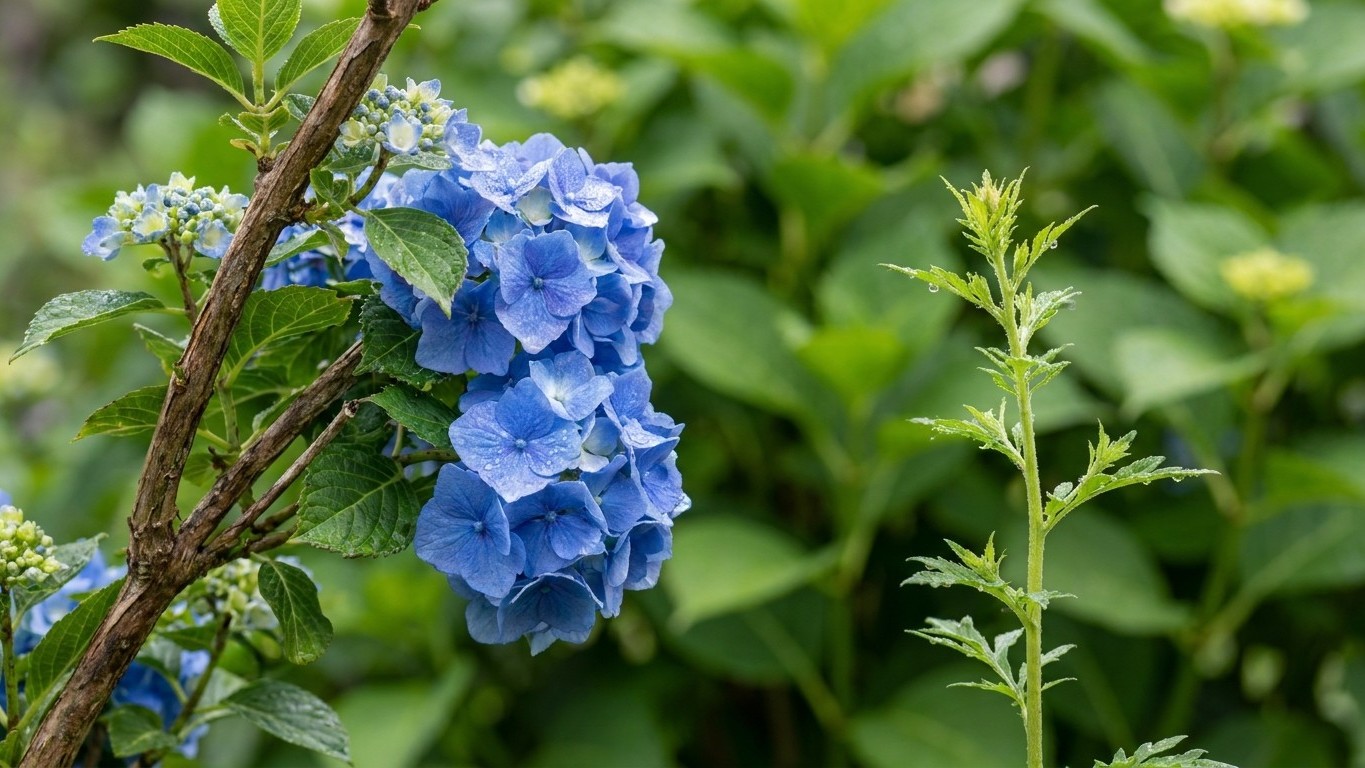

Hydrangeas turn out pink in Tennessee because many soils sit near neutral or on the alkaline side, and that chemistry keeps aluminum away from the roots. Blue flowers need acidic soil and available aluminum. A bigleaf hydrangea can usually be shifted toward blue, but expect steady work over time. White varieties and panicle or smooth types will not change at all.
What this comes down to in Tennessee
The color change is a spring-to-early-summer job, and its window is set by frost: at Nashville, the last spring frost falls between March 31 and April 12, and the first fall frost arrives between October 28 and November 8. Treat the soil after the first window closes and stop well before the second opens. The rest depends on soil chemistry and on which hydrangea you own.
What makes a hydrangea pink or blue?
Bigleaf hydrangeas (Hydrangea macrophylla) and their close cousins, the mountain types, carry one pigment in their sepals. When the plant takes up aluminum, the pigment shifts blue. When it cannot, the flowers stay pink or red. Most soils hold plenty of aluminum. The trouble is availability: as soil pH climbs, aluminum locks into forms the roots cannot absorb.
As a rough guide, more acidic soil favors blue, less acidic favors pink, and the range between gives purple, mixed or muddy shades. Middle Tennessee sits on limestone-influenced ground, and lime-rich soil and hard tap water both push pH upward. Pink is the default outcome, which is why a hydrangea bought blue at the garden center often drifts pink after a season or two in the ground.
Which hydrangeas can turn blue?
Only the bigleaf and mountain types respond. Smooth hydrangeas such as ‘Annabelle’ (H. arborescens), panicle hydrangeas (H. paniculata) and oakleaf hydrangeas ignore soil chemistry. The white blooms of panicle and oakleaf types often fade to pink as they age in late summer and fall, but that is a seasonal blush (‘Annabelle’ usually fades to green or tan instead). Aluminum sulfate will do nothing for them.
When does the Tennessee season allow the change?
Aluminum uptake matters while the flowers are forming, which means the weeks after leaves open in spring and on into early summer. At Nashville that starts after the March 31 to April 12 frost window. Drenches given earlier, during a warm spell, can push soft new growth that a late freeze then burns. Applications made after midsummer do little for this year’s blooms, and by the time the October 28 to November 8 window arrives, next year’s flower buds on old-wood types are already set. Plan on a spring schedule and judge the results the following summer.
Working it out for your own garden
Color work goes better when you start with numbers instead of guesses. The method below holds up through a move, a cold winter or a change of variety.
How do you test soil before changing hydrangea color?
Pull a soil sample from the root zone, at the drip line of the shrub rather than at the trunk. Your county extension office can run a pH test, and a home probe or kit gives a rough check. Compare the result to the guide above. A reading near 6.5 or higher means a long climb to blue. A reading near 5.5 means the plant may be blue already, or only needs aluminum and low phosphorus.
Phosphorus matters because a high-phosphorus fertilizer ties up aluminum in the soil. If you want blue, choose a fertilizer with low phosphorus and moderate potassium, and avoid bloom boosters.
How long does it take to turn hydrangeas blue?
Plan on steady work over time for a partial shift and longer for a clear blue. Two tools do the work. Aluminum sulfate acts fast and is applied as a dilute drench to moist soil, never dry soil, with repeat doses through spring. Follow the label rate, because overdoing it burns roots. Elemental sulfur works slowly but holds longer, since soil bacteria convert it to acid over months. Pine bark or peat mixed into the planting area helps keep pH down. Retest each fall so you know whether the number is moving.
What does this look like with a real cultivar?
Take ‘Nikko Blue’, a classic bigleaf mophead. It blooms on old wood, meaning the buds form the summer before. Its color is steered by soil: blue near pH 5.5, pink at pH 6.5 or above. In Middle Tennessee with limestone-influenced soil, you would test, then drench through spring, and expect the flowers to look purple the first summer and bluer the next. The color work only pays if the buds live through winter. Tennessee’s hardiness zones run from roughly 6a to 8a on the 2023 USDA Plant Hardiness Zone Map, which is based on the average annual extreme minimum temperature. A shrub in the colder end of that range can lose its old-wood buds to a hard winter or a late spring freeze, leaving green leaves and no flowers at all, whatever the pH.
A reblooming bigleaf like ‘Endless Summer’ sits more safely on that line. It blooms on both old and new wood, so even if winter takes the old buds, summer flowers still come, and they still take the color of the soil. Pick that type if your garden is cold, and put your effort into the pH.
What changes across the state
Tennessee runs east to west and climbs from river bottoms to Appalachian ridgelines, so one soil test cannot stand in for the whole state. The Nashville frost windows are a reference point. East Tennessee and the Cumberland Plateau are cooler and run later in spring, so the start of treatment shifts later there, and so does the risk of a freeze that catches new growth.
Soil matters as much as air. The general tendencies are below, and a test overrides any of them.
| Area | Typical soil lean | What to expect |
|---|---|---|
| Middle Tennessee (Nashville Basin) | Limestone-influenced, near neutral to alkaline | Pink is the default; blue takes sustained acidifying |
| Cumberland Plateau | Sandy, often acidic | Blue or purple may appear with little help; cooler spring |
| East Tennessee valleys and ridges | Varies from limestone valleys to acidic mountain soil | Test each bed; neighbors can differ |
| West Tennessee | Silty soils that often lean acidic, but vary | Test before adding anything |
Elevation also adds winter risk for old-wood bloomers. A hydrangea on a high ridge faces colder minimums and later spring freezes than one in a sheltered Nashville yard, so the reblooming types make more sense in cold pockets and the old-wood mopheads suit warmer sites. Even within one yard, soil near a concrete foundation or walkway tends to be more alkaline, because lime leaches from the concrete. A shrub planted there can bloom pink beside a blue one nearby.
The mistakes this state punishes
One easy mistake is starting too early. A warm stretch in March tempts gardeners to drench the beds, but new growth that responds can be burned by a freeze that falls inside the frost window. Wait until leaves are open and the danger has passed.
A second mistake is treating without testing. In limestone-influenced soil, a single dose of aluminum sulfate will not hold; pH drifts back and the flowers go pink again. In an already acidic soil, extra aluminum can push toxic levels and scorch roots. Test first, then decide, and retest.
Many gardeners also feed with a general bloom fertilizer high in phosphorus, which blocks the aluminum they just added. Others water with hard tap water from limestone-fed supplies. A rain barrel or collected rainwater helps keep the root zone acidic.
A fourth trap is expecting results from the wrong plant. A white hydrangea or a panicle that blushes in fall will not turn blue, no matter how much sulfate it gets. Check the species on the tag before spending a season on it.
Finally, pruning at the wrong time costs flowers. Old-wood bigleafs set buds in late summer, so cutting them back in winter or spring removes the blooms you were trying to color. Prune only right after flowering, and remove dead stems once you see which ones leaf out.
Checking this against your county
A frost window from Nashville and a soil guide for the whole state are starting points. Your own yard may sit weeks later, hundreds of feet higher, or on soil that does not match the regional pattern. Your county office at University of Tennessee Extension can test soil pH and tell you what is typical in your area. For general care beyond color, see our guide to growing hydrangeas in Tennessee.
Common questions
Can I turn pink hydrangeas blue in one season?
Rarely all the way. Expect a purple or mixed shift the first summer if you start in spring and keep soil moist and acidic. A clear blue often takes time, because the soil pH has to move and stay there.
Do rusty nails or coffee grounds make hydrangeas blue?
Neither does it reliably. Rust supplies iron, and blue color depends on aluminum. Coffee grounds add a little organic matter and only mild acidity. A soil test and sulfur or aluminum sulfate give predictable results.
Why did my blue hydrangea turn pink?
Soil pH has probably crept upward, from lime in the soil, hard tap water, nearby concrete or a phosphorus-rich fertilizer. In Middle Tennessee, blue-flowered plants often drift back to pink without ongoing acidifying.
Can I make blue hydrangeas pink?
Yes, on bigleaf types. Raise the pH toward 6.5 with garden lime, applied according to soil test results, and avoid aluminum products. Pink comes more easily than blue in limestone-influenced soil, and the shift is slow.