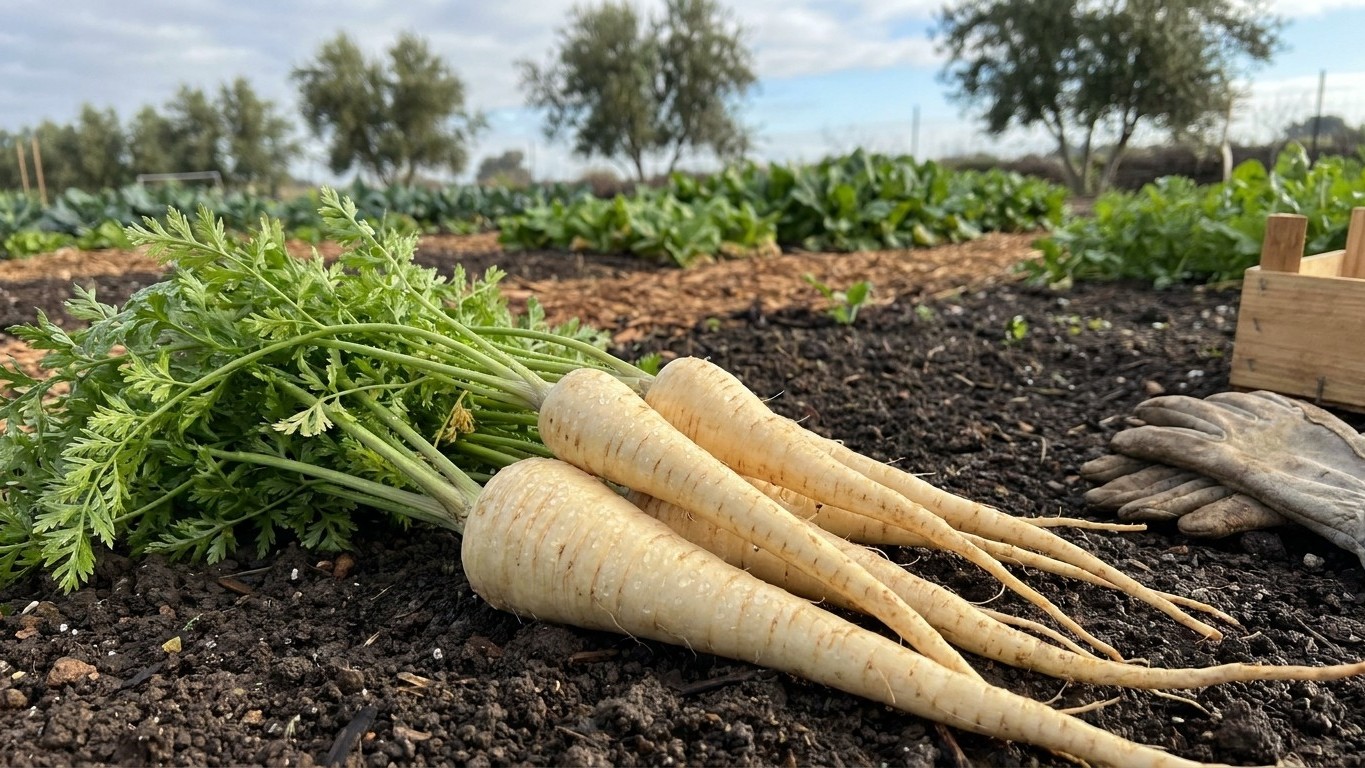

Lift Tennessee parsnips after the first frost has been followed by several cold weeks, which in practice means December through February. Sown in March, they are full size by summer but not sweet until winter. In the ground they hold until spring growth starts. Once dug and stored at 32 to 34 °F and 98% humidity, they keep 4 to 6 months. A normal kitchen manages far less, and a fruit bowl nearby can turn them bitter.
The short answer
Does Tennessee deliver several frosty weeks? Just barely, and that is the whole story. At the Nashville reference station, the mean daily minimum of the coldest month is 30.1°F, according to NOAA NCEI Climate Normals. The average night in the dead of winter dips only a little under freezing. Frost here is regular but shallow, and warm afternoons interrupt it often.
So will a parsnip grown here sweeten or merely grow? It will sweeten, in most winters, though not dramatically. Utah State University Extension says parsnips taste best after several weeks of cool, frosty weather, which converts stored starch to sugar. A Tennessee winter supplies those weeks in a typical year. A mild one, with only a handful of light frosts, gives you a perfectly good parsnip that tastes more like a pale carrot. East Tennessee and the Cumberland Plateau run cooler than Nashville, so they have the edge. The full mechanism is laid out in Will Parsnips Sweeten in Tennessee?
One trap deserves a flag. A comfortable hardiness zone is not the same as several frosty weeks. A zone tells you whether a plant survives the cold, and a parsnip root survives Tennessee winters without trouble. Sweetening depends on how many nights the roots actually spend in frost, and a zone map does not count those.
When to lift
The first fall frost at the Nashville station falls between October 28 and November 8. Several frosty weeks after that puts the earliest worthwhile digging in December. Dig a test root in early December and taste it raw. If it is still starchy, leave the rest and try again after the next cold snap. The roots can stay in the ground through winter, so lift only what you plan to eat in the next week or two. Finish before new top growth starts in spring, when the root begins spending its stored sugar.
How long they keep, and the fact most guides skip
USDA Agricultural Handbook 66 gives the benchmark: parsnip roots can be stored 4 to 6 months at 32 to 34°F with 98% relative humidity (USDA Agricultural Handbook 66). Four to six months is a long keeper by any standard. But the figure assumes that temperature and that humidity held steady, and almost no house does that. A refrigerator gets close on temperature and falls well short on humidity, so expect the roots to go limp sooner than the handbook’s number.
Cold itself is not the danger. The same handbook notes parsnips are not chilling sensitive. The danger is ethylene. Parsnips produce very little of it, but exposure to even low levels in cold storage causes bitterness. That means the crisper drawer next to apples, pears or any ripening fruit is the wrong place, even at the right temperature. Keep them in a separate drawer, a separate bag, or a separate fridge. The handbook adds one more instruction: top the roots after harvest, but do not trim into the crown.
Does the season fit?
Parsnips are sown in place, and the 100 to 120 days run from seeding, not from transplanting. The arithmetic below uses the Nashville station’s frost dates from NOAA NCEI Climate Normals (32°F freeze probabilities, 30 to 70% band).
- Start with the last spring frost. It falls between March 31 and April 12.
- Back up two to three weeks. Sowing goes in between about March 10 and March 29. Seed in this window waits a while, since germination takes 14 to 21 days. Do not dig up bare soil in the second week and assume the seed failed.
- Add 100 to 120 days from seeding. A March 10 sowing reaches the short end of that count in mid-June. A March 29 sowing reaches the long end in late July. The germination wait is already inside those numbers.
- Find the first fall frost. It falls between October 28 and November 8, so the frost-free stretch runs roughly 200 to 220 days, from about April 12 to October 28 at the short end and from March 31 to November 8 at the long end.
- Compare the two. The tightest case, a late-March sowing needing the full 120 days, still finishes about three months before the first frost. The loosest finishes nearly five months early.
The verdict is comfortable, with room to spare. The season is long enough that the risk flips: the problem is not running out of days but sowing so early that roots finish in summer and then sit in warm soil for months waiting for frost. A sowing made in the first days of July leaves fewer than 120 days before the first frost at the Nashville station, which is where the trouble starts. Count back 120 days from October 28 and you land on June 30. From November 8 you land on July 11. After those dates the plan gets tight.
In East Tennessee and on the Cumberland Plateau, spring runs later and fall frost comes sooner. The shorter frost-free window narrows the margin, though it still leaves room. For the full growing plan, see Growing Parsnips in Tennessee.
What goes wrong here
- Forked roots from heavy or stony ground. Utah State University Extension recommends deep sandy soil and says heavy soil must be double dug. Many Tennessee beds lean clay or rocky, though the state soil is a starting point, not a diagnosis of your bed. Dig a spade-deep hole and look. If the soil is dense or full of stones, loosen it to the depth of the root, pull the stones, and sow into a fine, even seedbed. A root that hits a stone splits around it.
- Forked roots from overwatering. This is a separate cause with a separate fix. Constantly soggy soil can also produce forked, misshapen roots, especially in a wet Tennessee spring. Water deeply and let the top inch dry between sessions. If your bed holds water after rain, build it up or amend it before the next sowing, rather than adding more water.
- A season that runs out. Sowing past the end of June leaves fewer than 120 days before the first fall frost. Seed early enough that the count finishes well ahead of October 28. If you are late, sow anyway and accept smaller roots, but know that the sweetening still depends on frost reaching a root that is already size-able.
- A winter too mild to sweeten. With the coldest month averaging 30.1°F at night, a warm winter can leave you short of frosty weeks. Leave roots in the ground through the cold snaps, taste a test root before committing the whole row, and be patient into January if the starch is still showing. Do not lift early just because the calendar says so.
- Bitter roots from storage. The fault here is the neighbor, not the cold. Keep stored parsnips away from apples and other ripening fruit, since low levels of ethylene cause bitterness. Top the roots, but do not cut into the crown.
Damage to the roots from animals and insects is a separate matter, covered in What Eats Parsnip in Tennessee, and When.
Common questions
When is the earliest I can pull parsnips in Tennessee?
Wait until at least several weeks after the first fall frost, which at the Nashville station arrives between October 28 and November 8. That points to December. Roots pulled in October are edible but have had little frost to convert starch to sugar.
Can I leave parsnips in the ground all winter?
Yes, and it is the best storage you have. Dig as needed through winter, and finish before spring growth begins. Roots left past that point spend their sugar on new tops and go woody.
How long do parsnips keep after digging?
USDA Agricultural Handbook 66 gives 4 to 6 months at 32 to 34°F with 98% humidity. A typical home refrigerator does not hold the humidity, so plan on a shorter life. Keep them away from apples and other ripening fruit, because ethylene makes them bitter.
Should I cut the tops off before storing?
Yes, top them, but do not trim into the crown. Cutting into the crown opens the root to rot and shortens storage life.