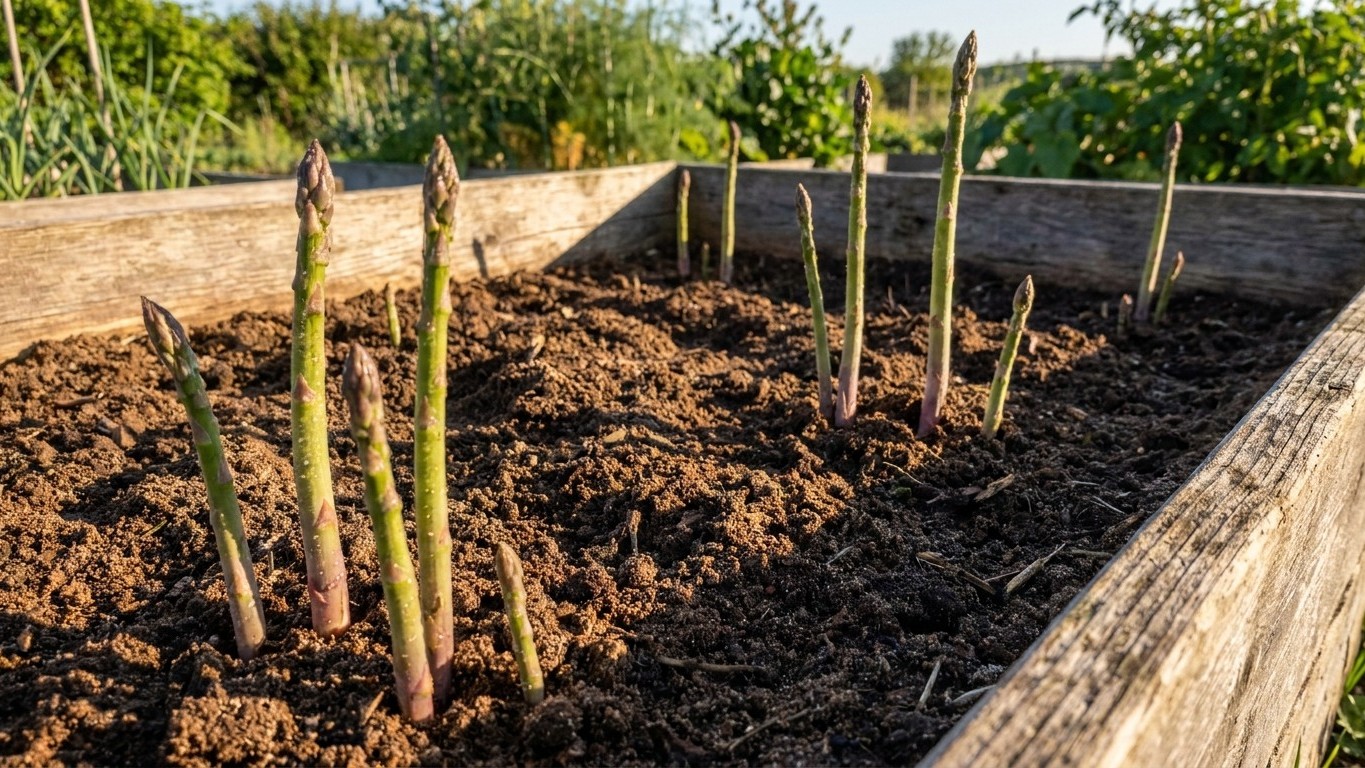

Stop cutting when most of the spears coming up are thinner than a pencil. That is the signal, not a calendar date. Before that, a new bed gets no harvest at all until year three, and the cutting season then runs four weeks, then six, then eight. Once the spears reach the kitchen, keep them at 32 to 35°F with the cut ends standing in water. Whether the bed lives long enough to make any of this matter depends on the ground it sits in.
The short answer
An asparagus bed is the one thing in a Texas garden you plant once and live with for 10 to 15 years. The extension guidance from Utah State University, the only authority behind this page, puts the soil requirement in one condition: most soils will do, provided they drain. Nothing about fertility, nothing about texture. Drainage, full stop.
So does the soil Texas is known for drain well enough? The state soil is the Houston Black series, a Vertisol, and it is a shrink-swell clay that cracks open when dry and turns to glue when wet. USDA’s representative surface values are 20 percent sand, 54 percent clay and 26 percent silt, with organic matter around 3.0 percent. Its drainage class is moderately well drained. That grade is a passing mark, not a strong one, and for a 15-year decision it deserves suspicion. Crowns sit in an 8-inch furrow, and in a heavy clay that furrow can behave like a shallow bathtub through a wet spring.
The surface pH of the series is about 7.9, which is alkaline. That is a property of the mapped series, not a reading of your yard, and the Utah State page is silent on soil pH for asparagus, so no target is offered here. A soil test gives you your own number.
Here is the catch with that state soil: it is a starting point, not a diagnosis. Texas holds hundreds of soil series. A river bottom, a Hill Country slope and a lot where the builder scraped off the topsoil and trucked in fill all behave differently from the Houston Black. In most gardens, a heavy soil is an annual nuisance you amend a little each season. With asparagus it becomes a decision you can’t undo without digging up the whole bed.
Check your own spot before you buy a single crown. Dig a hole about a foot deep after a good rain and see whether water is still standing in it a day later. If it is, you have three options:
- Build a raised bed and fill it with soil that drains.
- Move the bed to a higher, better-draining corner of the yard.
- Skip asparagus on that plot.
Our guide on Will Texas Soil Hold an Asparagus Bed for Fifteen Years? goes deeper on the testing. For the full crop picture, start with Growing Asparagus in Texas.
The pencil rule only matters if the crowns survive to year three. Waterlogged crowns rarely do.
Will the summer here water it for you?
Partly, and in a normal Houston-area year, mostly. The bed wants 1 to 2 inches of water every other week for its first two years, then every three weeks after that. NOAA’s 1991-2020 normals for the Houston reference station (IAH) give about 14.6 inches of rain across June, July and August, out of 51.8 inches for the year. By month, that is 6.0 inches in June, 3.77 in July (the driest) and 4.84 in August.
Those are Houston numbers, the wet Gulf end of the state. Elsewhere in Texas the summer delivers something different, and these figures are not a forecast for any single garden. Here is how to turn them into watering decisions:
- Set a rain gauge on the plot itself. Normals describe a station, not your yard. A gauge a few feet from the bed settles the question better than any chart.
- Add up the last two weeks. If 1 to 2 inches fell, skip the hose. A normal July at 3.77 inches covers roughly two two-week cycles on paper, so the average July leaves little to add.
- Add only the shortfall. If the gauge shows half an inch, give the bed the other half inch to inch and a half. Summer rain often comes as a single thunderstorm, and much of that runs off instead of soaking in, so a big total can hide a dry week.
- Read the soil, not just the sky. A clay holds an inch of rain for about a week, while a sandy surface lets it through within the day. A bed on sand in a wet summer can still need water every second day. Push a trowel down a few inches before you water.
- Stretch the interval after year two. Once the crowns have gone through two seasons, the schedule moves to every three weeks, and the gauge tells you when that is enough.
Heat matters here too. Hot stretches pull moisture out of the ground faster, so a two-week window with decent rain on the gauge can still leave the root zone drier than the number suggests. Over a full summer, the arithmetic favors the gardener. The cycle comes to six or seven waterings at 1 to 2 inches each, or roughly 6 to 14 inches against 14.6 inches of rain. The gap shows up in dry spells, not in the average.
When to put the crowns in
Crowns go in during early spring. For Houston, NOAA NCEI’s 1991-2020 normals put the last 32°F freeze at around February 4 to March 1. That range is the band where the odds of one more 32°F freeze sit between 30 and 70 percent, so it is an average, not a promise. A late cold snap can still arrive after it.
Do not treat that as a Texas calendar. The state spans four USDA hardiness zones, and the Houston figures are the mild Gulf end. The Panhandle freezes months earlier in fall and months later in spring, and Hill Country and North Texas each run on their own clocks. Even inside Houston, Hobby airport runs about two weeks milder than IAH. Find the last-frost window for your own county, then aim for the early part of spring, not the middle.
The crowns go into furrows 8 inches deep. Do not fill them back in all at once. Backfill gradually across the year, about 2 inches every other month, so the growing shoots are never buried under a heavy blanket of clay. That matters more on a heavy soil than on a light one.
Four varieties are named in the Utah State guidance, and the only thing the source says about them is their sex:
- Jersey Giant: all-male
- Jersey Knight: all-male
- UC 157 F1: male and female
- Purple Passion: male and female
It publishes nothing on flavor, yield or why you would pick one over another, so any claim that one tastes sweeter or produces more is not backed by that source. Buy crowns from a supplier you trust.
Seed is the alternative route. It means growing your own young plants before there is a bed to put them in, and the guidance behind this page is written around crowns and gives no seed calendar, so no dates are offered here. Expect it to add time before the three-year wait for the first cutting even begins. Pests will find the bed whichever route you take, and What Eats Asparagus in Texas, and When covers what to watch for.
Common questions
When do I stop cutting asparagus each season?
When most of the spears coming up are thinner than a pencil. It is a rule about an object, not a date, so there is no week number to circle on the calendar. Once the spears turn skinny, let them grow.
Can I cut a few spears in the first or second year?
No. Nothing is harvested until year three. After that, the season runs four weeks, then six, then eight. A bed that gets that patience produces for 10 to 15 years, so the wait is short against the payoff.
How do I keep cut spears fresh?
Aim for 32 to 35°F with air close to saturated, which UC Davis puts at 95 to 100 percent relative humidity. The window is narrow on both sides: above 50°F the spears toughen rapidly, and at about 31°F or below they freeze and collapse into mush on thawing. In a home kitchen, stand the cut ends in water or wrap them damp, because the cut end is where spears lose moisture fastest. The full numbers are in the UC Davis Postharvest fact sheet.
Does the Houston planting window apply across Texas?
No. Those frost dates come from one reference station at the mild Gulf end of a state with four hardiness zones. Hobby airport, only a few miles from IAH, runs about two weeks milder, which shows how much a short distance can move the calendar.