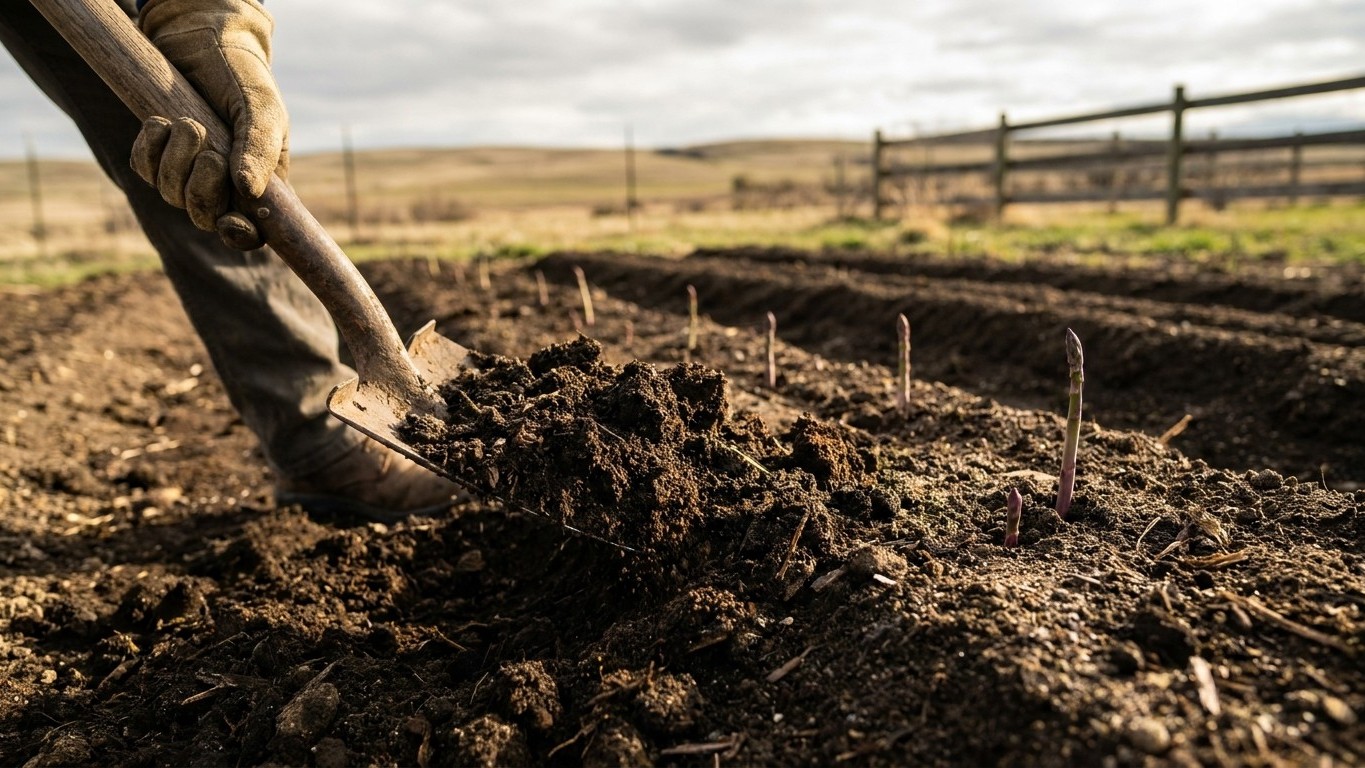

A Texas asparagus bed can sit in the same spot for a decade or more, and swapping it out midway isn’t really an option. Crowns go in as early spring warms the soil, the plant asks only for ground that drains, and the real work for a Texas gardener is checking whether the dirt under their boots actually does that before the first crown ever touches it — in other words, Will Texas Soil Hold an Asparagus Bed for Fifteen Years?
The short answer
Asparagus is a long-term tenant. Once a bed is established it keeps producing for 10 to 15 years, which means the planting decision made this spring is still paying off (or not) well over a decade from now. The only real soil requirement the crop makes is drainage. It doesn’t ask for a particular pH, it doesn’t demand sand over clay, it just needs water to move through and not sit — which is exactly why When to Plant Asparagus Crowns in Texas depends so much on soil conditions and not just the calendar.
That’s where Texas gets complicated. The soil USDA lists as representative of the state is the Houston Black series, a Vertisol, and Vertisols are famous for one thing: they swell. This is heavy clay, about 54 percent clay by weight against just 20 percent sand, and it behaves like a sponge that never quite empties. When it’s dry it cracks into wide fissures you could lose a garden trowel in. When it’s wet, those same cracks seal shut and the clay turns to something closer to glue. USDA’s own data lists it as moderately well drained, not poorly drained, but “moderately” is doing real work in that sentence. Water gets through eventually. Whether it gets through fast enough for a crown that will sit in the same eight inches of ground for fifteen years is a different question, and it’s one worth answering before planting rather than after.
None of this describes any single backyard. The Houston Black series is the soil USDA treats as representative of Texas as a whole, drawn from measurements across dozens of mapped locations, not a reading from one garden. A property sitting on river-bottom alluvium, hill country limestone, or fill dirt a builder graded in five years ago could be nothing like it. The state soil is a starting point for what the region’s ground tends to do, not a diagnosis of the bed a gardener is about to dig.
If your soil doesn’t drain
The practical fix for heavy, slow-draining clay is height. A raised bed, or even a mounded row built up 8 to 12 inches above grade with amended soil, lets excess water escape sideways and down instead of pooling around the crown. Since asparagus crowns are planted in furrows roughly 8 inches deep to begin with, a raised bed effectively gives the roots a full profile of soil that drains on the gardener’s terms rather than the clay’s. A simple test settles the question either way: dig a hole about a foot deep, fill it with water, and see how long it takes to disappear. If water is still standing after several hours, that spot is not where a fifteen-year investment belongs without raising the bed first.
Will the summer here water it for you?
an Asparagus Bed has two watering personas. For its first two years, while the root system is still building the reserves that will fuel a decade of spring spears, it wants 1 to 2 inches of water every other week. After that establishment period, the schedule relaxes to roughly the same amount every three weeks. Texas summers don’t hand that over consistently, and the shortfall has to come from somewhere.
- What the sky delivers: across June, July and August the region averages about 14.6 inches of rain, with June the wettest month at 6.0 inches, August close behind at 4.84 inches, and July the driest stretch of the whole summer at just 3.77 inches.
- What that means spread over 13 weeks: an every-other-week schedule of 1-2 inches works out to something like 6 to 12 inches of total water demand across a three-month summer during the establishment years. On paper, 14.6 inches of rain covers that. In practice it rarely lines up that neatly, since a single thunderstorm can dump an inch in twenty minutes and run straight off heavy clay instead of soaking in.
- The July gap: with July averaging only 3.77 inches against June’s 6.0, a bed can go through its hottest, most evaporation-heavy month with less rain than at any other point in the growing season, right when a young root system needs it most.
- The clay factor: the same Vertisol clay that raises drainage concerns also changes how rain behaves once it lands. It can hold surface moisture for days after a storm, then crack and shed water fast once it dries out, so a “wet enough on average” summer can still leave a bed thirsty in the gaps between storms.
- The bottom line for a gardener: a rain gauge staked in the actual bed, checked weekly, is the only way to know if that particular July delivered its share of the 3.77-inch average or fell short of it. Supplemental watering should fill whatever gap the gauge shows, not the seasonal average.
When to put the crowns in
Crowns go into the ground in early spring, timed to soil that has warmed but before the season’s growth really kicks off. For the Houston area, the window between the last spring freeze runs from around February 4 to around March 1. That’s a mean date range built from three decades of freeze-probability data, not a guarantee for any single spring, so “around” is doing honest work there, not hedging.
It’s worth being blunt about how local this window is. Texas spans four separate USDA hardiness zones, and the Gulf Coast dates above sit at the mild end of that range. The Panhandle can still be freezing solid a full season away from when Houston’s soil has already warmed enough to plant. Hill Country and North Texas run their own separate calendars. Even inside the Houston metro, the airport used for these normals runs about two weeks cooler than Hobby Airport across town. None of that is a Texas-wide planting calendar, it’s a Houston-specific one, and a gardener elsewhere in the state needs their own local dates before trusting it.
Crowns vs. seed
Crowns, essentially one-year-old dormant root systems, are the route most home gardeners use because they shortcut the slowest part of establishment. Starting from seed is the alternative path, effectively adding an extra year to the front end of the process before those seedlings are ready to go into a permanent bed. For a crop that already asks for a three-year wait before the first harvest, most gardeners weigh that extra seed-starting year against the convenience of buying crowns already a year along.
Which variety
Variety choice comes down to one detail that’s actually published: sex. Asparagus plants are either all-male or a male/female mix, and the difference matters because female plants spend energy producing seed instead of putting it all into spears.
| Variety | Type |
|---|---|
| Jersey Giant | All-male |
| Jersey Knight | All-male |
| UC 157 F1 | Male/female |
| Purple Passion | Male/female |
Utah State University Extension, the authority behind this list, doesn’t publish flavor comparisons, yield figures, or a recommendation for one over another. The sex of the plant is the documented distinction, and that’s as far as the published record goes.
Once crowns are in, patience is the whole game. No harvest happens in year one or two. Year three brings the first cutting, limited to about four weeks. Year four stretches that to six weeks, and year five and beyond allows eight weeks of cutting each spring. The stopping point every year isn’t a date on the calendar, it’s a visual cue: once most of the spears coming up are thinner than a pencil, harvest stops for the season so the plant can put its energy into building next year’s crop instead. The furrow itself gets backfilled gradually too, not all at once, with about two inches of soil added back every other month across the first year as the crown establishes.
Checking this against your own county
Everything above is built on regional averages: a representative state soil, a Houston-area frost window, a single weather station’s rainfall normals. None of it substitutes for what’s actually happening in one county’s soil and one county’s spring. Texas A&M AgriLife Extension keeps county-level offices across the state, and they’re the resource built specifically to answer the local version of every question raised here, from a real soil test result to the actual last-frost pattern in a specific county rather than the Houston airport average. Their statewide directory is at agrilifeextension.tamu.edu, and a call to the local office before breaking ground on a bed meant to last fifteen years is a cheap insurance policy against guessing wrong on drainage or timing.
Common questions
How long before an Asparagus Bed actually produces food?
No spears get harvested in the first two years at all. The first real harvest comes in year three, and even then it’s limited to about four weeks of cutting before the bed needs to rest and rebuild for the following spring.
Does Texas clay automatically rule out asparagus?
Not automatically, but it does raise the stakes on drainage. The state’s representative soil, the Houston Black series, is listed as moderately well drained rather than poorly drained, so it can work, but a simple water-fill test on the actual planting spot is worth doing first. Raised beds are the standard fix where drainage is borderline.
Is Texas summer rain enough on its own?
Not reliably. The three-month summer average of 14.6 inches roughly matches the bed’s theoretical demand, but it arrives unevenly, July is the driest month at 3.77 inches, and heavy clay doesn’t absorb storm bursts efficiently. A rain gauge in the actual bed is the only way to know if supplemental watering is needed in a given week.
Do all-male varieties produce more spears than male/female ones?
The published record from Utah State University Extension identifies the sex of each named variety but doesn’t publish a yield or flavor comparison between them. The sex distinction is documented; a performance ranking between the two types is not.