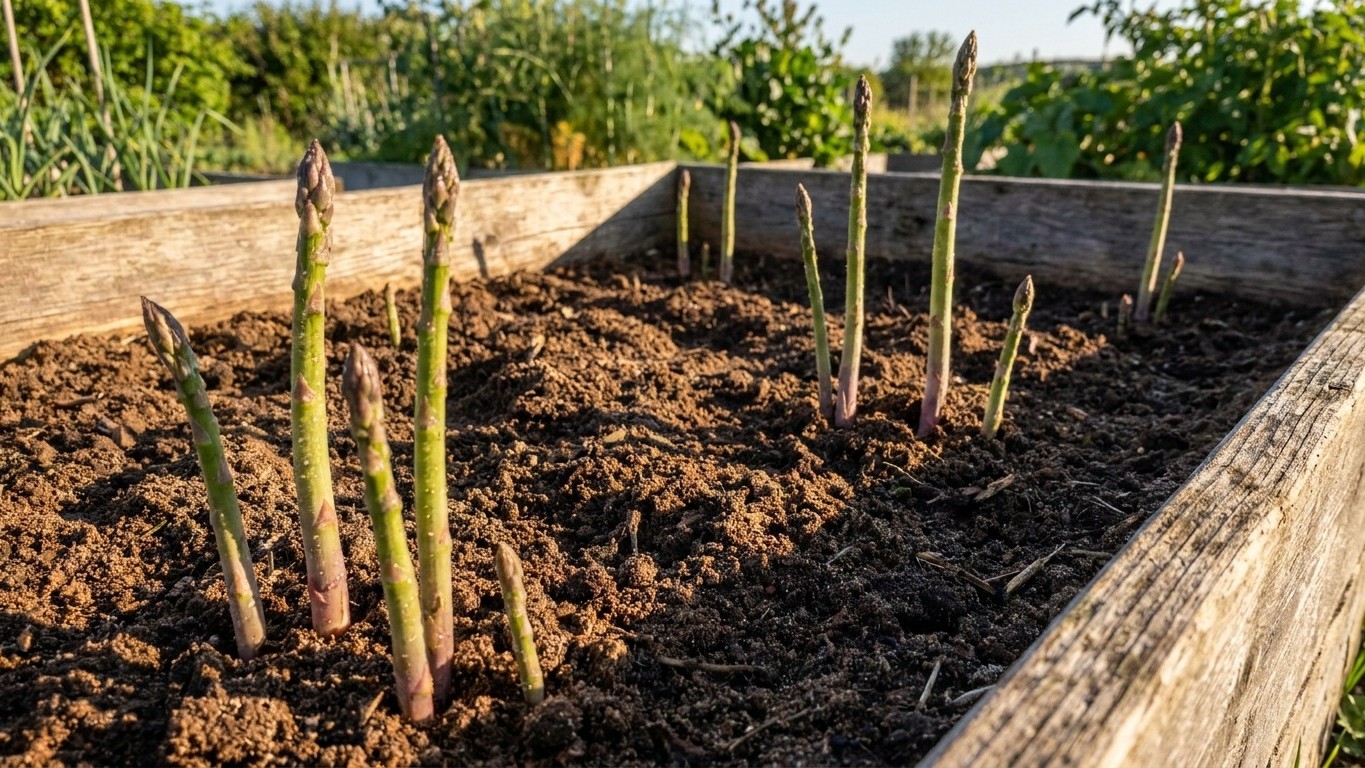

Asparagus in Texas gets chewed at two separate moments: when spears push up after the last spring freeze, and when the ferns fill out through the hot, humid summer. Which insects are involved changes from county to county. The Texas A&M AgriLife Extension Service county office is the place to get names. This guide covers what to look for, and when. For the bigger picture, see Growing Asparagus in Texas.
Which pests attack asparagus in Texas
The Texas A&M AgriLife Extension Service is the agency that documents garden insect problems across the state, and its county offices are where a named list for your county comes from. It helps to sort what might be feeding on a bed into three groups by how and where it eats.
The first group is chewing insects on spears and ferns. They take bites out of tips, scar the skin of spears, or strip the feathery foliage. The second is sap-feeding insects. They are small, usually clustered on the ferns, and they leave yellowed, sticky, or curled growth instead of holes. The third is soil-level feeders that work at night and cut or gnaw spears near the ground. In the heavy clay that represents Texas, the Houston Black series (54 percent clay, a soil that cracks open when dry), those cracks can give soil-level feeders a place to hide by day.
Plenty of insects turn up near an asparagus bed without eating it. Borers that tunnel into tree trunks, grubs that feed on lawn roots, and pests of fruiting vegetables such as tomatoes or squash all live in the same yard. They are looking for different host plants. Asparagus is a perennial with a crown and fern-like foliage, and those pests have no use for either. Finding one beside the bed tells you nothing about the bed.
The stakes depend on the age of the planting. Crowns go in as crowns, set in 8-inch furrows in early spring, and the rule is no harvest until year 3. For the first two seasons the ferns are the whole crop, since they feed the crown for the years ahead. After that the bed produces for 10 to 15 years. Fern damage in a young bed is therefore a bigger deal than the same damage in an established one, which has years of stored reserves behind it.
When each one shows up, and what it does first
Timing follows the freeze calendar. At the Houston reference station, the mean last spring freeze falls between February 4 and March 1, according to NOAA NCEI climate normals. That is the mild Gulf end of the state. The Panhandle freezes much later in spring, and Hill Country and North Texas differ again, A Houston window cannot serve as a Texas planting calendar. Even inside Houston, Hobby airport runs about two weeks milder than the airport used as the reference. Count from the last freeze where you garden. The page on when to plant asparagus crowns in Texas covers how that window moves around the state.
Spring: spears breaking the soil
The first thing you see is a damaged spear, not an insect. Look for ragged or notched tips, rough scarring along one side, or a spear cut off at ground level and lying beside its stump. Ragged tips point toward chewing feeders. A clean cut near the soil line points toward a feeder that works at night at ground level. Spears are tender and fast-growing, so damage shows up within days of emergence.
In an established bed, asparagus is not harvested until year 3, and then produces for 10-15 years. During those weeks, cutting often removes tender tips before much feeding happens. The end-of-harvest rule is an object: stop when most spears are thinner than a pencil. After that, let the ferns grow.
Summer: ferns in full growth
Once ferns open, the signs change. Chewing damage looks like stripped, thinned, or ragged foliage. Sap-feeding damage looks like yellowing or curling fern with small insects bunched on the stems, and sometimes a sticky film. Summer here brings about 14.6 inches of rain across June, July, and August at the reference station (6.0 in June, 3.77 in July, 4.84 in August), plus real heat. Fern that stays wet in humid air hides small insects well, so check the undersides of branches and the base of the stems.
In fall the ferns turn yellow on their own as the plant sends its reserves down to the crown. That is the normal end of the season. Yellowing across every fern at once in autumn is not an insect sign.
Telling the damage apart from everything else
Chewed-looking asparagus is not always eaten asparagus. Wind, hail, a harvest knife, dry soil, and wet soil can all produce damage that looks like insect feeding at first glance. The mistake is spraying for an insect before ruling those out. The table lays out the signs that separate them.
| What you see | Other possible causes | What settles it |
|---|---|---|
| Ragged or notched spear tips | Insect chewing, wind-whipped grit, a dull harvest knife | Irregular bites with insects or droppings nearby suggest feeding. Straight, clean cuts or scrapes on the windward side suggest mechanical damage. |
| Yellowing ferns in summer | Sap-feeding insects, too little water, too much water | Look for insects clustered on the stems. Then check the soil beside the bed: dry and cracked, or soggy and sticky. |
| Thin, spindly spears | A young crown, harvest past the pencil-thickness rule, crowding | Age of the planting and harvest history. No insect is needed to explain it. |
| Spots or lesions on stems and ferns | Fungal disease, favored by wet foliage | Defined lesions with a visible edge rather than bite marks. Extension can confirm. |
| All ferns yellowing in fall | Normal seasonal dieback | The whole bed changes at the same time, with no insects present. |
Water is the cause most often mistaken for an insect. A heavy, cracking clay soil can hold water for a long stretch after rain, and a crown that sits in it for weeks looks like a plant under attack. Press a finger into the soil beside the bed before blaming insects. The state soil is only a starting point, and your own bed may drain very differently, so the page on whether Texas soil will hold an asparagus bed for fifteen years is worth reading before you diagnose a drainage problem as a pest problem.
The signs above narrow things down. A fresh sample and a photo taken to the county extension office settle it.
What actually works here, and what is a waste of time
A physical barrier placed before the damage starts beats any treatment applied after it. Lightweight row cover over a young bed before spears emerge keeps chewing insects off the first flush of growth. In an established bed, cut spears often and cut them clean, since a spear left to open is both a snack and a hiding place.
Gradual backfilling helps too. The furrow gets filled in gradually across the year, never all at once. Leaving the furrow open for a stretch is intended, and you do not need to level it early to tidy up. Then, once the ferns yellow in fall and die back, remove them. Old fern litter gives insects a place to wait out the cool months.
Drainage is the other half of the story. A bed that stays wet stresses the crown, and a stressed plant is a weaker plant when insects arrive. Watering on a schedule instead of checking the soil is a common way to cause that stress in clay, particularly in a summer that already brings about 14.6 inches of rain. A rain gauge on your own plot tells you more than a regional average does.
What does not work is spraying blind. Treating the whole bed whenever something turns up kills the bystanders along with the problem, and it does nothing about damage that was never caused by an insect. Spraying during harvest has its own rules, and the product label governs what can be used on a crop you plan to eat. Only the county extension office knows what is currently approved in Texas, and it can match a product, if one is needed, to the problem you actually have.
Where to check this for your own county
Start with the Texas A&M AgriLife Extension Service and find your county office. County agents see what is actually in local gardens this season, and they can identify a sample in person.
Texas spans four USDA zones, and the Houston window quoted above is the mild Gulf end. A pest that is common near the coast may be absent in the Panhandle, and the reverse is equally true. Elevation, a river bottom, a slope, and ground a builder scraped or filled can all change what shows up in a bed.
When you go, bring a fresh sample in a sealed bag and a photo of the whole plant. Note when you first saw the damage, how old the planting is, and when the last rain fell. Do not treat anything before the office has looked at the sample. Your next step is a call to that office.
Common questions
Can I harvest spears while insects are feeding?
Not in the first two years. Before any harvest, ask the county office what can be used near spears you plan to eat.
Is insect damage worse in the first two years?
The damage is not necessarily heavier, but it matters more. Young ferns are the only source of energy for the crown, so losing foliage in a new bed costs more than the same loss in a mature one.
Does heavy clay make pests worse?
Clay does not attract insects, but it changes the conditions. Cracks can shelter soil-level feeders, and slow drainage stresses crowns. Your own soil may be quite different from the state soil, so a soil test and a look at how water drains after rain tell you more.
Are yellow ferns in fall a sign of insects?
Not when the whole bed yellows at once. That is the normal end of the season. Yellowing in summer, or on only some ferns, deserves a closer look at the stems and the soil.