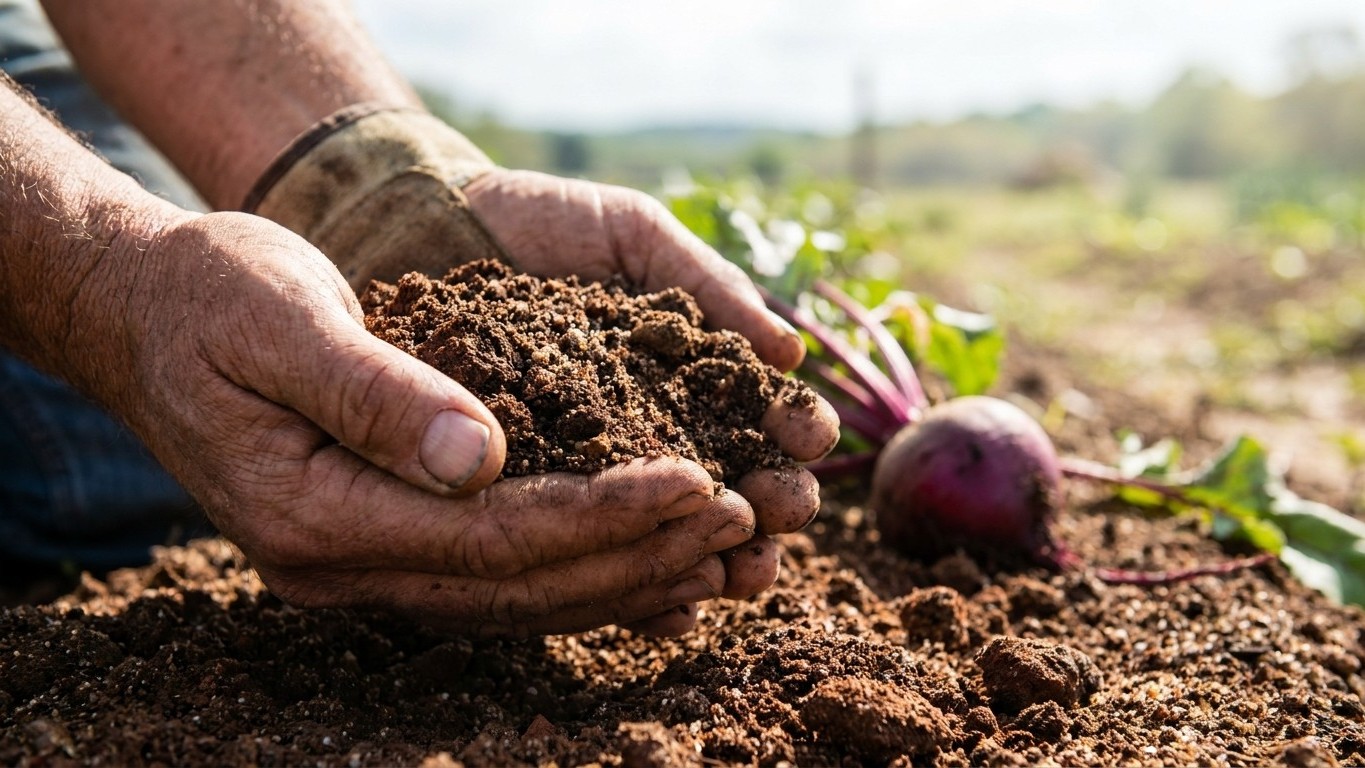

Texas’s representative soil is Houston Black, a heavy clay that cracks when dry and turns to glue when wet, alkaline and dense in a way that fights the deep, sandy, well-drained ground beets actually want. That mismatch shapes almost everything else: how you amend the bed, when you water, and which two failures, bolting or woodiness, you’re actually guarding against at any given point in the season.
The short answer
Texas’s official representative soil, the Houston Black series, is nothing like the loose sandy loam a beet root wants to push through. It’s a Vertisol, a shrink-swell clay that cracks into fissures when dry, then swells shut and turns to something close to wet cement after a rain. Surface pH runs around 7.9, solidly alkaline. Texture breaks down to 20 percent sand, 54 percent clay and 26 percent silt, with organic matter around 3.0 percent. Drainage is rated moderately well drained, which sounds reassuring until you remember that rating describes a soil that eventually sheds water, not one that lets a taproot glide through in the meantime.
Compare that to what a beet actually needs: deep, sandy, well-drained ground carrying decent organic matter, according to Utah State University Extension. The clay-versus-sand gap is the whole story here.
| Trait | What beets want | Houston Black series |
|---|---|---|
| Texture | Deep, sandy, well-drained | 20% sand / 54% clay / 26% silt |
| Drainage | Well drained | Moderately well drained |
| Surface pH | Not specified in the source | About 7.9 (alkaline) |
| Organic matter | Amend up to 1 inch per 100 sq ft | About 3.0% |
A beet root grown in soil that’s 54 percent clay doesn’t so much grow as fight its way downward, and the same clay that resists the root also resists a shovel. That’s why so many gardeners working Houston Black soil end up putting beets in a raised bed or a heavily amended trench rather than straight into the ground.
Heat plays a role too, though the exact number of days Houston spends above 90 F in a given year isn’t published in the sources behind this page. What is established is the mechanism: Utah State’s guidance on beets says heat above 85 F combined with water stress is what turns a root woody, and Houston’s hot stretch runs long by any measure. Heavy clay that’s slow to warm and cool evenly, paired with a long hot season, is the backdrop every Houston-area beet grower is working against.
None of this describes any single backyard with certainty. Texas carries hundreds of mapped soil series, and Houston Black is simply the one USDA lists as representative of the state, not a stand-in for whatever sits under a particular raised bed or side yard. A soil test is the only way to know what’s actually there. This is a starting point, not a verdict.
The six weeks that decide it here
Beets go into the ground directly, not as transplants, and the 60 to 80 days growers count toward harvest start on the day the seed goes into soil, not on any later date. Sow beets 2 to 3 weeks before the last frost, and in the Houston area that last-frost window falls between February 4 and March 1, based on 1991-2020 climate normals for the IAH station. That puts a typical sowing date somewhere in mid-January into mid-February, which means the first six weeks after seeding, the window Utah State University Extension flags as the one where water stress triggers premature flowering, lands squarely in late winter and very early spring here, not in the deep heat of summer.
That timing matters because it’s the water, not the heat, that decides bolting in those first six weeks. Houston’s late-winter stretch swings between dry, cool spells and sudden wet fronts moving in off the Gulf, and a bed of Houston Black clay makes both extremes worse: it can go from cracked and dry to waterlogged within days, and a beet root sitting through either extreme long enough reads that as the kind of stress that pushes the plant to flower early instead of building a root. The fix isn’t complicated, but it is a discipline: keep moisture in that clay steady through the first six weeks, rather than reacting after the fact once a dry crust has already formed or a rain has already pooled.
Two caveats are worth repeating. Texas spans four USDA hardiness zones, and the Houston frost dates above describe the mild Gulf Coast end of that range. The Panhandle freezes months earlier in fall and thaws months later in spring, and Hill Country and North Texas run their own separate calendars entirely. Even within Houston itself, Hobby Airport typically runs about two weeks milder than IAH, so a gardener working from a citywide “average” frost date is already working with a soft number. None of that changes the mechanism, water stress in the first six weeks causes bolting, but it does mean the calendar date attached to “six weeks” shifts depending on exactly where in Texas, or even where in Houston, the bed sits.
What goes wrong here
- Bolting from early water stress. Beets sown into a bed that swings between soggy and cracked-dry in the first six weeks after seeding read that swing as stress and shift into flowering instead of building a root. Keep moisture steady through that window rather than letting Houston Black clay dry to a crust between waterings.
- Woody roots from summer heat. A root that goes through water stress once temperatures climb past 85 F comes out fibrous and tough, per Utah State University Extension. This is a separate failure from bolting and shows up later in the season, so a bed that sailed through the first six weeks fine can still produce a woody harvest if watering lapses once real heat arrives.
- Roots that fight the clay instead of growing straight. With 54 percent clay in the surface horizon, Houston Black resists a taproot the same way it resists a shovel. Working a shallow layer of coarse sand or compost into the bed before sowing, staying under roughly 1 inch of composted organic matter per 100 square feet, gives the root a looser column to push through without swinging the bed’s fertility too far.
- Standing water after a heavy rain. “Moderately well drained” means water leaves the profile eventually, not quickly, and a Gulf Coast downpour can leave a flat bed sitting wet for days. Raised beds or ridged rows shed that water faster than a flat planting does.
- Over-amending a soil that’s already decent. Houston Black already carries about 3.0 percent organic matter, which is respectable on its own. Piling on more than the recommended inch per 100 square feet doesn’t speed up drainage and can throw off a balance the clay already holds.
Common questions
Do beets need acidic soil to grow well in Texas clay?
The Utah State University Extension guidance behind this page doesn’t specify a pH requirement for beets, so no claim can be made here about how well beets tolerate the roughly 7.9 alkaline reading typical of Houston Black soil. What the source does establish is the texture beets need: deep, sandy and well-drained, which the state’s representative clay is not.
How many days does it take beets to reach harvest?
60 to 80 days, and that count starts from the day the seed goes into the soil, not from a transplant date, since beets are grown from direct-sown seed rather than started indoors and moved out.
When should I actually sow beets around Houston?
Sow 2 to 3 weeks before the last frost. For the Houston area, that last-frost window runs from February 4 to March 1 based on 1991-2020 climate normals at the IAH station, which puts sowing roughly in mid-January to mid-February. That date shifts elsewhere in Texas: the Panhandle, Hill Country and North Texas each carry their own frost calendars, and even Hobby Airport within Houston tends to run about two weeks milder than IAH.
Does one beet variety handle Texas clay better than another?
The Utah State University Extension source names five beet varieties but provides no data distinguishing season, color, or use for any of them. Without that data, the more reliable move is matching the bed’s soil texture and moisture routine to what beets need generally, rather than picking a variety on the assumption it performs differently in clay.