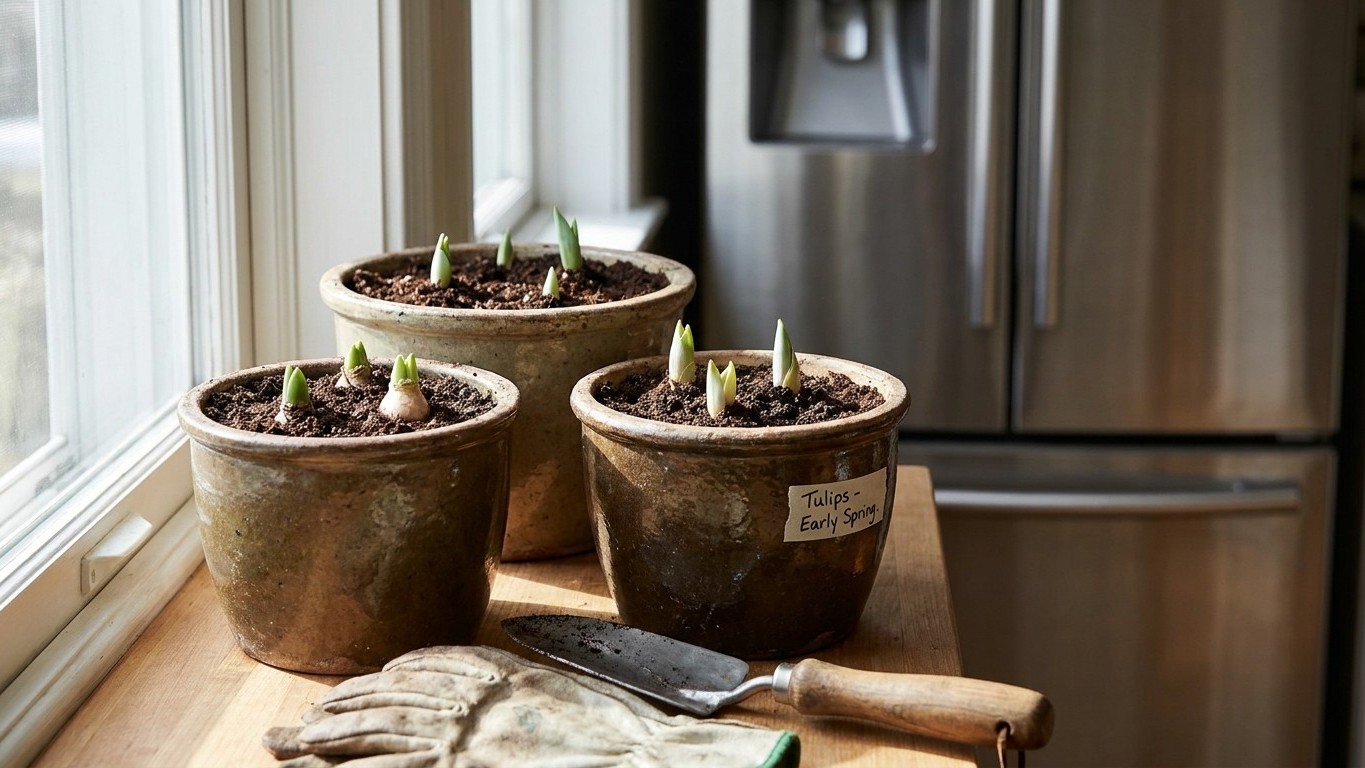

Container bulbs in Texas usually need help getting cold enough to bloom, since winters here rarely hand over the sustained chill spring bulbs expect. The fix is forcing: you supply the cold yourself, in a refrigerator or unheated space, rather than trusting the calendar. Containers add a second wrinkle, because a pot can freeze solid in weather that only skims the surface of garden soil.
Why this matters in Texas

Start with one number: 43.7°F. That’s the average daily minimum temperature during the coldest month at Houston, according to NOAA NCEI Climate Normals for 1991-2020. Not the record low, not a single cold snap, but the typical overnight floor across an entire month of winter.
A spring bulb like a tulip or hyacinth needs roughly twelve to fourteen weeks with temperatures staying below 45°F to complete the internal chemistry that turns a bulb into a flower stalk. Houston’s coldest-month average minimum sits just barely under that 45°F line, which tells you the margin is thin. A monthly average that close to the threshold means plenty of individual nights and days climb well above it, so the bulb never gets a clean, uninterrupted stretch of cold long enough to satisfy its chilling requirement. That’s the forcing situation: the ground isn’t going to do this job reliably, so the gardener has to.
Containers change the calculation again, in the opposite direction from what you’d expect in a cold climate. A bulb planted in open ground is insulated by the mass of surrounding soil; even where the top few inches freeze, the bulb itself often sits below the freeze line. A bulb in a pot has no such buffer. The container’s thin walls expose the root zone on every side, so a cold snap that leaves garden soil untouched can chill or kill the same bulb sitting in a pot on a patio. That’s why nurseries recommend treating a potted bulb as needing hardiness two zones tougher than what the tag says for in-ground planting.
Here’s the twist for this territory: the USDA Plant Hardiness Zone Map (2023 edition, built on 1991-2020 normals) places the state anywhere from zone 6a to zone 10a depending on where you stand. That’s a huge spread, and it means the freeze-through risk for a container is not the same in the Panhandle as it is near the Gulf. Houston, the reference point for the 43.7°F figure above, sits toward the warmer end of that range, which softens the pot-freezing danger somewhat, but doesn’t erase the chilling shortfall that makes forcing necessary in the first place.
How to do it here
The sequence below assumes you’re forcing bulbs in containers rather than relying on the ground to chill them, which is the situation the numbers above point to for most of this area.
- Choose bulbs suited to forcing before you buy anything. The next section names which ones tolerate the process and which ones don’t; skipping this step is the single most common reason forcing fails.
- Pot the bulbs shallowly in a container with real drainage holes, using a loose, fast-draining mix. Set bulbs close together, shoulders just at the soil surface, and water once to settle them in.
- Give the bulbs their chilling period of roughly twelve to fourteen weeks below 45°F. Since Houston’s own coldest-month average minimum barely dips under that mark, don’t count on an outdoor spot to deliver the full stretch reliably.
- Pick a cold space you can actually verify. An unheated garage works only if you’ve checked that it stays above freezing but still cold enough, meaning consistently under 45°F; a refrigerator drawer is more dependable, but keep it away from ripening fruit, since the ethylene gas fruit gives off can damage or abort the flower bud forming inside the bulb.
- Check the container’s cold tolerance if any part of the chilling happens outdoors. The rule of thumb is that a potted bulb needs hardiness roughly two zones tougher than the same bulb in the ground, or it needs to be moved into shelter and mulched heavily around the pot sides during any hard cold.
- Bring the pot into a cool, bright spot once the chilling period is complete, rather than straight into a warm, sunny window. Sudden warmth rushes the stem before it has grown tall enough to hold the flower properly.
- Move to full light and normal room temperature as shoots reach a few inches, watering regularly but not letting the pot sit in standing water.
Which bulbs are worth it
Not every bulb rewards the effort of forcing in a container, and the difference usually comes down to how much chilling the species evolved to expect and how tall its flower stem grows. A bulb with a short or nonexistent cold requirement forces fast and predictably; a bulb that naturally throws up a tall stem tends to flop over in a lightweight pot once the flower opens. It also helps to remember that many of these bulbs were never going to rebloom reliably in a Texas garden anyway, since they need a winter this climate doesn’t reliably provide, so treating them as a one-season purchase costs you nothing extra.
- Paperwhite narcissus, which need no chilling period at all and bloom a few weeks after potting
- Amaryllis, another bulb that skips the cold requirement entirely
- Hyacinths, which have a relatively short chilling need and a sturdy, compact flower stalk
- Crocus and miniature daffodils, both short-stemmed and quick to respond once chilling ends
- Tall, single-late or Darwin hybrid tulips, which need a long chilling stretch and grow stems that outrun a small pot’s stability
- Tall alliums, whose globe-shaped flower heads sit atop stems too heavy for the root mass a container can hold
- Gladiolus, which grows from a corm rather than a true bulb and simply gets too tall and top-heavy for indoor forcing
What goes wrong, and when you can still fix it
Leaves but no flower
This means the chilling period ran short. The bulb had enough stored energy to push out foliage but never completed the internal changes that trigger a flower bud. There’s no rescue this season; the bulb needs a full, uninterrupted chilling period next winter before it will bloom.
A flower on a stem too short to really see
This is what happens when the bulb gets moved into warmth too soon after chilling ends. The flower bud was ready, but the stem didn’t have time to elongate before blooming took over. Once that’s happened, the stem won’t lengthen retroactively; the bulb has already spent its stored energy on this year’s undersized bloom.
Rot in the pot
Soft, mushy bulbs almost always trace back to standing water, whether from a container without real drainage holes or a soil mix packed too dense to let excess moisture escape. A rotted bulb won’t recover this season and should be discarded rather than replanted. The fix belongs to next time: drainage holes that actually work, a loose mix, and watering just enough to settle the soil rather than saturate it.