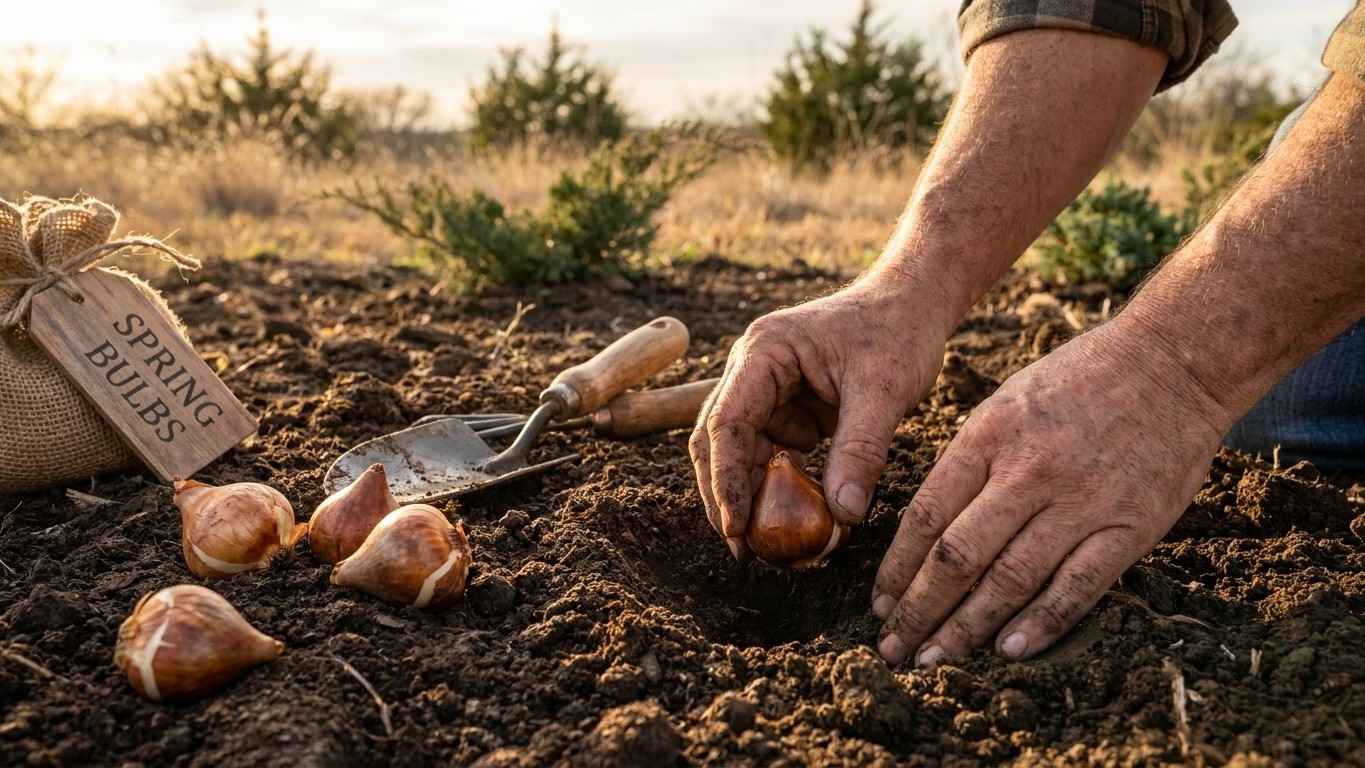

Texas gardeners lose more spring bulbs to weak winters than to bad soil or poor planting technique. The state’s mild Gulf Coast winters rarely deliver the sustained cold that tulips, hyacinths, and most daffodil varieties need to bloom. Some bulbs handle that shortfall fine. Others need twelve weeks in a refrigerator before they ever touch dirt.
When to plant bulbs in Texas

Spring bulbs go into the ground once the soil has cooled enough to signal dormancy, but before a hard freeze locks it up. For the Houston area, that means working backward from the average first fall frost, which NOAA’s 1991-2020 climate data pins between December 1 and December 19 at the IAH weather station. Aim to plant roughly six weeks ahead of that window, which lands most Houston-area planting in mid to late October.
Plant too early and the still-warm soil tricks bulbs into pushing top growth before winter arrives. That tender green growth then gets nipped by the first real cold snap, and the bulb wastes stored energy it needed for spring. Plant too late and the bulb goes into ground that’s already cold enough to stall root development. A bulb with weak roots either skips its bloom the first year or comes up short and thin, if it comes up at all.
An average frost date isn’t a promise
That December window is an average built from three decades of data, not a guarantee. Roughly half of all years bring frost earlier than December 1, and half bring it later than December 19. A gardener who plants exactly on the calendar date and assumes safety is gambling on the coin flip that built the average in the first place. Watch the extended forecast in late October and early November instead of circling one fixed date.
Houston’s frost timing also shifts inside the metro itself. Hobby Airport, closer to the coast, typically runs about two weeks milder than the IAH station used for these normals. A garden in the Heights and a garden near League City aren’t working with the same calendar, even though they’re both “Houston.” Statewide, the gap is far wider. The Panhandle sees its first freeze months earlier than the Gulf Coast, and Hill Country and North Texas fall somewhere between the two extremes. None of the Houston-anchored figures here apply north of the coastal plain.
Whether your winter is cold enough
This is the question that decides whether a Texas bulb purchase turns into a spring bloom or a leafy disappointment. Most classic spring bulbs, tulips and hyacinths especially, need twelve to fourteen weeks with soil temperatures below about 45°F to complete the internal chemistry that produces a flower stem. Skip that chill requirement and the bulb still sprouts leaves, because leaf growth doesn’t need the cold trigger. What it skips is the flower, or it pushes one up on a stem so short it barely clears the mulch. For gardeners without enough natural cold, Forcing Spring Bulbs Indoors in Texas offers a reliable workaround to satisfy that chill requirement artificially.
Houston’s coldest month, January, averages a mean daily minimum of just 43.7°F, according to NOAA’s 1991-2020 Climate Normals. That number sits barely under the 45°F chill threshold, and it only applies to a single month. The twelve to fourteen weeks a tulip needs would have to come from consistently cold nights stacked across most of the winter, not from one month scraping past the line. Houston simply doesn’t have that many cold weeks to offer.
That’s the whole crossing in one sentence: chill required versus chill available, and in Houston the ledger comes up short for anything bred for a northern winter.
| Bulb | Chill weeks required (below 45°F) | What Houston delivers | Verdict |
|---|---|---|---|
| Tulip | 12-14 weeks | Roughly one marginal month | Needs pre-chilling or grow as an annual |
| Hyacinth | 12-14 weeks | Roughly one marginal month | Needs pre-chilling |
| Trumpet/large-cup daffodil | 12-14 weeks | Roughly one marginal month | Leaves without flowers most years |
| Crocus | 8-15 weeks, varies by type | Falls short even at the low end | Unreliable without pre-chilling |
| Muscari (grape hyacinth) | 8-10 weeks | Close, but usually short | Marginal, better in a cool, shaded bed |
| Tazetta narcissus (paperwhite type) | 0 weeks | Not needed | Reliable, blooms without chilling |
Where the chill requirement isn’t met, pre-chilling is the only fix, and it has to be done properly. That means twelve weeks in a refrigerator crisper drawer, held near 40°F, and kept far away from apples, bananas, or any ripening fruit. Ripening fruit releases ethylene gas, and ethylene destroys the flower bud forming inside the bulb before it ever gets planted. A gardener who skips that step, or who chills bulbs in the same drawer as the weekly grocery run, has planted tulips that were never going to bloom. That’s not bad luck. That’s the chemistry working exactly as expected.
Which bulbs suit Texas
The bulbs that thrive in Houston without any refrigerator gymnastics are the ones bred, or native, for a short or nonexistent chill period. Their USDA hardiness ranges also happen to cover the Gulf Coast’s zone 9a-9b conditions comfortably, with room to spare.
- Paperwhite narcissus (zones 8-10): no chilling needed, blooms reliably, often the single most dependable spring bulb on the Gulf Coast
- Louisiana iris (zones 6-9): a native rhizome that treats Houston’s humidity as home turf
- Spider lily, Lycoris radiata (zones 7-10): fall-blooming, no chill requirement
- Rain lily, Zephyranthes species (zones 7-10): naturalizes readily in Texas lawns and beds
- Crinum lily (zones 7-10): large, long-lived bulbs that tolerate wet winters well
- Snowflake, Leucojum (zones 4-9): modest chill needs, generally fine in Houston’s mild winters
The bulbs that consistently disappoint here are the classic mail-order favorites: tulips, hyacinths, and most large-flowered daffodil cultivars. Their hardiness ranges (zones 3-8 for tulips and hyacinths, similar for trumpet daffodils) technically brush against Houston’s zone 9a edge, but that edge is where the failure happens, not where it’s avoided. The disappointment shows up as leaves with no flower stalk the first spring, or as a decent first-year bloom, since the bulb arrived already loaded with stored energy from a northern grower, followed by nothing but foliage in every year after. A wet Houston winter adds a second failure mode: bulbs that need dry dormancy can rot in soil that never really dries out between rains.
None of these hardiness lines are absolute. A tulip in a raised bed against a south-facing brick wall, with better drainage and slightly different microclimate, might eke out one more year than the same bulb in an open, low-lying yard. The range is a guideline, not a fence.
What digs them up here
Squirrels and voles don’t raid every bulb bed equally, and the pattern isn’t random. It comes down to chemistry. Daffodils and every bulb in the onion family carry compounds, calcium oxalate crystals and lycorine among them, that make them either toxic or simply unpleasant to a rodent’s palate. Tulips and crocus carry neither defense, which is exactly why they’re the bulbs squirrels dig up within days of planting.
- Bulbs squirrels and voles typically leave alone: paperwhite and other narcissus, spider lily, rain lily, crinum, snowflake, alliums
- Bulbs squirrels and voles typically dig up and eat: tulips, crocus
The good news for Houston gardeners is that most of the bulbs already recommended above, paperwhites, spider lily, rain lily, crinum, fall into the protected column. The two bulbs most at risk from rodents, tulips and crocus, are also the two that struggle hardest with the region’s weak winter chill. That’s one less reason to fight for them here.
For anything worth protecting anyway, wire mesh hardware cloth laid flat over the planting bed and left until the ground freezes is the one method that consistently works, because it’s a physical barrier rather than a taste deterrent. Repellent sprays, whether pepper-based or predator-scent products, wash off in the first good Houston rain and need constant reapplication to do anything at all.
Where to check for your own county
Every figure above, the December frost window, the 43.7°F coldest-month minimum, the zone 9a-9b range, comes from the Houston area specifically, using the IAH weather station as the reference point. Texas stretches across four separate USDA hardiness zones, from the Panhandle down to the Rio Grande Valley, and a planting calendar built for Houston can be off by three weeks or more once you cross into North Texas or the Hill Country.
The most reliable local check is the Texas A&M AgriLife Extension service and its county office network. County extension agents work with soil and frost data specific to their own area, not a statewide average, and they can confirm whether a particular bulb variety has a track record of blooming in that exact county. For anyone planting outside the immediate Houston metro, that local call is worth more than any statewide guide, this one included.