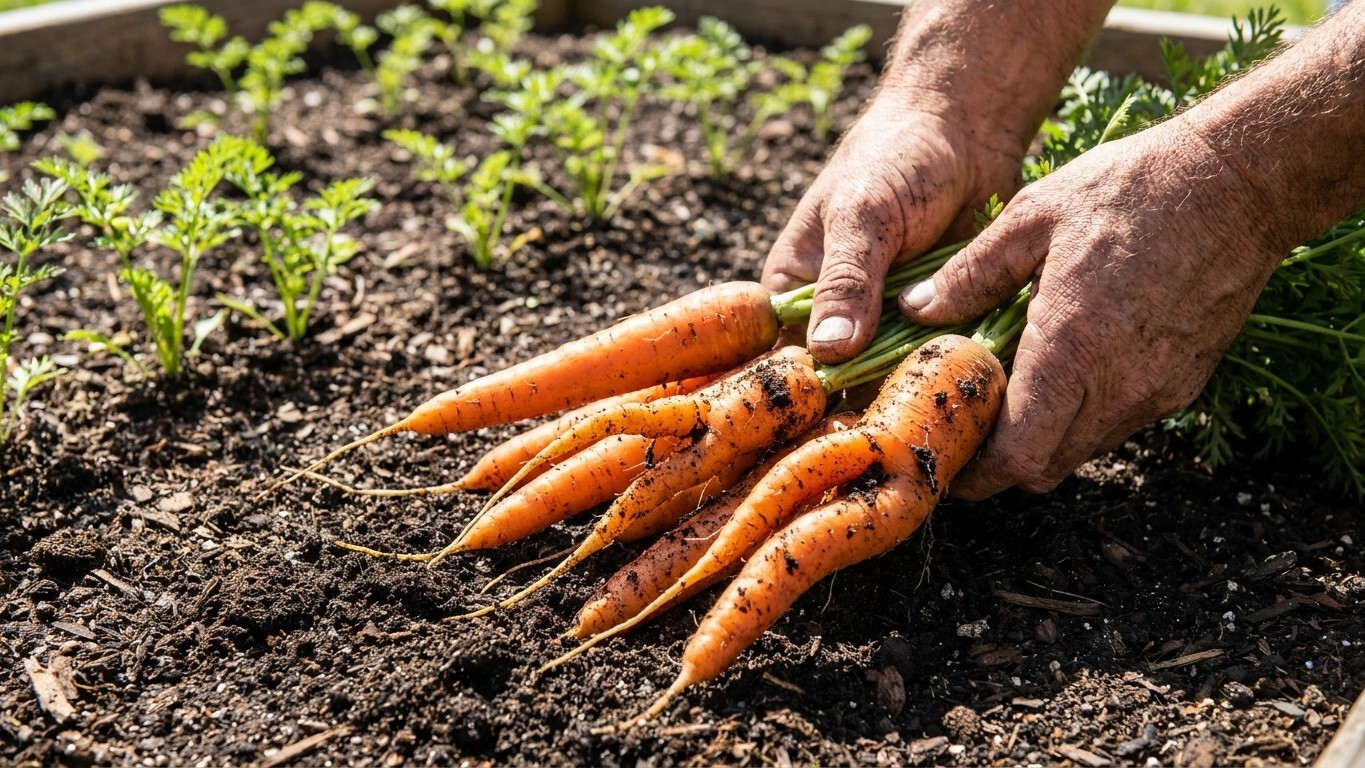

Count back 70 to 100 days from your local last spring frost date, and that’s when Texas gardeners sow carrot seed directly into the bed. There’s no transplanting with this crop, so every one of those days runs from the seed going into the soil, not from a seedling going into the ground. That’s the calendar half of the question. The harder half is whether the dirt under those seeds will let a straight, unforked root grow at all, and across much of Texas, that’s where the real planning happens.
The short answer
The soil USDA lists as representative of Texas is the Houston Black series, a Vertisol, which is a technical way of saying it’s clay that behaves like a living thing. It cracks open into wide fissures when it dries out, then swells shut and turns to something close to glue when it’s wet. Measured at the surface, Houston Black runs 20 percent sand, 54 percent clay and 26 percent silt, with organic matter around 3.0 percent and a surface pH near 7.9, solidly alkaline. Drainage is rated moderately well drained, which sounds better than it behaves in a wet spring, when that same clay can hold water at the surface long enough to rot a seed before it ever germinates.
None of that is friendly to a carrot. Carrots want deep, sandy, well-drained soil rich in organic matter, and heavy or rocky ground makes the root fork instead of running straight down, according to Utah State University Extension. Fifty-four percent clay is heavy ground by any definition, and a root trying to push through shrink-swell clay is going to hit resistance, split around a crack, or simply stop and thicken sideways. That’s not a variety problem. Utah State’s guidance is direct on this point: heavy soil needs plenty of compost and double digging, worked in well before the seed goes in, or the bed goes into a raised frame filled with a lighter mix from the start.
Say plainly what that means for a Texas gardener starting from scratch: if your ground behaves anything like Houston Black clay, expect forked, stubby roots unless you change the growing medium before you sow, not after you see the results. A raised bed 10 to 12 inches deep, filled with a sandy loam blend, sidesteps the clay problem entirely. Double digging a native bed and working in several inches of compost does the same job in place, at more labor and less certainty, because the clay underneath doesn’t disappear, it just gets diluted near the surface.
None of this is a diagnosis of your yard specifically. Texas spans hundreds of mapped soil series, from Panhandle silt loams to Gulf Coast sands to Hill Country caliche, and Houston Black is simply the one USDA names as representative of the state as a whole under the NRCS State Soils programme. Your own bed could be nothing like it. Treat this as the starting assumption you test, not the answer you act on blind.
The test that settles it in your own garden
State-level soil data tells you what to expect in general. It doesn’t tell you what’s six inches under your own carrot bed, and that’s the number that actually decides whether this year’s crop comes up straight or forked. A short dig settles it faster than any map.
- Pick a spot in the actual bed you plan to sow, not the edge of the yard, and dig a hole at least 12 inches deep with a spade or post-hole digger.
- Look at the sides of the hole as you go. Note where the color or texture changes, and how deep you can dig before you hit rock, caliche, hardpan, or a dense clay layer that resists the shovel.
- Pull out a handful of soil from the depth carrots will actually root in, roughly the top 8 to 10 inches, and check it for stones or chunks that a growing root would have to push around.
- Wet that handful slightly and rub it between your fingers. Sandy soil feels gritty and falls apart. Clay feels smooth, sticky, and holds a shape when you squeeze it into a ball. Loam sits somewhere in between and crumbles loosely.
- Fill the hole with water and time how long it takes to drain fully. Water still standing after several hours points to poor drainage; water gone within an hour or so points to a soil that moves water freely.
- Repeat in two or three spots around the bed if the yard has any history of grading, fill dirt, or construction, since disturbed ground rarely matches the surrounding native soil.
What you’re really looking for is whether that Houston Black profile, heavy clay, alkaline, slow-draining, shows up in your own dirt or not. If it does, plan on compost, double digging, or a raised bed before you sow. If your handful crumbles loose and sandy instead, you may already have close to what a carrot wants, and the Texas state average simply won’t apply to your particular corner of it.
What goes wrong here
- Forked, stubby roots in heavy clay. This is the direct result of soil like Houston Black, where 54 percent clay content and a shrink-swell structure block a taproot from running straight down. The fix Utah State University Extension points to is working in generous compost and double digging the bed before sowing, or skipping the native soil altogether with a raised bed filled with a lighter mix.
- Poor germination during a hot, dry stretch. Carrot seed is small and sits shallow, so it dries out fast once the surface bakes, and a clay soil that cracks open when dry (a known trait of Vertisols like Houston Black) can pull moisture away from the seed row even faster. Keeping the row consistently damp through germination, rather than watering heavily on a schedule, matters more than the calendar date on this crop.
- Cracked or split roots from uneven watering. Once carrots are established, a dry spell followed by a heavy soak makes the root swell faster than the skin can stretch, and it splits. Steady, even moisture through the growing season avoids the swing that causes it, which is harder to manage on clay soils that alternate between waterlogged and cracked bone-dry.
- Water sitting on the surface after rain. Even though Houston Black is rated moderately well drained, that clay-heavy texture can perch water at the surface long enough to rot seed or young roots in a wet spring. A raised bed or a worked-in layer of compost improves surface drainage without changing the clay underneath.
Common questions
Do I count the 70 to 100 days from sowing or from when the seedlings come up?
From sowing. Carrots are direct-seeded, and Utah State University Extension’s guidance treats the 70 to 100 days as running from the seed going into the ground, since there’s no transplant step on this crop to reset the clock.
Is the pH of 7.9 something I need to correct before planting carrots?
That figure is the surface pH USDA records for the Houston Black series specifically, not a universal number for every Texas garden. It’s a reasonable flag that many heavy clay soils in the region run alkaline, but the only way to know your bed’s actual pH is a soil test of that bed, not this state-level figure.
Will a raised bed really solve the clay problem, or does it just delay it?
A raised bed filled with a lighter, well-drained mix keeps carrot roots entirely out of the native clay for the depth they need to grow, which is usually enough on its own. The clay underneath doesn’t change, but the root never has to push through it if the bed is deep enough, generally 10 to 12 inches for carrots.
Can I skip the compost and just pick a shorter carrot variety instead?
Shorter, rounder varieties can reduce forking somewhat in shallow or rocky ground, but the underlying issue Utah State University Extension identifies is the soil itself, heavy or rocky ground causing the fork, not the variety. Compost and either double digging or a raised bed address the cause directly; variety choice is a partial workaround at best.