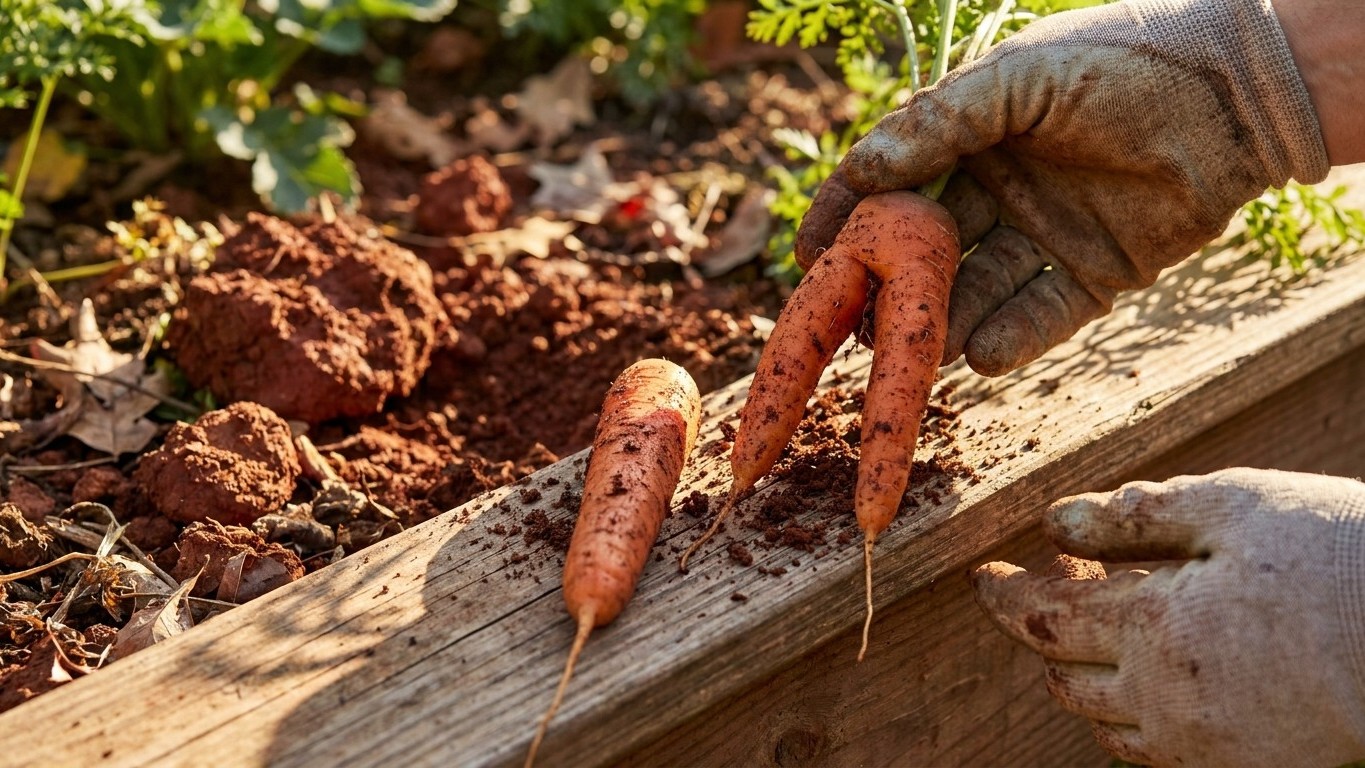

The straightforward answer: on Texas’s representative soil, yes, carrots are likely to fork unless the ground gets amended or the bed gets raised. That representative soil, the Houston Black series, is a heavy, alkaline clay that resists the clean, downward path a carrot root wants to take. Compost, double digging or a raised bed change the outcome, but only a look at your own dirt tells you which fix your garden actually needs.
The short answer
Texas’s benchmark soil, listed by USDA as representative of the state, is the Houston Black series. It runs 20 percent sand, 54 percent clay and 26 percent silt in the surface horizon, with organic matter around 3.0 percent and a surface pH near 7.9, solidly alkaline. It’s classified as a Vertisol, the shrink-swell clay family that cracks open into wide fissures when the ground dries out and swells shut into a sticky, airless mass when it rains. Drainage is rated moderately well drained, which sounds better than it feels underfoot after a summer downpour.
None of that works in a carrot’s favor. Utah State University Extension is direct about what carrots need: deep, sandy, well-drained soil rich in organic matter. Heavy or rocky ground makes the root fork, because the growing tip meets resistance and splits around it instead of pushing straight down. A clay this dense, with barely a fifth of its particle content in sand, is close to the opposite of what the crop wants. Add the cracking and swelling behavior of a Vertisol and you get a second problem on top of forking: roots that are shearing and re-knitting themselves as the ground moves underneath them through a wet-dry cycle.
The fix, per the same Extension guidance, isn’t a different carrot variety. It’s changing the ground. Heavy soil needs plenty of compost worked in and double digging, loosening and enriching the soil to a depth well beyond where a carrot root will travel, so the taproot has soft, uniform material to grow through instead of a wall of clay. For gardeners who don’t want to dig that deep into Houston Black clay, a raised bed filled with a lighter, sandier mix sidesteps the problem instead of fighting it season after season.
All of that comes with a real caveat. Houston Black is what USDA lists as representative of Texas soil, not a description of every backyard in the state. Texas spans hundreds of mapped soil series, and a garden in a river bottom, in the Hill Country, or on ground a builder has scraped and refilled can be entirely different from the state benchmark, sandier, rockier, better drained, or worse. Treat the numbers above as a starting point for what the region’s ground tends to do, hold water, run alkaline, crack when dry, not as a diagnosis of the bed you’re about to plant.
The test that settles it in your own garden
The state soil tells you what to expect from the region. It doesn’t tell you what’s actually in your raised bed or backyard plot. A short physical check does that.
- Dig a hole a foot or so deep where you plan to sow carrots, and look at what comes out. Note the depth before the soil changes color or texture, that tells you how much rooting room a carrot actually has before it hits something different.
- Check for stones and hard clumps in the excavated soil. Anything solid enough to deflect a growing root tip is a candidate for forking, the same mechanical resistance that heavy clay causes.
- Feel the texture by rubbing a moist handful between your fingers. Gritty means sand, slick and sticky means clay, and something in between, smooth but not sticky, points toward silt or loam.
- Squeeze a handful and watch what happens. Soil that holds a tight ball and stays stuck together behaves like clay. Soil that falls apart the moment you open your hand leans sandy.
- Watch how water drains. After a rain or a deep watering, look at the surface a few hours later. Standing water or a glossy, saturated look points to poor drainage; ground that darkens and dries evenly is moving water the way carrots need it to.
None of these steps require a lab, and none of them will hand you a precise percentage the way a soil test lab would. What they will tell you is whether your ground behaves like the region’s heavy clay benchmark or like something looser and better suited to a straight taproot. That’s the distinction that actually decides whether you dig deep, build up, or plant as-is.
What goes wrong here
- Forking in heavy clay ground. When the soil is dense and low in sand, like the 54 percent clay content of Texas’s representative Houston Black series, the root tip meets resistance and splits instead of growing straight. Utah State University Extension’s remedy is direct: work in plenty of compost and double dig the bed, or skip the digging altogether and grow in a raised bed filled with lighter soil.
- Cracking and shifting ground disturbing young roots. A Vertisol like Houston Black shrinks and cracks open when it dries, then swells shut when it’s wet. That movement can shear or displace a young carrot root that’s still trying to establish itself, on top of the forking risk the clay content already creates. Consistent moisture and a mulch layer reduce how wide those cracks open between waterings.
- Alkaline soil that doesn’t match what the crop was bred for. A surface pH near 7.9 is solidly alkaline. Amending with compost, which is naturally closer to neutral, nudges heavy alkaline ground toward a range where nutrients are more available to a developing root system, one more reason the compost-and-double-dig approach does double duty here.
- Splitting from uneven watering. Roots that dry out and then get soaked in a heavy rain expand unevenly, and the outer layer can split along the length of the carrot. A steady watering schedule, rather than long dry spells followed by a soaking, keeps growth even. This matters more, not less, in ground that already swells and cracks the way Houston Black clay does.
Common questions
Does every garden in Texas have this same clay?
No. Houston Black is the soil series USDA lists as representative of the state, but Texas contains hundreds of mapped soil series. A garden in sandy East Texas ground or a hill-country plot can differ completely from this benchmark. Use the state figures as a general expectation, then confirm with the physical checks in the test above.
Can I fix forking by choosing a different carrot type instead of amending the soil?
Utah State University Extension’s guidance points to soil preparation, not variety selection, as the fix for forking. Heavy or rocky soil is the stated cause, and compost plus double digging, or a raised bed, is the stated remedy.
How long until carrots are ready if I sow them in this soil?
Carrots are sown directly in place; there’s no transplanting step for this crop. Days to maturity are counted from the seeding date, not from any later planting event.
Is a raised bed really necessary, or is double digging enough?
Both are listed as valid responses to heavy soil in the Extension guidance, compost with double digging on one hand, a raised bed on the other. Which one makes sense depends on how deep the clay runs in your own ground, which is exactly what the dig-and-feel test above is meant to reveal.