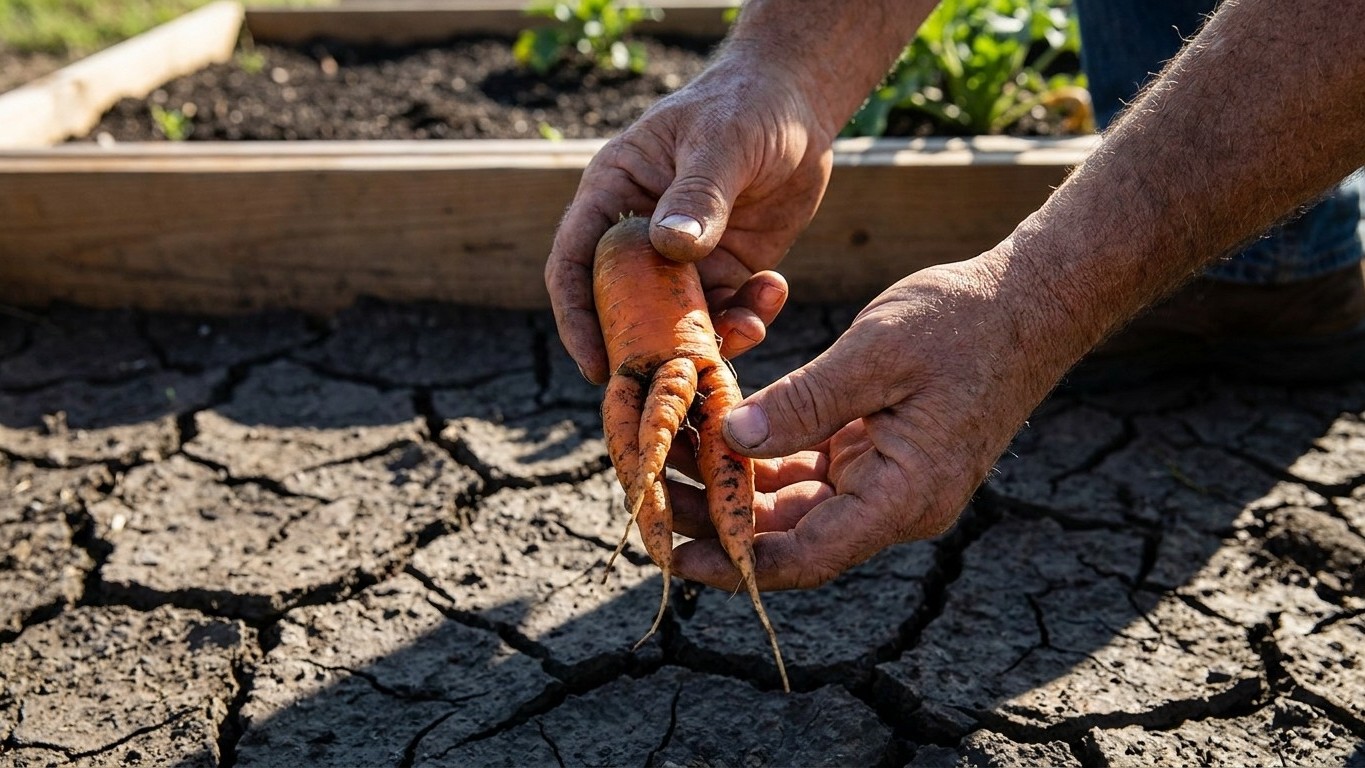

If you’re planting carrots in Texas, the soil under your boots is more likely to fight you than help you. The state’s benchmark soil is a heavy, alkaline clay that resists a straight taproot unless you change it first, either by loosening it deeply or building up instead of down. What follows is the mechanism behind that answer, plus the exact math for timing your sowing around frost.
The short answer
The soil that USDA NRCS uses to represent Texas is the Houston Black series, a Vertisol. That’s a shrink-swell clay that cracks open into fissures when it dries out and turns to a sticky, gluey mess when it’s wet. The surface horizon runs about 20 percent sand, 54 percent clay and 26 percent silt, with organic matter around 3.0 percent and a surface pH near 7.9, which is alkaline. Drainage is classed as moderately well drained, meaning water does move through it, just slowly, and unevenly as the clay swells and shrinks with the seasons.
That texture matters more than almost any other number on this page. Utah State University Extension is blunt about it: carrots want deep, sandy, well-drained soil rich in organic matter, and heavy or rocky ground makes the root fork. A soil that’s 54 percent clay is exactly the kind of ground that produces forked, stubby, or split roots, because the taproot hits resistance and either splits around it or stops growing straight down. This is the core of the question Will Carrots Fork in Texas Soil?, and the Houston Black series answers it plainly.
The fix isn’t a different carrot variety. Utah State University Extension names the remedy directly: heavy soil needs plenty of compost worked in, combined with double digging to break up the compacted layers below the surface. Digging down 12 to 15 inches and mixing in generous amounts of compost loosens the clay enough that a taproot can push through without hitting a wall. Where the clay is especially stubborn, or where a yard has been graded, filled, or compacted by construction equipment, a raised bed filled with a lighter growing mix sidesteps the problem instead of fighting it. Either approach works. What doesn’t work is sowing carrot seed straight into unimproved Houston Black clay and hoping.
None of this is a diagnosis of your particular yard. Texas covers an enormous range of ground, from Panhandle plains to Hill Country limestone to Gulf Coast river bottoms, and the state is mapped across hundreds of distinct soil series. Houston Black is what USDA lists as representative of Texas as a whole, not a measurement taken from your garden bed. Treat it as a starting point that tells you what to expect, then confirm it with your own hands and a shovel.
The test that settles it in your own garden
A state soil profile can only tell you what’s typical. Your own bed might sit on sandy loam left by an old creek, or on fill dirt trucked in when the house was built. The only way to know is to check it yourself, and none of the steps below require lab equipment.
- Dig a test hole. Go down at least 12 inches in the spot where you plan to sow. A shovel or a soil probe both work; what matters is getting past the top inch or two of topsoil that can look nothing like what’s underneath.
- Look at depth and stones. Check how far down the loose, workable soil goes before you hit dense clay, hardpan, caliche, or a layer of rock and rubble. Carrots need that clear depth to grow straight; a shallow layer over hard ground is a strong sign the root will fork or stop short.
- Feel the texture. Take a handful of moist soil and squeeze it. Clay holds its shape and feels sticky or slick. Sand falls apart and feels grainy. Loam sits in between, holding together loosely without turning into a slick ribbon between your fingers.
- Watch how water drains. Pour a bucket of water into the test hole and time how long it takes to soak in. Water that sits for hours points toward the same heavy, slow-draining clay the state series describes. Water that vanishes almost instantly suggests sandy, fast-draining ground that may need more organic matter to hold moisture instead.
Run through all four steps before you commit to sowing directly in the ground versus building a raised bed. The state soil profile tells you the odds; your own test tells you the reality.
When to sow here
Carrots are sown as seed directly in the ground, never transplanted, so every day of their 70 to 100 days to maturity is counted from the seed going into the soil, not from any later date. Timing that seeding correctly around frost is where a lot of Texas gardeners lose weeks without realizing it.
- Start from the local last frost window. For the Houston area, NOAA’s 1991-2020 Climate Normals put the last spring freeze between February 4 and March 1, based on station data at Bush Intercontinental Airport. That’s a real, measured window for that one location, not a statewide date.
- Count backward 2 to 3 weeks. Carrot seed goes in the ground before the last frost, not after it. Counting Back From a window of February 4 to March 1 lands sowing somewhere in the second half of January through the middle of February for that Houston station.
- Confirm soil temperature separately. The calendar math only works if the ground itself has warmed up. Soil needs to reach at least 40 F before carrot seed will germinate at all, and germination is best once soil sits in the 55 to 65 F range. Heavy clay warms more slowly than sandy ground in spring, so a bed built on Houston Black clay may lag behind the calendar date even after the air has warmed.
That arithmetic holds for the Houston station only. Texas spans four different USDA hardiness zones, and a Panhandle garden freezes on a completely different schedule than one along the Gulf Coast. There’s no single Texas planting date, and this page doesn’t have the frost data to hand you one for Amarillo, Lubbock, or Abilene. Check your own local frost window before you count backward from it.
What goes wrong here
- Forked or split taproots in heavy clay. Houston Black clay’s dense, 54 percent clay texture blocks a straight root exactly the way Utah State University Extension describes. Double digging 12 to 15 inches deep and mixing in compost before sowing, or switching to a raised bed with a looser mix, is the remedy, not a different carrot.
- Poor germination during a hot spell. Carrot seed germinates best between 55 and 65 F, and a Gulf Coast warm snap can push soil well past that range even in late winter. Watering lightly and often to cool the surface, and timing sowing to the cooler edge of the frost window, keeps germination from stalling out.
- Roots splitting from uneven watering. A Vertisol like Houston Black cracks open when it dries and swells shut when it’s wet, which means moisture around the root swings harder than it would in a more stable soil. Split roots follow when a dry stretch is broken by a heavy soak. A steady, even watering schedule, rather than occasional deep floods, keeps that swing under control.
- Slow drainage waterlogging the root zone. Moderately well drained still means water moves slowly through this clay. Beds that sit low or lack any slope can hold water long enough to rot a root before it matures, which is another argument for raised beds on the heaviest ground.
Checking this against your own county
Everything above starts from one representative soil series and one weather station near Houston. Your county’s actual ground, rainfall pattern, and frost dates can differ from both in ways this page can’t cover.
Texas A&M AgriLife Extension runs county offices across the state and is the right place to check both a local soil test and a planting calendar built around your own zip code rather than a Houston airport. Their site is at agrilifeextension.tamu.edu, and most county offices offer soil testing services directly or can point you to a lab. That test will give you an actual pH and nutrient reading for your bed, rather than the state-level figure used here as a starting point.
Common questions
Can I grow carrots in Houston-area clay without building a raised bed?
Yes, if you’re willing to double dig the bed to 12 to 15 inches and work in enough compost to loosen the clay before sowing. A raised bed is simpler and more reliable, but it isn’t the only route; it’s the one that skips the labor of reworking the clay in place.
Does a shorter or rounder carrot variety avoid forking in clay soil?
The facts behind this page don’t name specific varieties, so no variety claim can be made here. What’s established is that the fix for heavy, rocky, or compacted soil is improving the soil itself, through compost and deep digging or a raised bed, rather than swapping seed.
How do I know if my soil has warmed to 40 F without a thermometer?
There’s no reliable substitute for measuring it. A simple soil thermometer, pushed a few inches into the bed, is the only accurate way to confirm the ground has reached the 40 F minimum carrot seed needs before it will germinate.
Is there one sowing date that works across all of Texas?
No. The frost window used on this page comes from a single Houston-area weather station, and Texas spans four USDA hardiness zones with very different freeze schedules. A Panhandle garden and a Gulf Coast garden are working from entirely different calendars, so check your own county’s frost dates before counting backward to a sowing date.