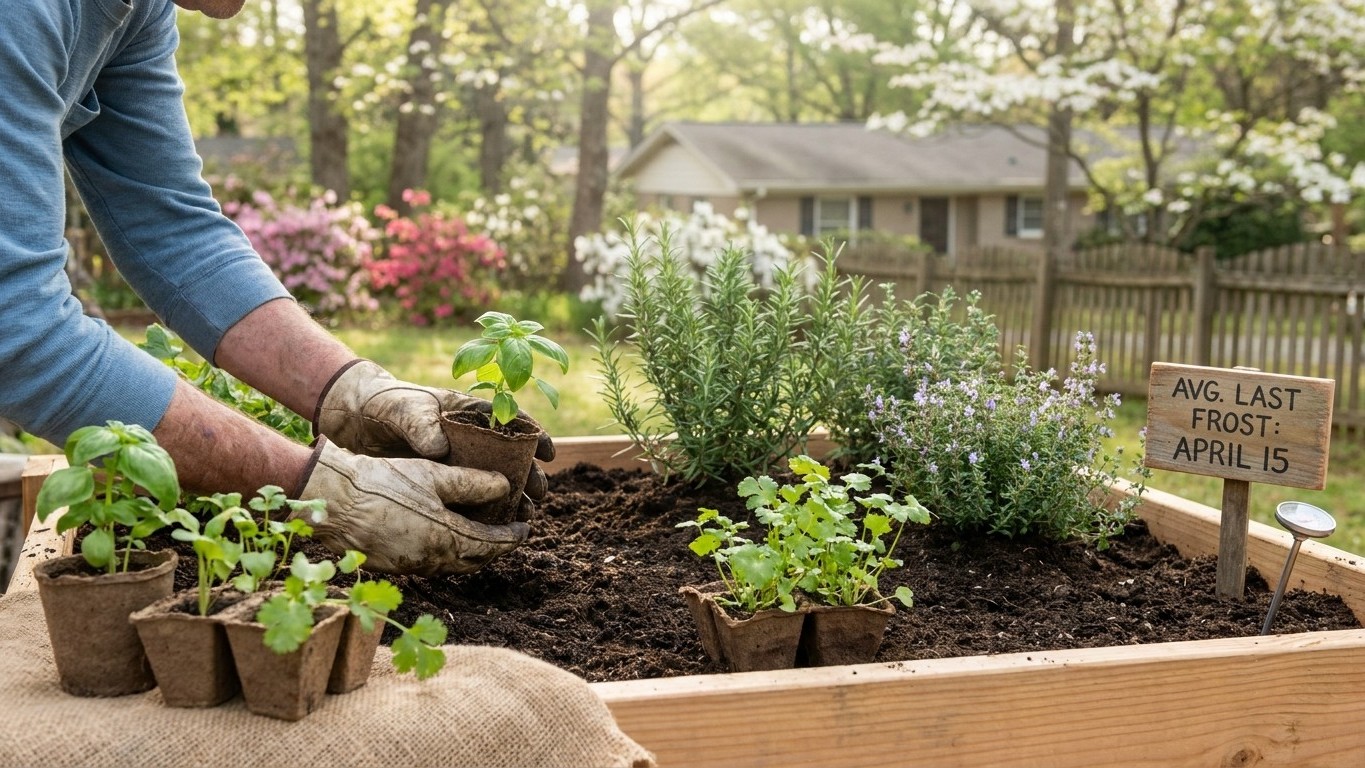

Using Houston’s official climate station (IAH) as the reference, the last spring freeze falls between February 4 and March 1, and the first fall freeze arrives between December 1 and December 19. Those two windows mark the frost-free stretch for warm-season herbs. But Texas stretches across four USDA hardiness zones, so a Panhandle garden and a Rio Grande Valley garden are working from entirely different calendars.
The short answer for Texas
For the Houston area, basil, tender annual herbs, and anything frost-sensitive go in the ground after March 1, and stay productive until roughly December 1. Those dates aren’t a promise, though. NOAA classifies them as a 30-70% probability band, meaning a freeze still has a real chance of happening on either side of that window. Planting basil on March 2 in Houston doesn’t guarantee safety; it just shifts the odds in your favor.
The coldest month’s mean daily minimum in Houston runs 43.7°F. That number matters more than most gardeners realize, because it’s not the record low and not a seasonal average. It’s the typical overnight low during the coldest stretch of winter, and it’s the figure that decides whether a woody perennial herb like rosemary or bay laurel can stay outdoors year-round without protection, or whether it needs to come inside or get wrapped on the coldest nights.
The hardiness zone picture for the state runs from 6a to 10a under the USDA Plant Hardiness Zone Map, a system built on a single variable: the average annual extreme minimum temperature. Houston itself sits toward the milder end of that range. That’s an important distinction, because a planting date built on Houston’s numbers describes the Gulf Coast, not the state. Even within Houston, Hobby Airport runs about two weeks milder than the IAH station used for these figures, which tells you something about how fast these numbers shift with local geography, let alone across five hundred miles of Texas.
Cool-season herbs work the opposite calendar. Cilantro, dill, and parsley prefer to go in during fall and winter in the mild Gulf zones, since Houston’s frost-free winter allows for outdoor harvest through the coldest months, while the same herbs sown in June would bolt within weeks under Gulf Coast heat.
What will not work here

A Houston garden doesn’t have a short-season problem. With frost-free stretches often running nine or ten months, the state’s mild end has the opposite issue: a long, brutal summer that defeats herbs and gardeners who aren’t prepared for it. Weekly watering, a habit that works fine in a milder, cooler climate, isn’t enough once daytime highs sit in the 90s for weeks at a stretch. Basil, mint, and parsley planted in full sun with a once-a-week soak will show scorched leaf edges and stalled growth by July.
Humidity creates a second failure point that a dry-climate planting guide won’t warn you about. Mediterranean herbs like oregano, thyme, and lavender evolved in dry, rocky soil with sharp drainage and airflow between plants. Crowd them together in Gulf Coast humidity, and powdery mildew or root rot shows up fast, especially in a wet spring. Wide spacing and raised beds with fast-draining soil matter more here than in a drier part of the country.
The coldest month’s 43.7°F mean minimum also rules out treating rosemary, bay laurel, or other borderline-hardy perennials as fully outdoor plants without a plan. That figure describes an average cold night, not the occasional harder freeze that still reaches the Gulf Coast in a bad winter. A plant rated for the mild end of the state’s zone range can still take damage when an outlier cold snap arrives outside the typical pattern, which is exactly what the 30-70% probability band is warning you about.
Basil deserves its own warning. It has zero frost tolerance, and the Houston data shows real freeze risk lingers into early March. Set it out in late February because a warm week showed up, and a return freeze in the probability band can wipe out the planting. The same applies at the other end of the season: a warm December doesn’t mean basil will keep producing, since even one light frost ends it for the year in most of the state.
What changes across Texas
A hardiness range of 6a to 10a is not a rounding error. It’s the difference between a Panhandle winter that regularly drops well below zero and a Rio Grande Valley winter that barely dips near freezing at all. There is no single planting date for Texas, and any calendar that offers one is quietly describing just one part of it.
North Texas and the Panhandle, toward the 6a-7a end, see their last spring freeze weeks to months later than Houston’s February 4 to March 1 window, and their first fall freeze arrives correspondingly earlier. A gardener there working from the Houston dates in this article would lose basil, tender cilantro starts, or newly set transplants to a freeze the Gulf Coast calendar never accounted for.
Central Texas and the Hill Country sit in a transitional band between those extremes, with their own freeze timing that doesn’t match either end of the state. South Texas, closer to the 10a end near the Rio Grande Valley, runs close to frost-free in most winters, which changes the entire approach to perennial herbs: rosemary, bay laurel, and even some tender basil varieties can behave as true perennials there instead of annuals.
None of this tells an individual reader which zone applies to their own address, and it shouldn’t. The USDA Plant Hardiness Zone Map is built for exactly that lookup, using zip code level detail that a statewide article can’t replicate. What this section can say is that the spread across Texas is wide enough that a planting date pulled from one part of the state is close to useless in another.
Where to check this for your own county
Texas A&M AgriLife Extension is the source built for this exact gap. State and regional data, like the Houston frost dates used above, describes the mild Gulf reference point. It doesn’t describe a specific county, and it was never meant to.
Two things are worth looking for once there. First, a county-level or regional planting calendar, since AgriLife’s county offices publish planting windows built from local weather station data rather than the single Houston reference used in this article. Second, look for herb variety trial results specific to that county’s growing conditions, since a rosemary or basil variety that thrives on the Gulf Coast’s humid, mild winters may not be the same variety recommended for a Panhandle county’s harsher freeze pattern or a Hill Country county’s thin, alkaline soil.
A county recommendation will always outrank a statewide one. The county extension office describes a specific piece of ground, with data collected from growers working that same soil and that same microclimate. When the two disagree, the local number wins.
Checking this against your own garden
Every date is a probability built from decades of station data, and none of it beats what’s actually happening in a specific garden on a specific week. Three signs are worth checking by hand before trusting a calendar over what’s in front of you.
Soil warmth by feel is the first and most reliable. Basil and other warm-season herbs germinate poorly in cold soil no matter what the calendar says; if the soil still feels cool and slightly damp-cold to the touch rather than warm through the day, seeds set now will sit and rot before they sprout, even on a date well past the average last freeze.
The first true leaves on a young seedling tell a different story. Herbs push out simple, rounded seed leaves first, then a second set that looks like the plant’s actual mature foliage. That second set showing up strong and unstressed, rather than pale or curled, is a sign the transplant timing matched the soil and air conditions well, regardless of what the probability band predicted for that week.
Bolting is the third signal, particularly for cool-season herbs like cilantro. A sudden flower stalk shooting up from the center of the plant means the herb has hit its heat threshold, a moment that can arrive earlier or later than any calendar date depending on how that particular spring or summer is running. Watching for it tells a gardener more about their own yard’s microclimate than any station average ever will.
If you follow the almanac, here is when to plant herbs by the moon. It is a tradition, not a proven method.