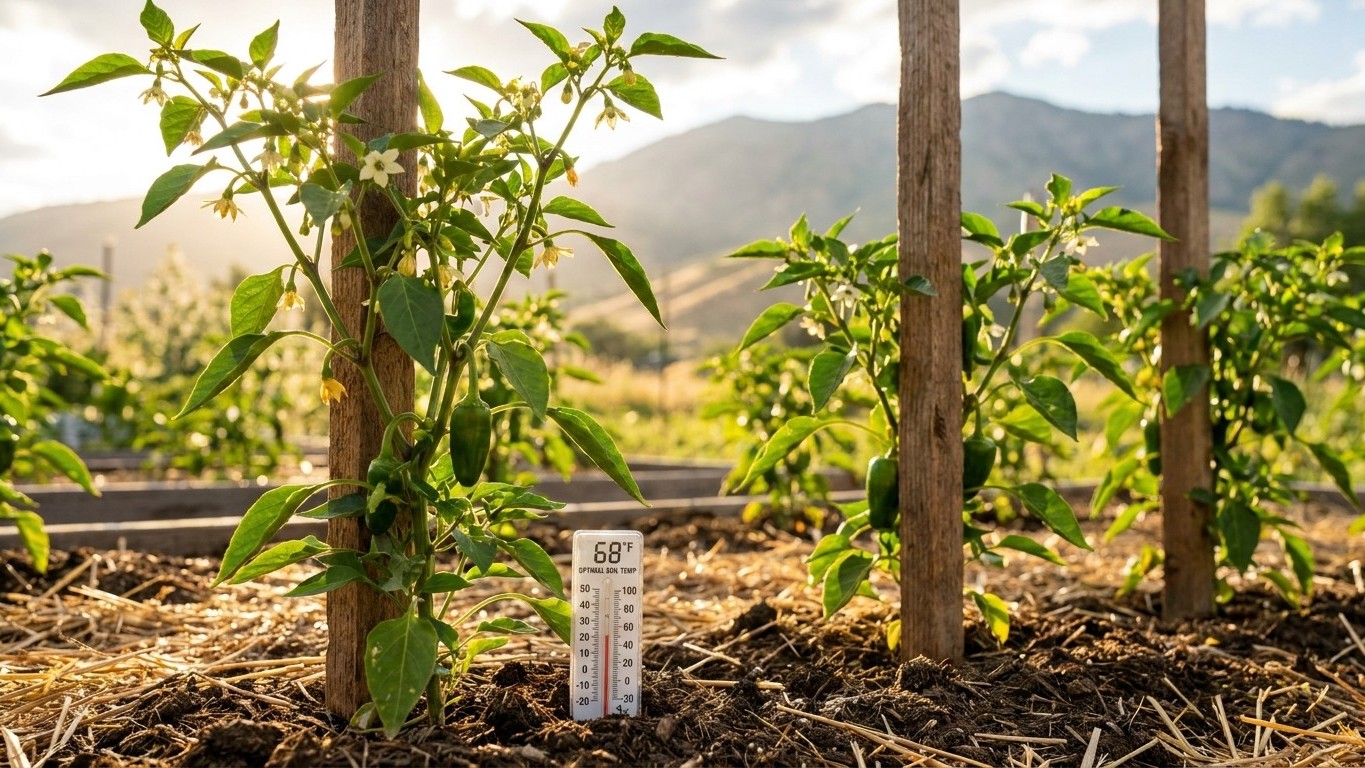

In Houston and along the Gulf Coast, peppers ripen reliably from spring transplant through early fall, but the same heat that pushes early fruit also shuts fruit set down in July and August. The fix isn’t a different plant, it’s timing: start early enough to catch fruit before the worst heat, and expect a summer lull before a second flush in September.
The short answer

Houston averages 102.4 days a year at or above 90 F, according to NOAA NCEI Climate Normals covering 1991 to 2020. That’s not a handful of scorching afternoons scattered across summer. That’s roughly a third of the year running hot enough to stall pepper fruit set, because pepper flowers drop their pollen viability once daytime highs push past that 90 F mark for stretches of days, not hours. A plant loaded with blossoms in June can look healthy and productive right up until it stops setting anything at all in mid-July, and the grower who doesn’t know why will often blame disease or a bad transplant when the real cause is just the thermometer.
Utah State University Extension frames this as a two-sided failure, not a one-sided heat problem. Pepper fruit set fails at both ends: nights below 55 F on the cool side, and days above 90 F on the hot side. Houston’s climate data answers the hot half of that equation clearly, with over a hundred days a year crossing the threshold. The cool half is a different story. This site carries daytime heat counts by location, but it does not carry summer night-time low temperatures for Houston or anywhere else. That gap matters more than it sounds like it should.
A grower in a river-bottom low spot, a shaded interior lot, or a spot near open water can see cooler overnight lows than a nearby weather station would suggest, and none of that shows up in a regional average. Latitude doesn’t settle it either. Two towns at the same latitude can differ by several degrees at night depending on elevation, tree cover, and how much pavement surrounds the garden. The only reliable move is to watch an actual thermometer at the planting site through late spring and again in early fall, rather than assume a number based on where the town sits on a map. Once nights settle above 55 F and before the daytime heat count climbs into its heaviest stretch, that’s the setting window for fruit. Miss it on either side, and the plant just holds blossoms it can’t turn into pepper.
Put together, the short answer is this: Houston’s growing season is long enough for two productive stretches, but the middle of summer is effectively dead time for fruit set, heat-driven and confirmed by over a hundred 90-plus days a year, with the cool-night side of the equation left for the grower to track locally rather than assume.
When to start seed here
The planting math for peppers works backward from the last frost, and Houston’s frost window itself needs a caveat before any of the arithmetic matters. Texas spans four separate USDA hardiness zones, and a Houston-area frost date is only useful for growers near Houston. The Panhandle freezes for months longer, the Hill Country and North Texas run their own separate calendars, and even within the Houston area, Hobby Airport tends to run about two weeks milder than the Bush Intercontinental (IAH) station the NOAA data is drawn from. With that boundary set, here’s how the count runs for growers near the IAH reference station:
- Start with the last spring frost. NOAA NCEI’s 1991-2020 Climate Normals, using 32 F freeze probabilities in the 30 to 70 percent band at station USW00012960 (IAH), place Houston’s last spring frost between February 4 and March 1. That’s the earliest safe outdoor date, not the seed-starting date.
- Confirm soil temperature separately from frost date. Utah State University Extension is specific that peppers transplant only once soil reaches 60 F, after frost has passed. Air can warm up well before soil does, especially in shaded or clay-heavy ground, so a soil thermometer checked at planting depth is the more reliable signal than the calendar alone.
- Count backward 8 to 10 weeks for indoor seed starting. That’s the window Utah State University Extension gives for pepper transplants to reach a size ready for the garden. Using the earlier end of Houston’s frost window, February 4, as an anchor, 8 to 10 weeks back lands seed-starting somewhere in late November to mid-December. Using the later end, March 1, lands it in late December to early January.
- Adjust the whole sequence for your actual county, not the Houston average. A grower in a colder pocket of Texas needs to slide every one of these dates later by however many weeks their local last frost lags behind Houston’s; a grower in a milder microclimate near the coast can sometimes nudge earlier, but only after confirming with their own soil thermometer.
This backward count is the same arithmetic any Texas grower can redo for their own county: find the local last frost date, add the time needed for soil to reach 60 F, then subtract 8 to 10 weeks for the indoor start. The Houston numbers above are a worked example, not a statewide calendar.
What goes wrong here
- Blossom drop from heat spikes. When daytime highs run above 90 F for several days running, as Houston averages 102.4 times a year, flowers open and drop without setting fruit. The plant isn’t sick; it’s simply outside its fertile temperature range. Once a heat spell breaks and highs drop back under that threshold, new blossoms set normally again, so the practical response is patience and continued watering rather than fertilizer changes or fungicide.
- Blossom drop from a cool snap. The same failure happens at the other end, when night temperatures drop below 55 F, which can occur in early spring after an unusually mild stretch, or again in early fall before the season fully closes. Because this site doesn’t track summer night lows for Houston, growers need a thermometer at the actual planting site during those transition weeks rather than an assumption based on the calendar or the region’s general reputation for warmth.
- Sunscald on exposed fruit. Gulf Coast sun is intense enough, especially reflected off pavement or bare soil, that fruit left without leaf cover can develop pale, papery patches on the side facing direct sun. Maintaining full foliage rather than aggressive pruning, and avoiding heavy leaf removal during the hottest stretch of summer, keeps fruit shaded without cutting airflow so much that disease pressure builds instead.
- Blossom-end rot from uneven watering. Houston’s combination of intense heat and heavy clay soils common across the region makes it easy to swing between drought stress and waterlogging, and that inconsistency interferes with calcium uptake at the fruit tip. Consistent, even soil moisture, rather than deep soaks followed by dry stretches, is the more reliable fix than adding calcium products directly to soil that’s already adequately supplied.
Common questions
Can peppers keep producing all summer in Houston?
Not continuously. With over a hundred days a year at or above 90 F, most Houston-area pepper plants go through a genuine mid-summer lull in fruit set, then resume once temperatures ease into early fall. Plants that look full of blossoms during that lull usually aren’t failing, they’re just waiting out the heat.
Why do my pepper plants look healthy but stop setting fruit?
The most common cause locally is a stretch of days above 90 F, which interferes with pollen viability according to Utah State University Extension. The less obvious cause is a run of nights that drop below 55 F, which this site doesn’t track for Houston specifically, so it’s worth checking an actual thermometer at your planting site before assuming heat is the only culprit.
How early can I safely transplant peppers in the Houston area?
Safety depends on two separate checks: frost and soil temperature. NOAA’s data places Houston’s last spring frost between February 4 and March 1 near IAH, but Utah State University Extension is clear that transplanting also requires soil to reach 60 F, which can lag behind the frost date depending on how quickly the ground warms that particular year.
Does this frost window apply across all of Texas?
No. This window is specific to the Houston area and drawn from the IAH weather station. Texas covers four separate USDA hardiness zones, and the Panhandle, Hill Country, and North Texas all run on different frost calendars entirely, some by months. Even inside the Houston metro, Hobby Airport tends to run about two weeks milder than IAH, so precision matters down to the specific location, not just the region.