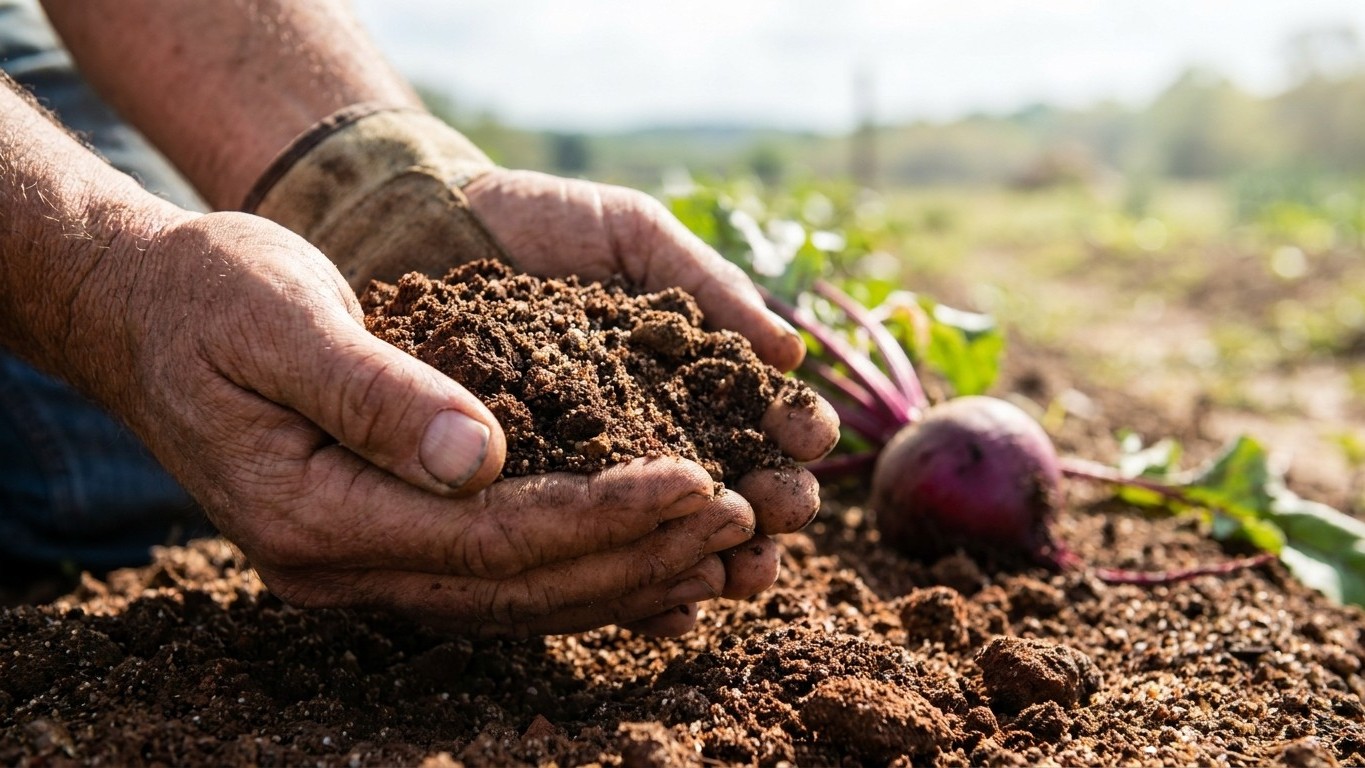

Utah’s benchmark soil, the Mivida series, is sandy and alkaline, draining fast and holding little organic matter. That combination gives beets the loose root run they want, but it strips away the fertility and the neutral pH they also want. The fix isn’t complicated: build organic matter carefully, watch water in the first six weeks after sowing, and treat any single reading as a starting point rather than a verdict on your own ground.
The short answer
The Mivida series is what USDA NRCS lists as representative of Utah under its State Soils program, and it tells a fairly blunt story. It’s an Aridisol, the classification given to soils that form in dry climates and that tend to run alkaline and carry salt. The surface horizon comes in at pH 8.1, meaning alkaline, with a texture of 72 percent sand, 9 percent clay and 19 percent silt. Organic matter sits around 1.5 percent. Drainage class is well drained.
Texture and drainage
Beets, according to Utah State University Extension, want deep, sandy, well-drained soil rich in organic matter. The Mivida numbers give you two out of three for free. Seventy-two percent sand and well-drained status mean water moves through fast and roots meet little resistance pushing down, which is exactly the loose run a beet root needs to size up straight instead of forking. But “rich in organic matter” is the part this soil doesn’t hand you. At 1.5 percent, there’s not much reserve of nutrients or water-holding capacity, so building that up with compost matters more here than it would in a heavier, richer soil back east. USU Extension’s guidance is specific on the dose: no more than 1 inch of composted organic matter per 100 square feet. More isn’t automatically better on ground this thin.
What the alkalinity and the heat add up to
A pH of 8.1 is on the alkaline side of what most vegetables prefer, and it can tie up certain micronutrients even when the fertility label says they’re present in the soil. That’s a separate issue from the heat question. USU Extension is clear that heat above 85 F combined with water stress is what turns a beet root woody. The specific count of days a given Utah location spends above 90 F in a typical year isn’t published in the data behind this page, so it isn’t stated here as a number. What can be said is that an Aridisol classification, by definition, describes a soil that forms under a dry, warm climate regime, and that alone is reason to plan for heat management (mulch, consistent watering, timely harvest) rather than assume it away.
None of this describes every backyard in the state. Utah spans hundreds of mapped soil series, and a river-bottom garden, a hillside plot or any yard a builder has graded and filled can differ completely from the Mivida numbers above. Treat this as the regional tendency, then pull an actual soil test for your own bed before you decide how much lime, sulfur or compost to add.
The six weeks that decide it here
USU Extension’s guidance to sow beets 2 to 3 weeks before the last frost puts the critical early stretch on a fairly predictable calendar, at least for one reference point. NOAA NCEI’s 1991-2020 climate normals put the last spring freeze at station USW00024127 somewhere between April 12 and April 29, based on the 30 to 70 percent freeze-probability band. That means a beet bed at that location, sown on schedule, spends its first six weeks somewhere in the stretch running from late March into early June, depending on exactly when the grower plants relative to that window.
Sowing window and elevation
That April 12 to April 29 range comes from one valley station, and it’s worth being blunt about what that means for the rest of the state. Salt Lake sits in a comparatively mild valley. Most of Utah runs higher in elevation and colder in spring, which pushes the safe sowing window later. Southern Utah runs warmer, which can pull it earlier. Nobody publishes a single statewide date, and this page doesn’t invent one; the April 12-29 figure is specific to that one station, not a state average.
Where the bolting risk actually sits
The mechanism that matters in those first six weeks is water, not temperature. USU Extension states plainly that water stress during that early window is what causes premature flowering, meaning the plant bolts instead of building a root. A sandy, fast-draining Aridisol like Mivida loses surface moisture quickly between waterings, and a spring that’s cooling off from a late freeze but hasn’t settled into a steady rain pattern is precisely the kind of stretch where a bed can go dry between checks without anyone noticing. The practical takeaway isn’t “keep it watered” as a vague gesture. It’s that the six weeks right after sowing are the specific window where a missed watering does damage that later care can’t fully undo, because the plant has already committed to flowering rather than root growth.
What goes wrong here
Given a sandy, alkaline, low-organic-matter soil and a dry spring climate, the same handful of failures show up again and again in Utah beet beds.
- Bolting from early thirst. Water stress in the first six weeks after sowing pushes the plant into premature flowering instead of root growth, per USU Extension. On fast-draining sandy ground, that stress can arrive quickly between waterings. The remedy is a watering schedule that doesn’t let the top few inches dry out during that early stretch, checked by hand rather than by calendar.
- Woody roots from later heat. This is a separate failure from bolting. Once temperatures climb past 85 F, water stress at that stage makes the root fibrous and tough rather than tender. The remedy is mulch to hold soil moisture and moderate soil temperature through the hot weeks, plus keeping the watering schedule steady rather than easing off once seedlings are established.
- Micronutrient lockout from alkaline pH. A surface pH around 8.1 can restrict how available certain nutrients are to the plant even when a fertility test shows adequate levels. The remedy is a soil test before adding lime or wood ash, and organic matter worked in over time rather than a single heavy amendment.
- Thin fertility from low organic matter. At roughly 1.5 percent organic matter, the soil holds less water and fewer nutrients than beets prefer. USU Extension’s remedy is composted organic matter worked in at no more than 1 inch per 100 square feet, repeated over seasons rather than dumped in all at once.
- Salt accumulation. Aridisols form under conditions that often leave salts in the profile. In a raised or contained bed, that can mean a slow buildup over repeated seasons of light watering. The remedy is deeper, less frequent watering that pushes salts down past the root zone rather than shallow watering that concentrates them near the surface.
Common questions
Do I start beets from seed or from transplants in Utah?
Beets are sown directly in place. The 60 to 80 day maturity window USU Extension gives runs from seeding, not from setting out a transplant, because beets don’t transplant the way tomatoes or peppers do.
When should I put beet seed in the ground?
USU Extension’s rule is 2 to 3 weeks before the last frost. At the NOAA NCEI station used on this page, that frost date falls between April 12 and April 29, but that’s one valley location; higher and colder parts of the state will run later, and warmer southern Utah can run earlier.
Why did my beets bolt before the root filled out?
That points to water stress during the first six weeks after sowing, which USU Extension identifies as the trigger for premature flowering. It’s an early-season problem, driven by inconsistent moisture right after germination, not a late-season heat issue.
Why did my beet root turn tough and woody?
That’s a different failure from bolting. USU Extension links a woody root to heat above 85 F combined with water stress later in the growing season, after the root has already started sizing up. Steady watering and mulch through the hot stretch address this specifically; they won’t fix bolting that already happened weeks earlier.