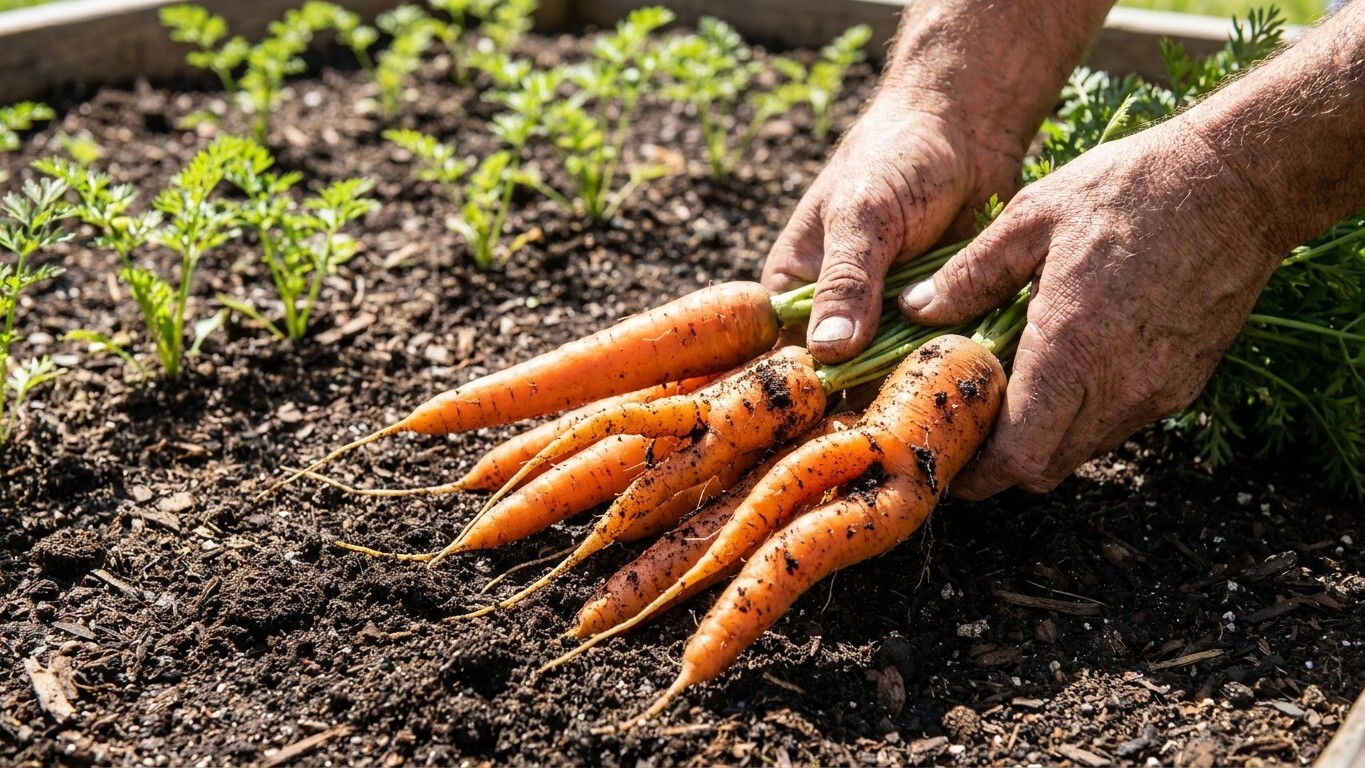

Utah gardeners can’t rely on one statewide sowing date because frost timing swings wildly with elevation, from valley floors that clear by mid-spring to mountain benches that stay frosty into early summer. What actually anchors the calendar is your own soil: how it drains, how fast it warms, and whether it holds enough structure for a straight, unforked root. Get that right first, then work backward from your local last-frost date.
The short answer
Utah’s representative soil, the one the USDA lists as the state’s benchmark series, is called Mivida. It’s an Aridisol, the kind of dry-climate soil that forms under low rainfall and tends toward alkaline, sometimes carrying salts near the surface. The surface horizon runs about pH 8.1, which is alkaline, and it’s built from 72 percent sand, 9 percent clay, and 19 percent silt. Organic matter sits around 1.5 percent. Drainage is classed as well drained.
For a carrot, that texture is mostly good news. Utah State University Extension is direct about what wrecks a carrot root: heavy or rocky soil makes it fork. A soil that’s three-quarters sand with only 9 percent clay isn’t the heavy, clay-bound ground that splits a taproot into two or three legs. Well-drained, sandy soil is close to what a carrot wants: deep, loose, and free of the resistance that turns a straight root sideways.
The catch is that 1.5 percent organic matter. That’s thin. Carrots want soil that’s rich in organic matter, not just loose, and a sandy soil with almost no organic content drains so fast it can starve young roots of moisture and nutrients between waterings. The fix Extension points to is straightforward: work in plenty of compost before sowing, and double dig the bed if you’re starting from unimproved ground, breaking up the top 12 to 16 inches rather than just the top few inches a trowel reaches. If your ground turns out to run heavier than this benchmark, a raised bed filled with a loose, sand-and-compost mix sidesteps the forking problem entirely, since you control the texture instead of fighting whatever the yard came with.
None of this is a diagnosis of your yard. Mivida is the series USDA names as representative of Utah under its State Soils program, but a single state spans hundreds of distinct soil series, and river-bottom ground, foothill ground, and anything a builder graded or filled behaves nothing like this benchmark. Treat these numbers as a starting point for what the region’s soil tends to do, sandy and alkaline and thin on organic matter, not as a reading of the bed outside your door.
The test that settles it in your own garden
- Dig a test hole. Pick the spot where you plan to sow carrots and dig straight down at least 12 inches. Carrots need that depth of loose ground to grow a long, unobstructed root, so this hole tells you immediately whether you’re working with soil or with a shallow layer over something harder.
- Check what’s in the hole. Look for rocks, gravel, chunks of construction debris, or a hard, compacted layer partway down. Utah State University Extension is clear that rocky soil is one of the two things that makes a carrot fork, so if your shovel keeps hitting stone, that’s your answer before you plant a single seed.
- Feel the texture. Take a handful of moist soil from a few inches down and rub it between your fingers. Gritty and loose means sandy. Sticky, smooth, and able to roll into a rope without crumbling means clay-heavy, the other condition Extension flags for forking. Somewhere between the two, with a bit of both grit and stickiness, is loam.
- Watch how water drains. Pour a bucket of water into the test hole and time how long it takes to disappear. Water gone within a few hours points to fast, sandy drainage. Water still standing after half a day or more points to a heavier soil that holds water near the surface, the kind that needs raised beds or heavy compost amendment before carrots go in.
- Match what you found to the fix. Loose, deep, well-draining soil with decent texture needs mainly compost to build organic matter. Rocky or clay-heavy soil, or a hard layer within that first 12 inches, needs double digging at minimum, and a raised bed if the problem runs deep.
What goes wrong here
- Forking in heavy or rocky ground. A carrot root pushing into clay-bound soil, or hitting a stone, splits into two or three legs instead of growing straight down. Utah State University Extension names this as the direct result of heavy or rocky soil. The remedy is working in generous compost and double digging the bed before sowing, or building a raised bed filled with loose, stone-free soil if the native ground is too compacted to fix in place.
- Poor germination during a hot, dry spell. Carrot seed is small and sits close to the surface, and in sandy, low-organic-matter soil like Utah’s benchmark series, that top inch can dry out fast once temperatures climb. Seed that dries between watering cycles simply won’t come up. Keeping the seedbed consistently moist until seedlings are established, with light, frequent watering rather than one deep soak, keeps germination on track through a warm stretch.
- Splitting from uneven watering. A root that grows through a dry spell and then gets hit with a heavy soak can crack open as it swells too fast. Fast-draining, sandy soil with thin organic matter is especially prone to these swings, since it holds little reserve moisture between waterings. Even, regular watering, rather than long gaps followed by a flood, keeps root growth steady and reduces splitting.
Common questions
Does Utah’s alkaline soil hurt carrots?
The state’s representative soil runs around pH 8.1, which is alkaline. Utah State University Extension’s guidance on carrots focuses on soil texture, deep, sandy, well-drained ground amended with organic matter, rather than a specific pH target, so no pH threshold for carrots is published here. If your soil test comes back strongly alkaline, working in compost helps buffer the extremes regardless of what number your test shows.
How many days from sowing to harvest?
Carrots are sown directly in place, there’s no transplanting step for this crop, so every day counted toward maturity starts from the seed going into the ground. Depending on variety, that runs roughly 70 to 100 days from seeding to harvest, according to Utah State University Extension.
Can I just plant by the calendar instead of testing my soil?
You can, but a calendar date tells you nothing about whether your ground will fork the root or starve it of moisture. Utah spans hundreds of distinct soil series, and the benchmark figures for the state’s representative soil describe a general tendency, not your yard specifically. A quick dig-and-feel test takes a few minutes and settles the question a calendar can’t.
What’s the single biggest soil fix for carrots in Utah?
Organic matter. The state’s benchmark soil sits at roughly 1.5 percent organic matter, which is thin for a crop that Utah State University Extension says wants soil rich in it. Working in compost before sowing addresses both the low organic matter and, in heavier pockets, the forking risk at the same time.