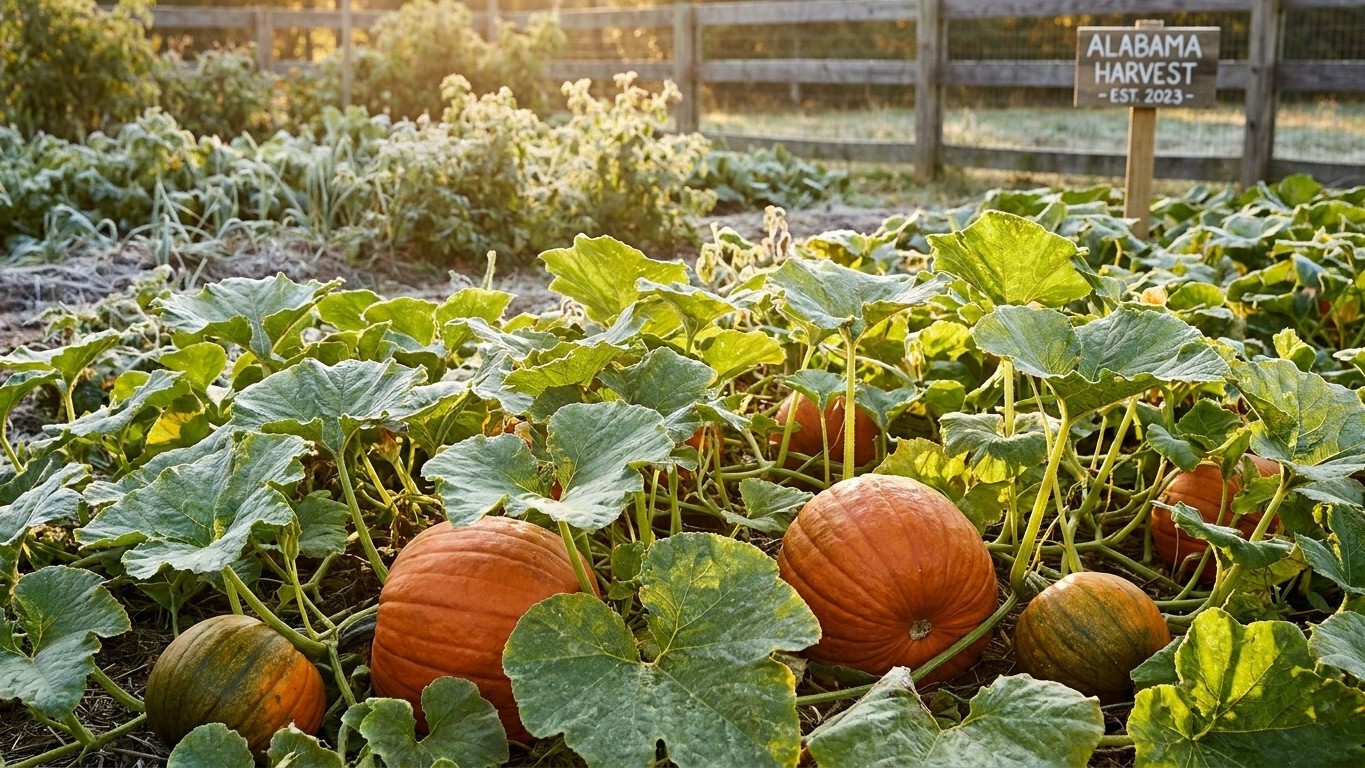

In the Salt Lake Valley, most pumpkins can Ripen Before Frost, but only if the flower that made the fruit opened by late August or, at the very latest, the middle of September. Miss that window and the fruit is still green when the first freeze shows up. Everything else about timing this crop, from when to sow to what can go wrong along the way, exists to get a flower open inside that narrow stretch.
The short answer
Salt Lake City’s first fall freeze lands somewhere between October 18 and October 29, based on NOAA’s 1991-2020 Climate Normals for station USW00024127 (https://www.ncei.noaa.gov/access/services/data/v1?dataset=normals-annualseasonal&stations=USW00024127). That eleven-day spread is the finish line for anyone racing a pumpkin patch toward harvest.
Utah State University Extension puts pumpkin maturity at 45 to 55 days after the flower opens, not from the day seed goes into the ground. Count backward from the frost window and the deadline narrows fast. If frost holds off until October 29 and a particular fruit only needs 45 days, the last flower can open as late as September 14. If frost arrives on the early side, October 18, and the fruit needs the full 55 days, that flower had to open by August 24. Somewhere inside that stretch, roughly the turn from August into September, sits the real cutoff for this valley.
That’s close to a three-week swing, driven by two things no gardener sets in advance: which end of the frost window the season actually lands on, and which end of the 45-to-55-day range a given fruit needs. A flower open by August 20 is safe under almost any scenario the valley throws at it. A flower that opens closer to September 20 is betting on a late frost and a fast-finishing fruit, and that’s not a bet the numbers favor.
Elevation and location shift the dates without changing the mechanism. Salt Lake City sits in a comparatively mild valley; benches, canyons, and higher towns elsewhere in Utah see frost weeks earlier, which pulls the flowering deadline forward. Southern Utah runs later, with more room on the calendar. The 45-to-55-day clock from flower to harvest stays fixed. What moves is the date it has to start.
None of this concerns the earlier weeks, when a vine is only leafing out and setting its first blossoms. What matters for the frost calculation is the pollination date on the fruit that’s actually headed to harvest, since a healthy vine keeps throwing new flowers long after the ones that will make it to the porch have already been pollinated.
When to sow here
Working backward from a flowering deadline only helps if the sowing date lines up with it, and in this valley two dates get confused constantly: the last spring frost, and the day soil is actually warm enough for pumpkin seed.
- Start with the last frost window. NOAA’s Climate Normals put Salt Lake City’s last spring freeze between April 12 and April 29. That date marks when the air stops threatening seedlings. It says nothing about the ground.
- Wait for the soil, not the calendar. Utah State University Extension calls for soil at 65 F before sowing pumpkins, and soil warms well after the air does, sometimes by weeks, because the ground holds onto cold long after the last frost has passed and the days feel warm again. Treating April 29 as sowing day, instead of the day a soil thermometer actually clears 65 F, is one of the more common ways a Utah pumpkin patch falls behind before it even starts.
- Use row cover to close the gap. Floating row cover over the bed can buy roughly two weeks, warming soil faster than open air alone would manage. For a gardener trying to get a flower open by the end of August, two weeks recovered in May can be the margin that makes the whole season fit.
- Track the calendar forward from sowing, not only backward from frost. Once seed is in warm soil, the plant still needs time to grow, run vine, and open its first female flowers, the ones that actually set fruit. The 45-to-55-day maturity clock doesn’t start at sowing, but everything between sowing and flowering decides whether a flower opens early enough to matter.
- Reassess by mid-summer. If female flowers haven’t opened by the point where 45 to 55 days stacked against the frost window starts looking tight, that’s the moment to decide whether the vine keeps setting new fruit or focuses everything it has on what’s already pollinated.
What goes wrong here
The gap between a Utah growing season and a pumpkin’s full clock is where most of the trouble shows up. A few failures repeat every year.
- A late flower that never colors. A blossom opening in mid-September, chasing the tail end of the maturity window, often leaves behind a fruit that’s still green and hard when frost arrives. The fix happens upstream: once the calculated flowering deadline has passed, pinch off new blooms so the plant stops spending energy on fruit with no real chance and puts it instead into the pumpkins already set.
- A fruit caught by frost before harvest. Even a pumpkin that’s colored up can sit exposed while a gardener waits for a little more size or a fully hardened stem, and a freeze landing anywhere in the October 18 to October 29 window can catch it there. Utah State University Extension’s guidance is to harvest with the stem attached before frost arrives, then move the fruit somewhere it will not freeze, rather than gambling on a few extra days on the vine.
- A vine that dies back before the skin hardens. Vines weakened by pests, including the ones covered on this site’s squash bugs and cucumber beetles pages, can collapse weeks ahead of frost, leaving fruit to finish without leaf cover or any more sugar coming from the plant. Once a vine is compromised, cutting the fruit free with a long stem attached and curing it somewhere warm and dry, out of frost’s reach, is the only move left. There’s no reviving a collapsed vine mid-season.
Common questions
Can pumpkins still be sown in July in the Salt Lake Valley?
It depends on how quickly that particular vine reaches its first female flowers, a timeline Utah State University Extension doesn’t publish as a fixed number of days. What’s known is the frost window, October 18 to October 29, and the flower-to-harvest math, 45 to 55 days. A July sowing leaves less room for a slow-starting vine to open its flowers before the safe window closes, at the latest, around September 14.
What happens if a pumpkin doesn’t turn orange before frost?
Extension guidance is to harvest before frost regardless of color, cutting with the stem attached and storing the fruit somewhere it will not freeze. Whether a green fruit continues to color once it’s off the vine isn’t addressed in that guidance, so that detail isn’t published here.
How long can a pumpkin stay on a dead vine before it has to come off?
No specific number of days is published for this. The guidance that does exist is straightforward: once the vine is gone or frost is close, cut the fruit with its stem attached and move it out of the cold rather than waiting.
Where should harvested pumpkins be stored to keep them from freezing?
Utah State University Extension’s instruction is simply to store pumpkins where they will not freeze. No storage temperature, humidity level, or keeping time is given in that guidance, so a cool, dry space clearly above freezing, an unheated garage or a shed away from an exterior wall, fits the letter of what’s published without adding numbers that aren’t there.