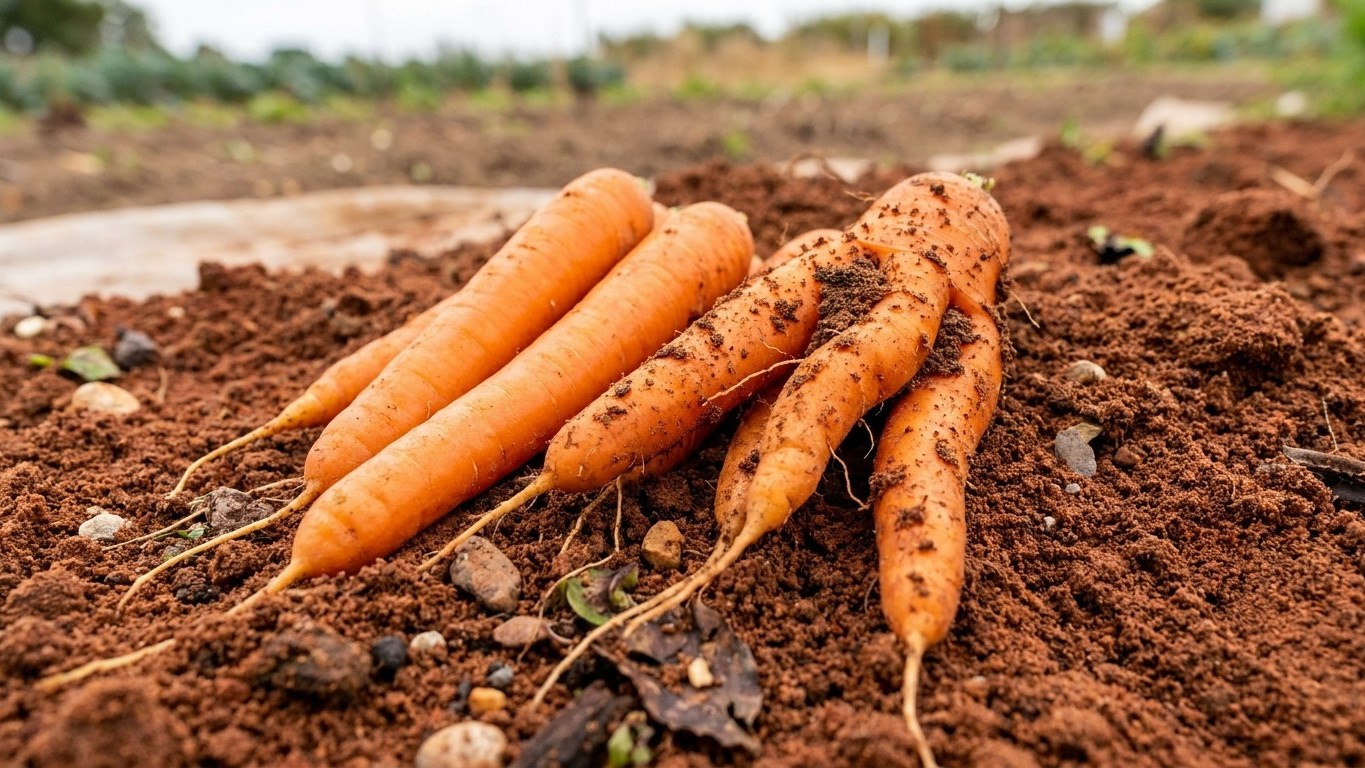

Pull carrots once the roots reach the size the seed packet promises, usually 70 to 100 days from seeding, and before the ground freezes hard. A light fall frost does them no harm. Cut the tops off right away, then keep the roots just above freezing and humid. Trimmed and kept that way, sound carrots can last for months. Leave the tops on and you get about two weeks.
How do you tell when carrots in Vermont are ready to pull?
Carrots are sown in place and never transplanted, so the count starts the day the seed goes into the row. Slow, cool spring soil stretches germination, and the packet’s day count already assumes you started from seed. Most of the swelling happens in the last few weeks. A carrot pulled early is smaller and less sweet, even though the tops look full.
How many days do carrots take from seeding?
Packets for carrots commonly run 70 to 100 days from seeding, depending on the variety. Clemson Cooperative Extension says to harvest about 65 to 75 days after planting, which sits at the quick end of that range. Cool northern summers tend to push a row toward the longer end. A row sown in late spring is usually ready in late summer, and a later sowing can stay in the ground well into fall.
What does a ready carrot look like?
Brush the soil back from one shoulder, the top of the root where the leaves join. When the shoulder is about as wide as the packet describes, the row is ready. The tops should be full and dense, and the color deep right up to the crown. Roots left far too long can split, especially when heavy rain follows a dry spell.
Does Vermont soil change how you pull?
Utah State University Extension says carrots want deep, sandy, well-drained soil rich in organic matter. Heavy or rocky ground makes the root fork. Vermont’s state soil is the Tunbridge series, a sandy, acid, strongly leached Spodosol that drains well. USDA records the surface layer at 79 percent sand and 21 percent clay, with 0 percent silt, a pH of about 3.5, and organic matter near 75 percent. That organic figure describes a natural forest-floor layer, which a cultivated bed will not have.
That soil represents the state. It is not a diagnosis of your garden, because river bottoms, hill country, and any ground a builder has scraped or filled can be completely different. A jar test settles it at home. Fill a straight-sided jar a third full of soil, add water, shake hard, and let it settle. A lot of clay means forking, and the fix is a raised bed or double digging with plenty of compost. A soil test through your extension office gives you the real pH, which is likely nowhere near 3.5. More on Will Carrots Fork in Vermont Soil?
When the row is ready, loosen the ground beside it with a garden fork and pull by the tops. Look at each shoulder as it comes out. Tunnels or scars mean a pest got there first, and those roots rot first in storage, so eat them soon. Pests are covered in What Eats Carrot in Vermont, and When, and the full season is in Growing Carrots in Vermont.
Keeping them, and for how long
Clemson Cooperative Extension’s Home & Garden Information Center gives the storage rule in a single line: store carrots at 33 °F and high humidity to prevent wilting (Clemson Home & Garden Information Center). That is just above freezing, colder than any cellar in early fall. A carrot is mostly water, and in dry air it loses that water and goes rubbery. Held at 50 °F, carrots sprout and soften in a fraction of the time they would last cold.
The same source says bunched carrots, meaning plants with the tops still on, can be stored for about 10 to 14 days. Treat that as a maximum under ideal cold and humidity. A warmer spot or a dry one shortens it, and a root with a nick or a pest tunnel gives out sooner.
Why do you cut the tops off first?
The leaves keep drawing moisture out of the root after it leaves the ground. The tops wilt and the carrot goes limp underneath them. That is why bunched carrots last only a couple of weeks while trimmed ones keep for months. Cut or twist the tops off at the shoulder, leaving a short stub. Brush off loose soil and leave the roots unwashed until you cook them. Sort out any damaged roots, since one rotting carrot spreads to its neighbors.
| Condition | What to expect |
|---|---|
| Tops on, 33 °F, high humidity | About 10 to 14 days (Clemson) |
| Tops cut, 33 °F, high humidity | Far longer, up to several months at best |
| Tops cut, 50 °F | Sprouting and softening in a fraction of that time |
How do you hold humidity without rot?
High humidity means damp air, not wet carrots. A loosely closed perforated bag in the fridge works for a few pounds. For larger harvests, pack the roots in layers of barely damp sand or sawdust in a box, so they do not touch one another. If you see condensation running down the inside of a bag, open it a little. Water pooling on the roots speeds rot.
Where in the house that actually is
Few spaces in a home sit at 33 °F, so each one comes with a trade-off:
- Refrigerator crisper drawer: the closest match for a few pounds of carrots. The back wall can dip below freezing and damage roots, so keep them off it.
- Heated room or kitchen: far too warm. Carrots go soft and sprout quickly.
- Garage: it follows the weather. It may be fine one week and then freeze solid on a January night, which ruins a crate overnight.
- Cellar or unheated mudroom: the best choice for a bushel. A cool corner against an outside wall gets close to the right range in late fall and winter. In early fall, when the house still holds summer warmth, it is too warm.
For quantity, an old farmhouse cellar with a damp floor often beats a modern finished basement, which tends to be warm and dry. A second refrigerator in the basement also works, and so does a cold-room corner kept humid. Wherever you choose, put a thermometer in the spot for a day or two before you commit the harvest. If it reads well above 33 °F, plan to eat that batch first, because carrots stored warm sprout and soften quickly. If it dips to freezing, move them. Frozen then thawed carrots turn mushy.
Check stored carrots regularly. Pull out any that have gone soft, and re-dampen the packing if it has dried out.
Common questions
Can carrots stay in the ground over winter in Vermont?
Roots handle light frosts and cold nights fine, and a deep layer of straw mulch keeps the soil workable longer. Repeated hard freezing and thawing damages them, and a frozen bed is nearly impossible to dig. Lift what you want to keep before the ground freezes hard. Your county extension office can tell you typical dates for your town.
How long can carrots with the tops on be kept?
Clemson Extension puts it at about 10 to 14 days at 33 °F and high humidity, with the tops still attached. That is the most you can expect under good conditions. Cut the tops off if you want them to keep longer.
Is my refrigerator the same as 33 °F?
Not necessarily. Many refrigerators run a little warmer, and the back wall can run colder. Put a thermometer in the crisper drawer for a day and read it. If it is close to 33 °F and above freezing, the drawer is a good spot for a few pounds of carrots.
Why did my carrots come out forked or tough?
Forking usually comes from heavy or rocky soil, which blocks the root as it grows down. A jar test shows whether your bed is clay-heavy. Raised beds or double digging with compost are the usual fixes.