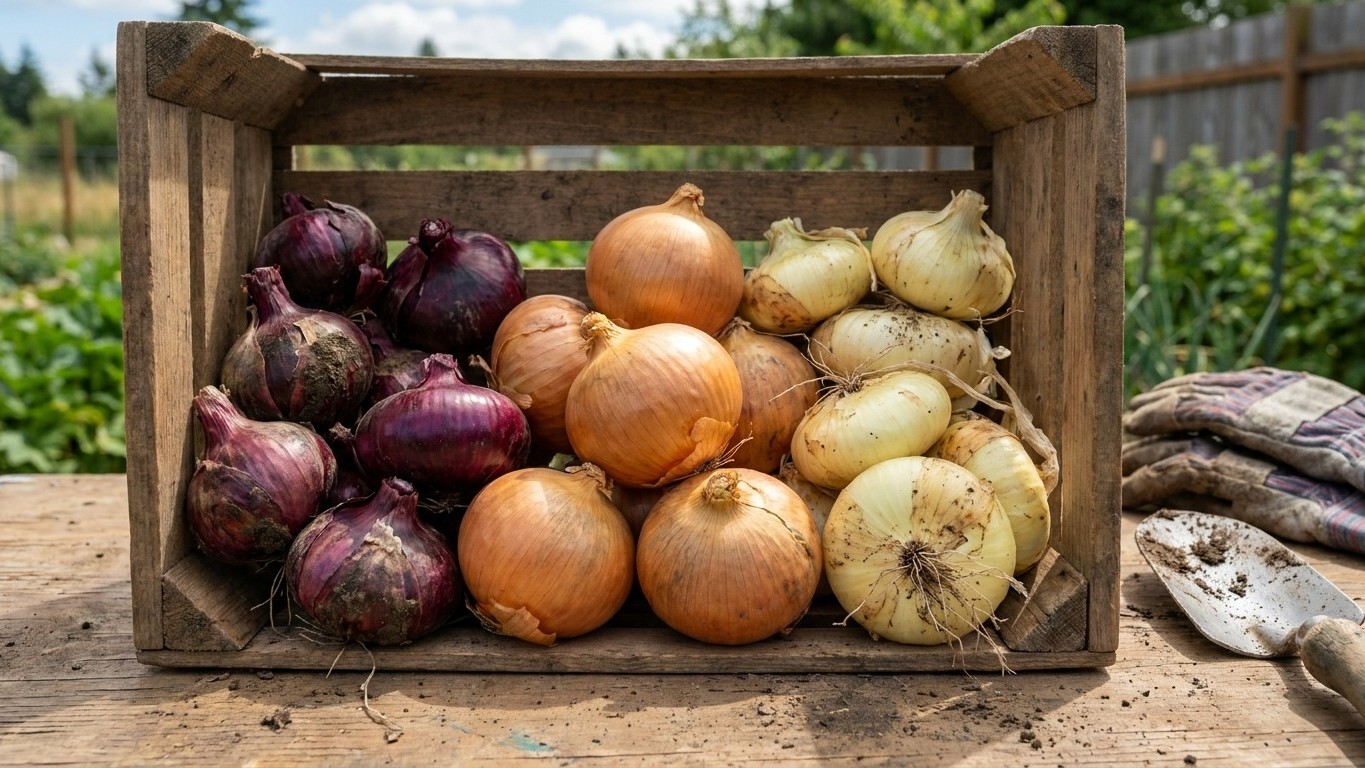

Lift onions when most of the tops have flopped over and started to yellow, then cure them before they go anywhere near a shelf. Curing means drying the bulbs in shade with moving air until the necks are tight and the skins feel papery. In Hawaii’s humid air, that step decides whether a harvest keeps or rots. The variety you planted decides how well it keeps: sweet onions do not store as well as the more pungent types.
When are onions ready to lift in Hawaii?
Day length tells an onion when to form a bulb. Honolulu sits at 21.32 degrees north and gets 13 h 18 of daylight on the longest day of the year. Clemson Cooperative Extension puts the bulbing trigger for short-day onions at about 12 hours, so those varieties bulb here without trouble. Long-day varieties wait for 14 to 16 hours, and the islands never give them that. They make leaves, then rot. Gardeners on other islands should look up their own latitude, but the same logic holds across the state. The The Best Onion Varieties for Hawaii page covers which short-day types suit which seasons.
Bulbing starts the clock, but the tops mark the finish. When most of the leaves have fallen over on their own and begun to yellow, the bulb has stopped growing. Pushing the tops down by hand early does not speed anything up. It leaves a thick, wet neck that is slow to seal. Skip the calendar, because planting date and variety move the harvest by weeks. The tops are the more reliable guide. If you are still planning or tending a bed, Onions in Hawaii covers the growing side.
Pick a dry day. Loosen the soil with a garden fork and lift the bulbs rather than pulling them by the tops, which tears the necks. Brush off loose soil with your hand. Don’t wash them. Set aside any bulb with a soft neck, a bruise or a chewed outer layer and eat it first, because damaged bulbs rot in storage and spread it. What Eats Onion in Hawaii, and When explains the usual culprits.
How do you cure onions in humid weather?
Curing pulls moisture out of the neck and outer layers so the skins seal over the flesh. The goal is dry air, not heat. Spread the bulbs in a single layer on a screen, a wire rack or slatted crates, with the tops still attached. A covered lanai, a carport or an open-sided shed works well. Rain on the skins undoes the whole job, so keep them out of trade-wind showers. Full midday sun is a poor choice too, since bulbs left in it can scald and turn soft in patches.
Airflow matters more than anything else on windward coasts and in wet months. A fan on low speed, aimed across the bulbs, helps when the air sits damp. Give each bulb some space so none touches another. Turn them once in a while.
Test the necks. A cured onion has a neck that is tight, dry and narrow, with no give when you squeeze it. The outer skins crackle and the roots are brittle. Once that is true, trim the roots and cut the tops to a short stub. Bulbs with thick necks that still feel moist go back on the rack. Those are the ones that rot first.
Keeping them, and for how long
Clemson Cooperative Extension’s Home & Garden Information Center gives the target for stored onions: “Ideal conditions are between 45 °F and 55 °F, and 50 to 60 percent humidity.” That is cool and dry. Roots such as carrots want the opposite, cold and damp, so one cellar cannot serve both well. Onions kept in damp air sprout, grow mold and go soft at the neck. Onions kept too warm sprout early and shrivel.
Only cured bulbs belong in storage. Bulbs that go in straight from the ground carry moisture in the neck, and that moisture is where rot starts. After curing, store them in mesh bags, old nylon stockings, slatted crates or shallow baskets that let air move.
How long do onions keep once cured?
Any duration quoted for onions is a maximum under ideal conditions, never a promise. A bulb in a house that drifts above the range will last less. The type of onion sets the ceiling more than anything. University of Missouri Extension (G6355) states it plainly: “As a rule, ‘sweet’ onions do not store as well as the more pungent types.”
The reason is chemical. The bite of an onion comes from volatile sulfur compounds, and those same compounds protect the bulb while it sits in storage. A sweet variety has fewer of them. That makes it better raw and worse over winter. No sweet onion stores like a pungent one, whatever the seed packet suggests.
What does that mean for a Hawaii garden?
Day length lines up with this trade-off. Short-day types run sweeter and long-day types keep longer. A northern garden grows long-day onions that can feed a household into March. A garden at 21 degrees north grows short-day onions, so plan to eat them soon after curing. Sort the harvest into two piles: the firmest, most pungent bulbs with the tightest necks go to storage, and everything else goes to the kitchen in the first few weeks.
Where in the house that actually is
The numbers sound simple until you walk around a real house. A household refrigerator runs colder than the 45 °F to 55 °F range, and its crisper drawer is humid, which suits lettuce and not onions. A heated or sunny room is too warm. A garage swings with the weather, hot by afternoon and clammy at night, and that swing is harder on bulbs than a steady, slightly warm spot.
Most Hawaii homes have no basement, and many have no air conditioning, so no room reaches the range by itself in summer. The room that comes closest is usually an interior closet or pantry on the shaded side of the house. It should sit away from the stove, the water heater, the dryer vent and any sunny wall. A shaded cabinet on a north-facing wall is often a few degrees cooler than the rest of the house. Homes higher on the slopes, in upcountry areas, run cooler overall and will have more options.
How do you check a storage spot with a thermometer?
Put a min-max thermometer and a small hygrometer in the spot for several days before you load it. Skipping that step means finding out the hard way, one soft bulb at a time. Read the lowest and highest temperatures, not just the number on the day you checked. Humidity matters as much. On a windward coast or in a rainy month, indoor air can sit well above 60 percent. If it does, move the onions to a drier room or run a dehumidifier nearby, and keep a fan going gently across the bags.
Check the stored bulbs every week or two. Any onion with a soft neck, a damp patch or green sprouts at the top goes to the kitchen right away, before it affects its neighbors.
Common questions
Can I store sweet onions from my Hawaii garden?
Not for long. Sweet varieties carry fewer of the sulfur compounds that protect bulbs in storage, so they soften and sprout sooner. Eat them first, and keep the more pungent, firmer bulbs for later.
Should I wash onions after lifting them?
No. Brush off the loose soil by hand and let the bulbs cure with the skins dry. Water on the neck and outer layers invites rot, and in humid air the bulbs may never dry properly.
Can I keep whole onions in the refrigerator?
It is a poor choice for whole bulbs. A household fridge runs colder than the 45 °F to 55 °F range, and the crisper is humid, while onions want 50 to 60 percent humidity. A cut onion is another matter: wrap the leftover half tightly and keep it cold.
Can I grow long-day onions in Hawaii?
No. Long-day varieties need 14 to 16 hours of daylight to form a bulb, and the longest day at Honolulu’s latitude is 13 h 18. Those plants make leaves all season and then rot. Stick with short-day types, which bulb at about 12 hours of daylight.