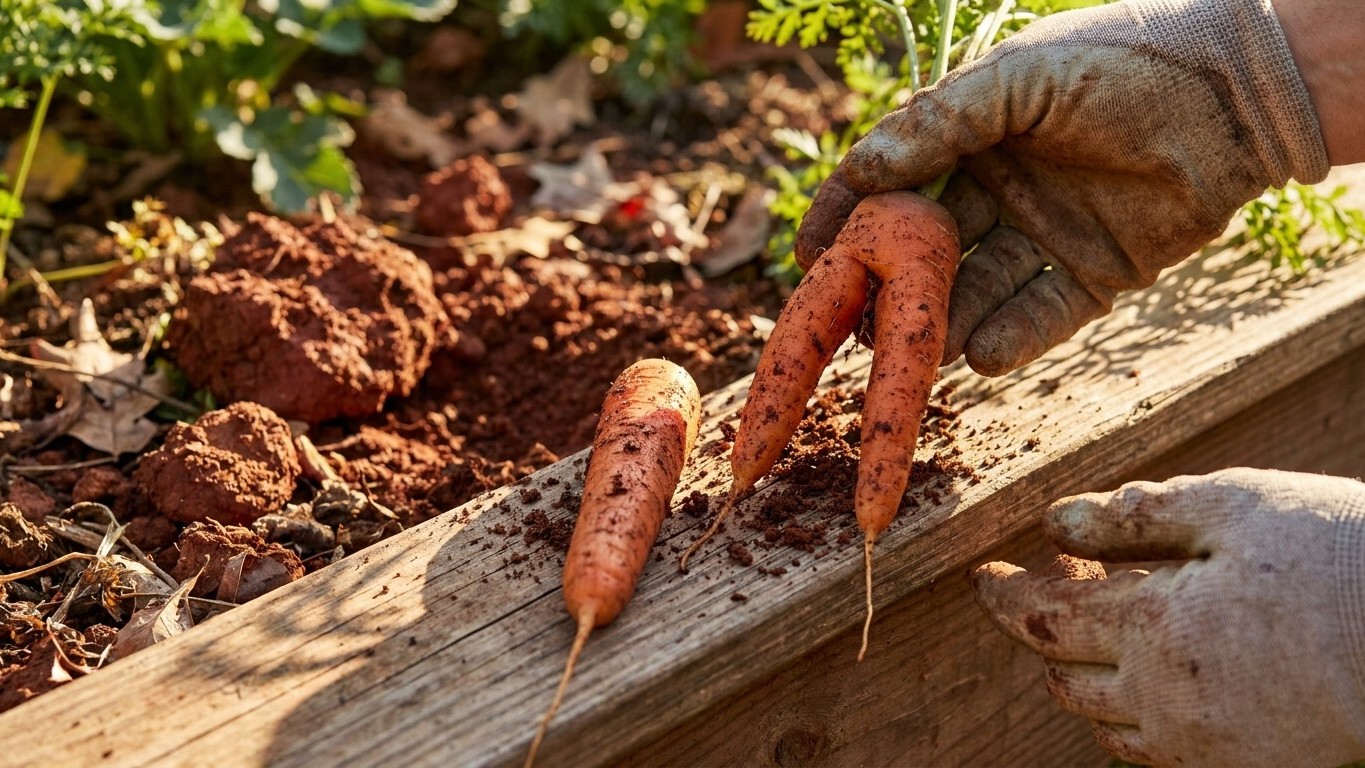

Not from the state’s own soil signature. Vermont’s official state soil, the Tunbridge series, runs sandy and well drained at the surface, which is the kind of loose ground carrots like. The bigger risk in most Vermont gardens comes from what lies below that surface, and from acidity so strong it changes how you’d manage the bed even if forking isn’t the problem.
The short answer
Vermont’s designated state soil is the Tunbridge series, a Spodosol formed under conifer forest and named the official state soil by Vermont law. The surface horizon, as USDA NRCS Soil Data Access records it across 442 mapped components, runs 79 percent sand, 21 percent clay and 0 percent silt, with a drainage class of well drained. The surface pH averages about 3.5, which is strongly acid, and organic matter sits around 75 percent.
That texture, 79 percent sand with no silt, is not the heavy, sticky ground that typically bends and forks a carrot root. Utah State University Extension is blunt about the mechanism: carrots want deep, sandy, well-drained soil rich in organic matter, and it’s heavy or rocky soil that forces the taproot to split around an obstruction instead of driving straight down. On texture and drainage class alone, the Tunbridge surface leans toward the “carrot-friendly” side of that equation, not the fork-prone side.
But that 75 percent organic-matter figure is a signal, not a bonus. Organic matter that high in a surface horizon means you’re looking at a natural forest litter layer, needles, leaf duff, partly decomposed wood, not the worked, composted loam of a vegetable bed. Once a plot is cleared, tilled and cropped for years, that litter layer is gone, and what’s left is the mineral soil underneath: the sandy, strongly acid material the series is built on. That acidity, pH 3.5, is far below where carrots do their best work, and while low pH does not by itself bend a root the way a rock or a clay lens does, it will limit how well roots take up nutrients even in soil that’s otherwise loose and open.
None of this is a diagnosis for any one backyard. Vermont’s soil survey maps hundreds of distinct series across the state, from river-bottom silt loams in the Champlain and Connecticut valleys to shallow, ledge-bound soils on hillsides, plus whatever a builder scraped, filled or compacted decades ago on a house lot. The Tunbridge series tells you what the state as a whole is associated with, a sandy, acid, forested upland soil, and nothing more specific than that about the dirt behind your own house.
So the honest answer splits in two. If your garden soil turns out sandy and open like the Tunbridge mineral horizon suggests, forking from texture alone is less likely, though you’ll still want lime and steady compost to correct that acidity and feed root growth. If it turns out heavy, compacted or full of stone fragments, which is common wherever glacial till sits close to the surface in Vermont, the fix is exactly what Utah State recommends for heavy ground: work in plenty of compost, double dig the bed to loosen and de-rock it a full spade’s depth or more, or skip the fight entirely and grow in a raised bed filled with a sandy, stone-free mix.
The test that settles it in your own garden
A state soil profile is a starting point, not a verdict. The only way to know what your carrots are actually growing into is to check the bed itself, and it takes about fifteen minutes with a shovel.
- Dig a hole at least 12 inches deep in the bed you plan to plant, and set the soil aside in a pile so you can see it in layers rather than one clump.
- Look at that pile for depth and stones. Note where the color or texture changes, that’s usually where topsoil ends and subsoil or parent material starts, and count how many rocks, pebbles or root-blocking fragments turn up in the top foot.
- Grab a handful of moist soil from the topsoil layer and rub it between your fingers. Gritty and loose means sand-dominant, like the Tunbridge series surface; sticky, smeary and able to hold a ribbon shape means clay-dominant; a smooth, flour-like feel that still holds together loosely means silt.
- Squeeze that same handful into a ball. If it falls apart the moment you open your hand, it drains fast and dries fast. If it stays packed in a dense clump, it’s holding water, and water logging around a root is one more way heavy ground pushes a carrot to fork.
- Fill the hole with water, let it drain once, then fill it again and time how long it takes to disappear. Water gone within a few hours points to well-drained ground; standing water after half a day or more points to a compacted or clay-heavy layer that will need amending or a raised bed instead of an in-ground row.
Do this test in more than one spot if the garden is more than a few years old or was ever regraded, because texture and drainage can shift completely within twenty feet in a yard that’s been filled, terraced or built up over time.
What goes wrong here
Vermont’s ground and climate create a specific set of carrot problems, and each one has a known fix rather than a reason to give up on the crop.
- Forking in heavy or rocky ground. Wherever glacial till sits close to the surface, a carrot’s taproot meets a stone or a dense clay lens and splits around it instead of growing straight. Utah State University Extension’s fix is direct: work in generous compost and double dig the bed to break up and clear the root zone, or build a raised bed filled with loose, stone-free soil so the root never meets an obstacle in the first place.
- Poor germination in a hot, dry spell. Carrot seed is small and sits shallow, so a crusted, sun-baked surface or a few dry days right after sowing can stop germination cold before roots ever get the chance to fork or split. Keeping the seedbed consistently moist with light, frequent watering until seedlings are up solves this, and a thin layer of compost or fine mulch over the row helps hold that moisture.
- Splitting from uneven watering. A root that grows steadily through a dry stretch and then gets hit with a heavy soaking can swell too fast and crack along its length. Regular, even watering on a schedule, rather than long dry gaps followed by a deep drenching, keeps root growth steady and reduces this kind of split.
- Extreme surface acidity limiting root vigor. A surface pH near 3.5, as recorded for the Tunbridge series, is well outside what carrots use efficiently, so even loose, sandy soil at that acidity will grow weak, stunted roots. Working in compost and, based on a soil test of the actual bed, lime to bring pH up, addresses this directly rather than leaving it to chance.
Common questions
Does sandy soil guarantee straight carrots in Vermont?
No. Sandy, well-drained texture like the Tunbridge series surface removes one common cause of forking, but rocks, clay lenses beneath the topsoil, or uneven watering can still split or bend a root even in generally sandy ground. The only way to know is to dig and check your own bed.
Is the state soil the same as what’s in my backyard?
Almost certainly not exactly. Vermont’s soil survey maps hundreds of distinct series, and a state soil designation describes one representative series, not the specific ground under any one garden. Use it as background, then test your own plot.
Why is the organic matter figure for this soil so high?
The roughly 75 percent organic-matter value USDA records for the Tunbridge series surface reflects a natural forest litter layer, needles and leaf duff under conifers, not a cultivated garden bed. A worked vegetable plot will not carry organic matter anywhere near that figure.
What fixes heavy or rocky soil for carrots, compost or a raised bed?
Both are valid, and Utah State University Extension recommends compost paired with double digging as the standard fix for heavy ground. A raised bed filled with a loose, stone-free mix is the simpler route if the native soil is consistently rocky or compacted across the whole garden.