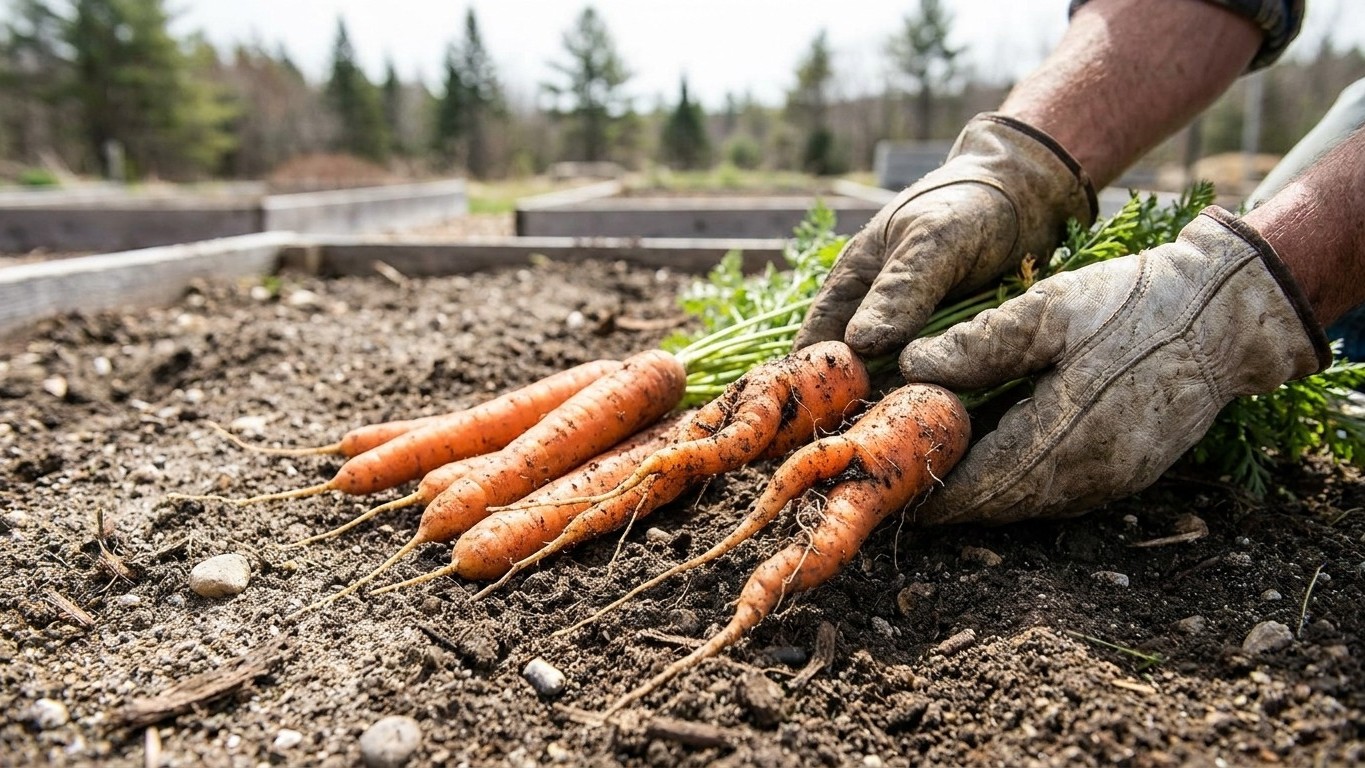

Vermont’s benchmark soil, the Tunbridge series, is sandy and well drained, which is exactly the texture carrots want. But it also runs strongly acid and, as mapped, carries far more organic litter than any dug garden bed ever will. Whether a root forks in your own plot depends less on that state average and more on stones, compaction and drainage where you actually dig.
The short answer
Vermont’s official state soil is the Tunbridge series, a Spodosol that formed under conifers across the state’s uplands. It was written into Vermont law in 1985 as the state soil under the USDA NRCS State Soils program. The numbers behind it, drawn from USDA NRCS Soil Data Access records of 442 mapped components, describe a surface texture of 79 percent sand, 21 percent clay and 0 percent silt, a well drained class, and a surface pH around 3.5, strongly acid. Organic matter in that surface horizon runs about 75 percent, a figure that flags a natural forest-litter layer, not the topsoil of a cultivated bed. Once a plot is turned, tilled and cropped for a season or two, that litter layer is gone and the number no longer applies.
Set against what Utah State University Extension says carrots need, sandy, deep, well-drained ground rich in organic matter, the Tunbridge texture is closer to friendly than hostile. Heavy clay and poor drainage are the two conditions that extension work names as the direct cause of a forked root, and this soil, at 21 percent clay with a well-drained rating, sits on the sandy side of that line rather than the clay side. The bigger obstacles here are the acidity and whatever stones or compacted layers your particular patch of ground has picked up from glacial till or from years of foot traffic and mowing, and getting the soil right matters just as much as knowing When to Sow Carrots in Vermont for your specific microclimate.
None of this is a diagnosis of your backyard. Vermont spans hundreds of mapped soil series, and river-bottom ground along the Connecticut or Winooski, hill farms in the Northeast Kingdom, and any lot a builder has scraped and refilled can differ completely from the Tunbridge profile. Treat the state soil as a starting point for what the region’s ground tends to do, not as a stand-in for a soil test on your own bed, and if you’re still unsure, Will Carrots Fork in Vermont Soil? walks through the conditions that actually decide it. If your garden runs heavier or shallower than this, the fix is the same one Utah State names for any heavy or rocky ground: work in plenty of compost, double dig the row, or build a raised bed deep enough for a straight taproot to run.
The test that settles it in your own garden
- Dig a test hole in the bed you actually plan to plant, going down as far as a spade will comfortably go, and note what stops you, whether it’s bedrock, a dense clay pan, or a bed of gravel.
- Look at the sides and bottom of that hole for stones and cobbles. A shovelful full of rock fragments is a strong hint that any taproot pushing down will meet an obstacle and split around it.
- Rub a handful of soil between your fingers. Gritty and loose means sand, slick and sticky means clay, and soil that rolls into a ribbon like modeling clay when wet is soil a carrot root will struggle to push through cleanly.
- Fill the same hole with water and watch how long it takes to disappear. Water that lingers for hours points to compaction or a clay-heavy layer that will hold too much moisture around the root. Water that vanishes almost immediately points to a soil so sandy and fast-draining that moisture swings will be hard to control, which is its own path to a split root later in the season.
None of these four checks needs a lab. They tell you, in your own bed, whether you’re closer to the sandy, well-drained profile carrots want or to the heavy, rocky ground that forks them, and that answer matters more than any state average.
When to sow here
- Start from the local frost window rather than a fixed date. Around Burlington, on Lake Champlain, NOAA NCEI’s 1991-2020 climate normals put the last spring freeze between April 30 and May 10. That’s measured at station USW00014742, and it’s the mildest corner of the state. The Green Mountains and the Northeast Kingdom run substantially shorter seasons, so a garden up in the hills should expect that window to arrive later.
- Check the soil itself before the calendar. Carrot seed needs the ground at a minimum of 40 degrees F to sprout at all, and no frost date matters if the soil hasn’t warmed to that floor yet.
- Sow two to three weeks before that last frost date, once soil temperature allows it. In the Burlington area, working back from the April 30 to May 10 window puts the sowing target in the middle of April for gardens that track close to that lakeside climate; gardens further into the hills should push that back to match their own later frost date.
- Aim for a germination range of 55 to 65 degrees F for the most even sprouting. Seed sown while soil sits right at the 40-degree minimum will come up slowly and unevenly; waiting until the soil is solidly into that 55-to-65 range gives a cleaner, more uniform stand.
Every one of those steps is counted from the day the seed goes into the ground. Carrots are sown directly and never transplanted, so the 70 to 100 days most varieties need to mature run from that seeding date, not from any later planting-out.
What goes wrong here
- Forking in heavy or rocky ground. Wherever a garden runs heavier or stonier than the sandy Tunbridge profile, compacted clay or buried stones split the taproot as it grows down. Utah State University Extension’s answer is direct: work in generous compost and double dig the row, or skip the native soil altogether and grow in a raised bed filled with a loose, stone-free mix.
- Poor germination during a hot spell. Carrot seed germinates best between 55 and 65 degrees F. A stretch of unusually warm weather right after sowing can push soil temperature well past that range, and the stand comes up thin and patchy as a result. Watering to cool the soil surface, mulching lightly, or sowing a second round a week or two later all help spread the risk.
- Splitting from uneven watering. A dry stretch followed by a heavy rain, common enough in a Vermont summer, makes roots swell suddenly and crack along the side. Steady, even watering through the growing season, backed by a mulch layer that slows evaporation between rains, keeps that swing from happening.
- Strongly acid native ground. Where garden soil tracks close to the Tunbridge series’ surface pH of about 3.5, strongly acid, carrots grow stunted and shallow regardless of texture. A soil test that comes back that low calls for lime worked in well ahead of sowing, not a different variety or a deeper bed.
Checking this against your own county
A state soil, a single frost-date station, and a set of general extension guidelines can only take a Vermont gardener so far. The next step is a soil test and a conversation with someone who knows the ground in your own county, not the state average. University of Vermont Extension runs that service statewide, with agents who can walk through a soil report line by line and match sowing dates to your particular valley, ridge, or lakeside lot. Their programs are listed, and reaching out there before the season starts beats guessing from a map every time.
Common questions
Is Vermont’s state soil good for growing carrots?
The Tunbridge series’ sandy, well-drained texture leans in carrots’ favor, since that’s the loose, deep profile Utah State University Extension recommends. The catch is its strong acidity, around pH 3.5 at the surface, which a garden built on similar ground would need to correct with lime before carrots would do well.
What causes carrots to fork?
Utah State University Extension names heavy or rocky soil as the direct cause. A taproot growing straight down meets a stone, a clay pan, or compacted ground, and splits around the obstruction instead of pushing through it.
When should I sow carrot seed in Vermont?
Sow two to three weeks before your local last spring frost date, once soil has reached at least 40 degrees F. Around Burlington, where NOAA NCEI records the last freeze between April 30 and May 10, that puts sowing in mid-April for gardens close to the lake, later for gardens in the Green Mountains or Northeast Kingdom.
Do carrots need to be transplanted?
No. Carrots are sown directly into the garden bed and never transplanted, since disturbing the young taproot causes forking and stunted growth. The 70 to 100 days most varieties take to mature are counted from the seeding date itself.