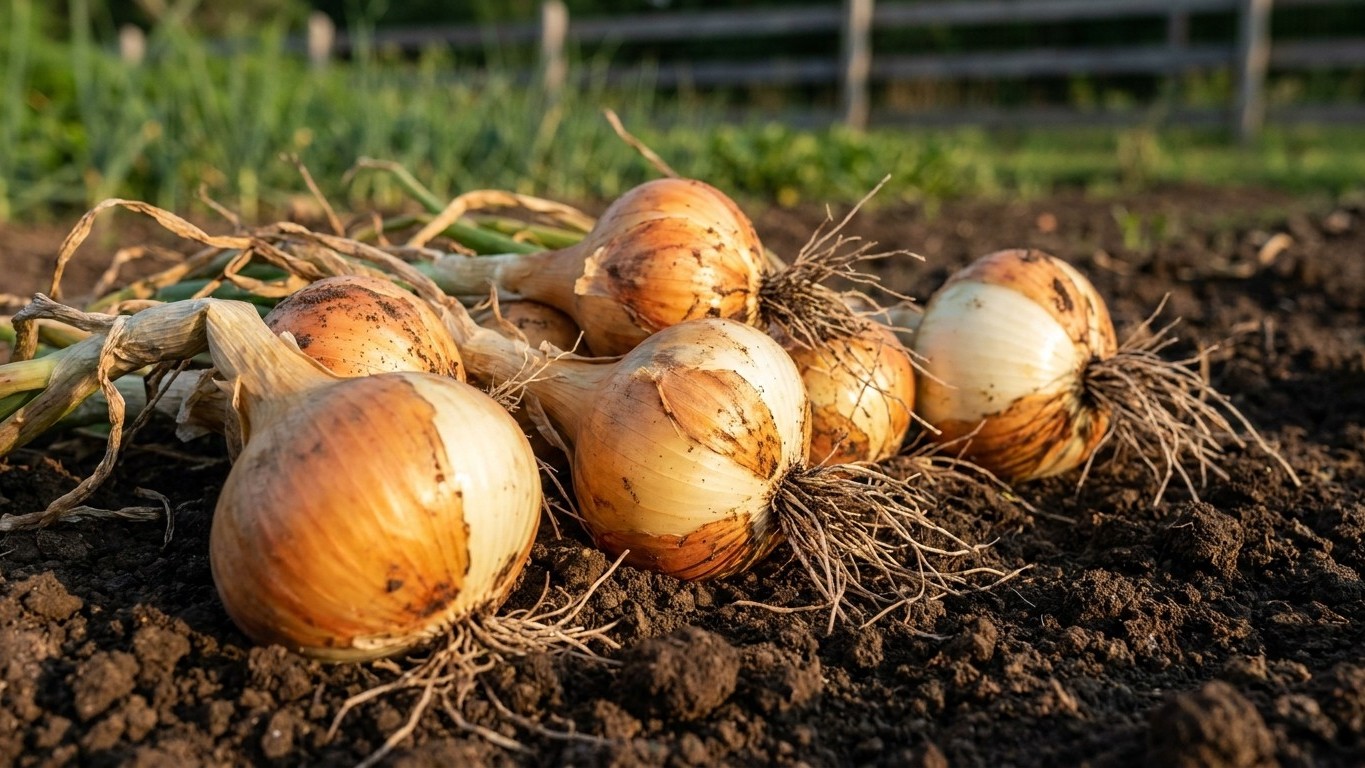

Burlington sits at 44.47 degrees north, and on the longest day of the year it gets 15 hours and 22 minutes of daylight. That single fact decides almost everything about growing onions in Vermont: it puts the state firmly in long-day territory, rules out most supermarket onion sets, and pushes the whole planting calendar toward late winter rather than fall. Twenty-three varieties documented on this site will actually bulb here. Eight will not, no matter how well you feed them.
How long your longest day is

Onions don’t respond to heat the way tomatoes do. They respond to daylight. A bulb starts forming only after the plant senses that days have gotten long enough, and that threshold is genetically fixed by variety type. Short-day onions switch into bulbing mode at around 12 hours of daylight, according to Clemson Cooperative Extension’s Home & Garden Information Center. Intermediate types wait for something in the 13-to-14-hour range. Long-day types hold off until 14 to 16 hours.
Burlington’s 15 hours and 22 minutes on the summer solstice clears the long-day threshold with room to spare, and it comfortably covers most intermediate varieties too. That’s the entire logic of this page in one sentence: Vermont’s summer daylight is long enough for long-day and intermediate-day onions, and too long for short-day ones, which will bulb prematurely and stay small before the plant has built enough leaf mass to support anything worth harvesting. Getting the timing right matters just as much as picking the right variety, so see When to Plant Onions in Vermont for the full seasonal breakdown.
One caution worth repeating. The 44.47-degree figure belongs to Burlington specifically, the mildest pocket of the state, sitting right on the shore of Lake Champlain. Vermont is a small state on a map but it isn’t flat or uniform in climate. The Green Mountains running down the spine of the state and the Northeast Kingdom up near the Canadian border sit at similar or slightly higher latitudes, which if anything makes their summer daylight even a touch longer, not shorter. Day length changes gradually with latitude, so a gardener in Newport or St. Johnsbury isn’t going to see wildly different numbers than Burlington. What does change sharply with elevation and distance from the lake is frost timing, which we’ll get to. For day length specifically, Burlington’s number is a reasonably safe stand-in for the whole state. If you’re gardening near the Massachusetts border, you’re a bit further south and closer to that number anyway.
Which varieties bulb in Vermont
Twenty-three varieties with published latitude ranges covering 44.47N will bulb reliably in a Vermont garden, and you can see the full breakdown in The Best Onion Varieties for Vermont. That’s the good news, and it’s a wider list than most northern gardeners expect:
- Ailsa Craig, Barolo, Blush, Bridger, Frontier, New York Early, Patterson, Powell, Red Carpet, Redwing, Rossa di Milano, Safrane, Talon, and Walla Walla Sweet (all long-day)
- Cabernet, Calibra, Elsye, Expression, Monastrell, Red Long of Florence, Red Long of Tropea, Scout, and Sierra Blanca (all intermediate-day)
Redwing stands out here because its published range runs 43 to 65N, meaning it’s bred for places with even longer summer days than Vermont gets, and it will still perform fine. Powell’s range (43-47N) is almost a perfect match for the state, which makes it a low-risk pick for a first-time onion grower who wants a variety with little margin for guessing wrong.
What happens if you plant the wrong ones anyway
Eight varieties documented on this site are published for latitudes below Vermont, and none of them belong in this garden: Candy, Gabriella, Madalyn, Red Rock, Red Sensation, Texas Grano 1015Y, Vidora, and White Castle. Candy is intermediate-day with a 33-40N range; the rest are short-day types rated for 20 to 38N depending on the variety.
This is the mistake behind a lot of disappointing onion harvests in northern gardens, and it usually isn’t a fertilizing or watering problem, it’s a variety problem. A short-day onion planted in Vermont senses 12 hours of daylight in May, long before Vermont’s plants have built real leaf mass, and starts bulbing anyway. The result is a small, premature bulb on a plant that hasn’t stored enough energy to fill it out. Push past that and the outcome gets worse: the plant keeps trying to bulb on a stunted frame, the bulb sits wet and undersized in the soil, and rot sets in before it ever reaches a usable size. A gardener who has tried a bagged set from a big-box store and ended up with marble-sized onions has likely lived this exact sequence.
Of those eight, Gabriella, Madalyn, Red Rock, and White Castle don’t have their own dedicated page on this site; they’re named here only because their catalogue latitude range rules them out for Vermont, not because we’ve covered them elsewhere.
When to plant onions in Vermont
Because Vermont sits in long-day territory, the planting calendar looks nothing like a fall-planting Southern garden. Long-day onions need a long stretch of cool weather to grow leaves before the June daylight trigger kicks in, so the planting window is late winter into early spring, timed around the last frost rather than the first.
At Burlington, the 1991-2020 NOAA climate normals put the last spring freeze at 32 degrees Fahrenheit between April 30 and May 10, based on the 30-to-70 percent probability band. The first fall freeze at that same threshold runs October 3 to October 13. That gives Burlington roughly five months of onion-growing season, which is plenty of time to take onion sets or transplants from spring planting through to a late-summer harvest.
Why these dates are a starting point, not a guarantee
Those NOAA figures are averages built from three decades of data at one weather station, USW00014742, which sits in Burlington’s mild lakeside microclimate. They describe probability, not certainty, and Burlington runs milder than most of the state. A gardener up in the Northeast Kingdom or tucked into a mountain valley should expect a later last frost in spring and an earlier first frost in fall, shrinking that growing window from both ends. If you’re gardening away from Lake Champlain’s moderating effect, treat these dates as roughly a starting point and lean a week or two later in spring, a week or two earlier in fall, to be safe.
Practically, that means getting onion sets, seedlings, or transplants into the ground in the weeks bracketing that late-April to mid-May frost window, once soil can be worked. Onions tolerate a light frost once established, which is part of why growers push the planting date early rather than waiting for a guaranteed frost-free week. Waiting too long into May costs the plant leaf-growing time it needs before the June solstice starts the bulbing clock, and that lost leaf growth shows up later as smaller bulbs.
Sweet onions or onions that keep
Every onion grower eventually runs into the same trade-off, and it isn’t about luck or variety hype, it’s chemistry. University of Missouri Extension puts it plainly: sweet onions generally don’t store as well as more pungent types. The bite in a pungent onion comes from volatile sulfur compounds, and those same compounds are what fend off spoilage and rot once the bulb is in storage. A sweet variety simply has fewer of them. Great sliced raw on a burger in August, but it won’t make it to Thanksgiving in a pantry, let alone March.
That mechanism lines up with day length in a way that shapes what a garden can realistically produce depending on where it sits. Short-day varieties, grown in the South, tend to run sweeter and softer, meant for eating soon after harvest. Long-day and intermediate varieties, the ones suited to Vermont’s long summer daylight, tend to run sharper and firmer, built to hold in storage through a cold winter.
What that means for a Vermont pantry
A Vermont garden growing long-day types like Patterson, Redwing, or Talon, or intermediate types like Cabernet or Monastrell, is stocking a root cellar more than a summer salad. Cure the bulbs properly after harvest and a well-grown long-day onion can realistically still be usable in March, months after the last one came out of the ground. Walla Walla Sweet is the one long-day exception on the list worth flagging: it’s bred for eating fresh and won’t hold nearly as long as its long-day siblings, so treat it as a summer onion even though the latitude range fits.
For a gardener choosing between varieties on that first list, that’s the real decision. Pick sweeter long-day types like Walla Walla Sweet or Blush for fresh eating through late summer, and lean on sharper types like Redwing, Patterson, or Talon for the bulbs meant to carry a Vermont kitchen through a long winter.