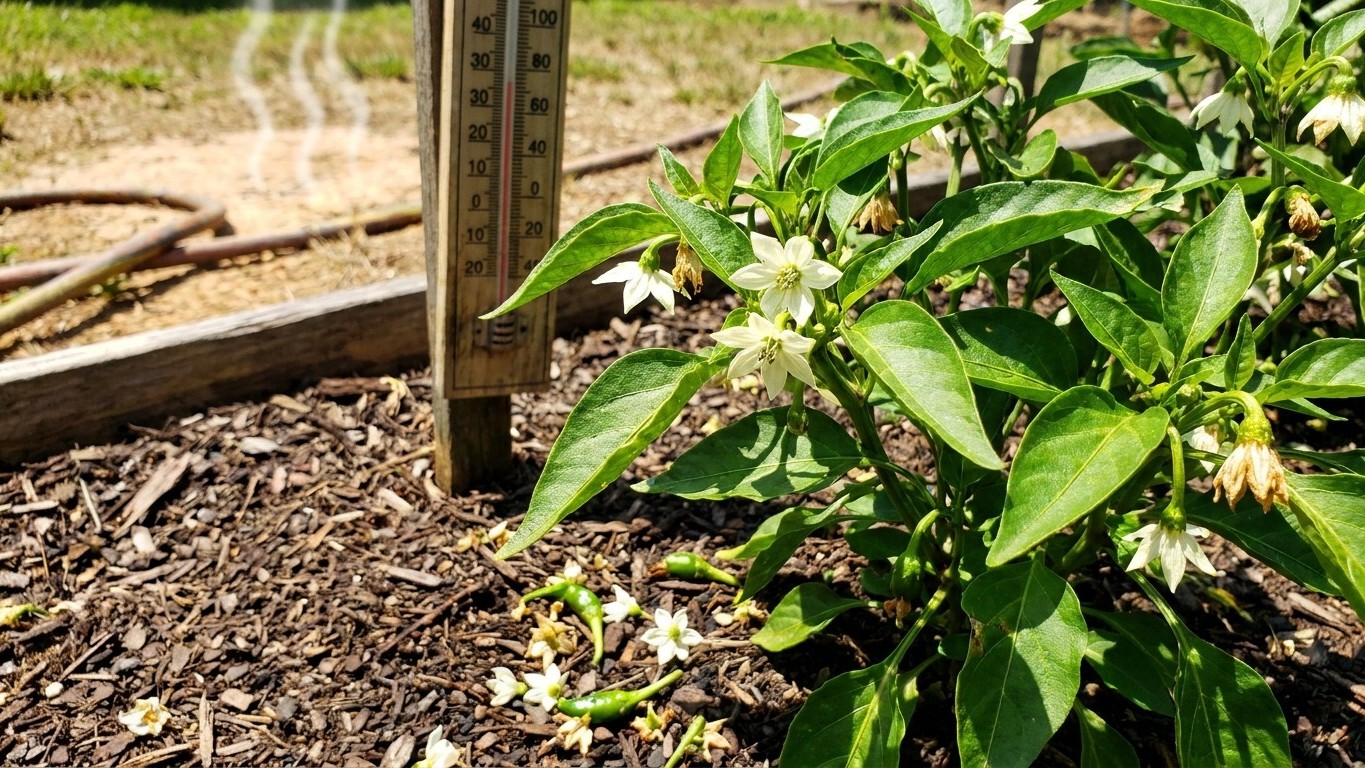

Vermont pepper plants abort blossoms for two opposite reasons: a hot stretch that pushes days above 90°F, or a summer night that slips below 55°F. Burlington’s climate record shows the state averages only 5.4 days a year reaching that heat mark, so the bigger risk for most Vermont gardens sits on the cold side, one this site can’t measure for you. Watch your own nighttime lows once flowers open.
The short answer
Start with the number that actually matters here: Burlington’s official climate normal puts the state at 5.4 days a year reaching 90°F or hotter (NOAA NCEI Climate Normals 1991-2020, reference station Burlington). That’s not an average summer temperature, it’s a count of how many days cross the threshold that stresses heat-sensitive crops and drives up water demand. Compared to the pepper belts of the mid-South or the desert Southwest, 5.4 days is a rounding error. Most Vermont summers simply don’t deliver the kind of sustained heat that shuts down pollen viability on its own.
But a low seasonal count doesn’t mean the risk is zero. Fruit set fails during a narrow window, the days a plant is actively flowering, not across the whole season. A single hot stretch landing in mid-July, right when a pepper plant is loaded with open blossoms, can stall pollen function for that batch even if the rest of the summer stays mild. Five days of 90°F heat spread across June, July, and August barely register as a seasonal statistic, but if two or three of them cluster during peak bloom, the grower feels it as a real drop in fruit.
The other failure point runs in the opposite direction, and it’s the one Vermont growers are more likely to meet: nights below 55°F. Cool nights interfere with pollen the same way extreme heat does, just from the other side of the thermometer. Vermont’s valleys, hillsides, and higher elevations can all produce different overnight lows on the same calendar date, and this site does not carry summer night minimum data for any Vermont location. That means there’s no shortcut here, no way to infer a safe night temperature from latitude, from how far north a county sits, or from how cold the coldest month of the year runs. Winter severity says nothing reliable about a July night. The only way to know if nights are cutting into fruit set is to track them directly, with a thermometer in the garden during bloom, especially in low spots and higher ground where cold air tends to pool after sunset.
When to start seed here
Pepper transplants need 8 to 10 weeks indoors before they go in the ground, and they shouldn’t go in the ground until two conditions are both met: the frost risk has passed, and the soil itself has reached 60°F (Utah State University Extension, Peppers in the Garden). Air temperature and soil temperature don’t warm on the same schedule, so the arithmetic runs in stages rather than off a single date.
- Find your local frost window. Burlington’s 1991-2020 climate normals put the last spring frost between April 30 and May 10, based on 32°F freeze probabilities at station USW00014742. Burlington sits on Lake Champlain, the mildest corner of Vermont, so this window marks an early edge rather than a statewide one.
- Adjust for where you actually garden. The Green Mountains and the Northeast Kingdom run substantially shorter growing windows than the Champlain Valley. Neither this site nor the source data publishes a specific frost date for those regions, so a grower there should treat Burlington’s window as a floor, not a match, and check local frost records for their own county.
- Wait for the soil, not just the air. Even after the last frost has passed, soil can lag well behind air temperature, especially in shaded or heavy ground. Peppers should stay out of the garden until soil hits 60°F, which in a cool Vermont spring can land noticeably later than the frost-free date alone would suggest.
- Set the transplant date at whichever condition is met last. If the soil warms to 60°F before the frost-free window closes, wait for frost safety. If frost passes first but the soil is still cold, wait for the soil.
- Count back 8 to 10 weeks from that transplant date. That’s the indoor seed-starting date. A transplant target in mid-May, for example, pushes seed-starting back into early-to-mid March, depending on which end of the 8-to-10-week range a grower uses.
| Region | Frost data on record | What it means for timing |
|---|---|---|
| Champlain Valley (Burlington area) | Last frost April 30 to May 10 (NOAA NCEI, station USW00014742) | Earliest safe transplant window in the state |
| Green Mountains | Not published on this site | Runs substantially later than Burlington; confirm locally |
| Northeast Kingdom | Not published on this site | Runs substantially later than Burlington; confirm locally |
What goes wrong here
- Blossom drop from a heat spell or a cool night. Even Vermont’s modest 5.4 days a year above 90°F can matter if a cluster of them hits during flowering, and a night under 55°F during that same window does the same damage from the cold side. Since this site doesn’t track summer night minimums, the practical fix is to watch a garden thermometer through the flowering stage and, where possible, time transplanting so peak bloom doesn’t land squarely inside the hottest stretch of a typical Vermont July.
- Sunscald where the sun is strong. Fruit exposed to direct, intense sun after heavy pruning or foliage loss can develop soft, pale patches on the exposed side. The fix is to leave the plant’s natural leaf cover in place rather than stripping it for “better airflow,” and to add light shade cloth over exposed fruit during the brightest stretch of summer afternoons.
- Blossom-end rot from uneven watering. This shows up as a dark, sunken patch at the fruit’s bottom end, and it tracks back to inconsistent soil moisture interrupting calcium uptake, not a soil calcium shortage on its own. A steady watering schedule and a layer of mulch to even out moisture swings between wet spells and dry stretches solves most cases.
Common questions
What temperature stops pepper fruit set in Vermont?
Fruit set can fail at both temperature extremes: nights below 55°F or days above 90°F. Vermont rarely delivers many days at the hot end, averaging 5.4 a year in the Burlington record, but summer night lows aren’t tracked on this site, so growers need to check their own conditions during bloom.
How many hot days does Vermont get each summer?
Burlington’s 1991-2020 climate normal counts 5.4 days a year reaching 90°F or higher. That figure measures heat load, not average summer warmth, and it’s specific to the Burlington reference station rather than the whole state.
When should I start pepper seeds indoors in Vermont?
Count back 8 to 10 weeks from your planned transplant date, which itself depends on whichever comes later: your local frost-free date or the point when garden soil reaches 60°F. Burlington’s frost window runs April 30 to May 10, but that’s the mildest part of the state.
Does the last frost date differ across Vermont?
Yes. Burlington’s April 30 to May 10 window applies to the Champlain Valley, the state’s mildest corner. The Green Mountains and the Northeast Kingdom run substantially shorter growing seasons, though specific dates for those regions aren’t published on this site.