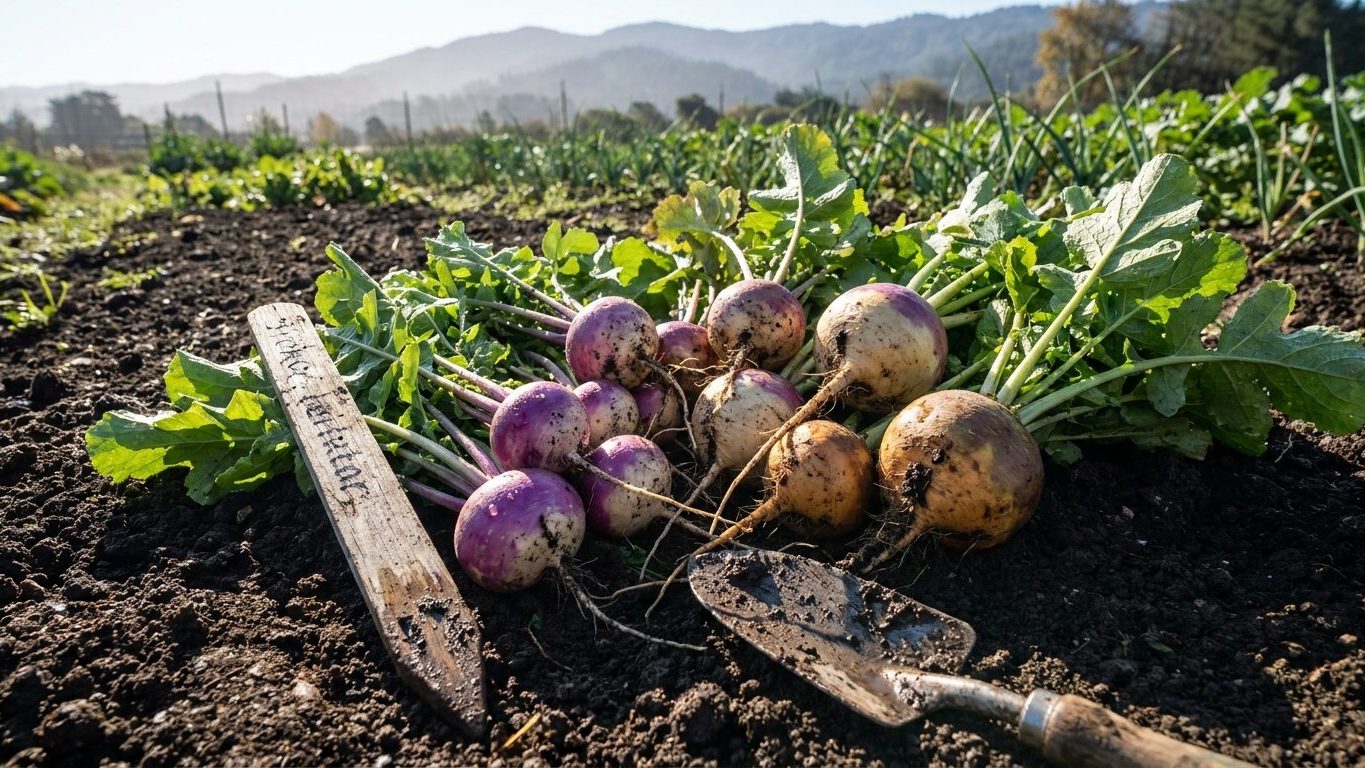

For Vermont, grow a fast white salad turnip for spring and fall, a purple-top storage turnip for the autumn crop, and a rutabaga sown by midsummer for the cellar. Rutabaga earns its place here because the cold that ends the season is the cold it likes. Choose by how long your garden stays frost-free, since that number varies more across Vermont than any other.
The short answer for Vermont
The frost dates set the rules. At Burlington, the station the data comes from, the last spring 32°F freeze falls between April 30 and May 10, and the first fall freeze between October 3 and October 13. Those are not guarantees. They come from the NOAA 1991-2020 Climate Normals and mark the band where the chance of a 32°F freeze sits between 30 and 70 percent. Burlington is also the mildest corner of the state, on Lake Champlain, so the Green Mountains and the Northeast Kingdom get substantially less room.
That window is roughly five months at Burlington. It is plenty for a quick turnip, comfortable for a storage turnip, and tight for a rutabaga if you wait. Here is how the types sort out:
| Type | Examples to look for | Best use in Vermont |
|---|---|---|
| Quick white salad turnip | Hakurei-type | Early spring and again from late summer; eaten fresh |
| Purple-top storage turnip | Purple Top White Globe | Fall crop for roasting, mashing and short storage |
| Rutabaga | American Purple Top, Laurentian | Midsummer sowing, harvested after frost, stored in a cellar |
| Vermont heirloom | Gilfeather | Long-season fall root; sweetens in the cold |
Gilfeather deserves a note. It is a Vermont heirloom from Wardsboro, sold as a turnip, and the state’s official vegetable. It has the long, tapered shape of a root that wants a full season, so treat it like a rutabaga when you plan sowing dates.
Seed packets list days to maturity, and that figure is the one to compare against your own frost window. Count backward from the first fall freeze in your town, not Burlington’s. For the sowing dates themselves, see When to Sow Turnips in Vermont, and for the crop as a whole, Growing Turnips and Rutabaga in Vermont.
What will not work here
Start with the slow roots sown late. A rutabaga put in the ground in July at Burlington has a workable runway. The same sowing in the Northeast Kingdom, where the first fall freeze arrives earlier than Burlington’s October 3 to 13 band, can leave you with golf-ball roots. Seed packets are written for the whole country, so the “days to harvest” figure on them assumes a season you may not have. A long-season heirloom like Gilfeather is the first to disappoint in a short-season garden.
Overwintering in the ground fails too. The mean daily minimum of Vermont’s coldest month is 12.9°F at the Burlington reference station. That is a typical night, not the record low, and it is far below what a turnip or rutabaga root survives in unprotected soil. Roots left in the bed past the hard freezes turn to mush or freeze solid. Harvest them, then store them. Gardeners in warmer states can leave roots in the ground all winter, but Vermont growers cannot.
Spring planting on the calendar’s earliest day also goes wrong. The last spring freeze band runs to May 10 at Burlington, later at altitude. Soil is often cold and saturated in late April, and seed sown into it sits and rots or germinates unevenly. Young turnips that sit through repeated cold snaps may bolt to seed instead of swelling a root, so a Hakurei-type sown too early can send up flower stalks. Spring is also when root maggots and flea beetles hit brassicas hardest, and a rutabaga sown in May to catch the summer sits in their path for months. Sowing in midsummer for a fall crop sidesteps much of that pressure.
One thing this page cannot tell you is how a given Vermont summer will treat midsummer seed. The facts for this page cover frost and winter cold, not summer heat or rainfall, so I won’t pretend to a dryness figure. The practical point stands: seedlings sown in July need steady moisture to come up, and a bed that dries out between waterings loses the stand.
What changes across Vermont
There is no single Vermont answer. The USDA Plant Hardiness Zone Map (2023, built on 1991-2020 normals) places the state across zones 3b to 5b. That is a wide spread, and it is built on one variable, the average annual extreme minimum temperature. It tells you about winter survival of perennials. It says little directly about a turnip’s frost-free growing window, so use it as a clue to how much colder your area runs, not as a calendar.
For a reader in the north or at altitude, the shift is straightforward. Move to the faster types. Favor quick turnips and earlier-maturing rutabaga selections over long-season heirlooms. Sow rutabaga earlier in the summer than the Burlington logic suggests, because the first fall freeze comes sooner and the runway is shorter. In the Champlain Valley, you get more margin, and the long-season roots become realistic.
Elevation works inside a single county. A garden on a hilltop and one in the valley a few miles away can sit in different zones, and cold air pooling in low spots can bring frost to a bottomland garden while the slope above stays clear. For your own zone, use the USDA Plant Hardiness Zone Map and look up your ZIP code rather than assuming. Treat the Burlington dates in this article as the generous end of the range.
Where to check this for your own county
Your state extension service is the next stop. University of Vermont Extension is the land-grant extension for Vermont. Look there for two things: a planting calendar that reflects your part of the state, and the vegetable varieties that have been trialled in your county’s conditions. A variety that performs in the Champlain Valley may not in a cold hollow, and trial results tell you which ones have actually been grown nearby.
A county recommendation beats a state one. This page is the state one: it is built from a Burlington reference station and a zone range that covers a very large climate spread. It can rule out clear mistakes and point you to the right type of turnip or rutabaga, but it cannot tell you your own last frost. This page also does not carry county trial results, and I have not cited a Vermont-specific turnip calendar here, so the extension is where that detail lives.
When you reach the extension site, look for the local frost-date information, the vegetable variety recommendations for your region, and any pest alerts for root maggots and flea beetles. If a county agent or Master Gardener helpline is listed, use it. They have seen what grew in your neighborhood this year.
Checking this against your own garden
Your own observation outranks every date above. Three things are worth watching, and none needs an instrument.
- Soil warmth by feel. Push a hand into the bed in spring. If it is cold and clammy and clings to your fingers, hold the seed. Soil that crumbles and feels mild is ready. If your bed warms later than a neighbor’s, your garden sits cold and wet, so sow later and lean on quick types.
- The first true leaves. After the seed leaves come the first rough, true leaves. If they appear slowly and the seedlings stall, the bed is running cool or dry. Thin promptly and water, because a stalled seedling is the one that bolts or never sizes up.
- The first fall frost on your own lawn. Note the date frost first whitens the grass at home, then compare it to the Burlington band of October 3 to 13. If yours comes sooner, shift every long-season sowing earlier the next year.
Write the dates in a notebook for a couple of seasons. After two or three years, your garden’s pattern is more reliable than any regional table.
Common questions
What is the best turnip variety for Vermont?
There is no single winner. A Hakurei-type is the best choice for quick spring and fall crops, and Purple Top White Globe suits the main fall harvest and storage. Match the variety to your frost window.
Is rutabaga better than turnip for Vermont?
Rutabaga stores longer and handles cold well, but it needs the longer runway. In the Northeast Kingdom or at altitude, a turnip is the safer bet. In the Champlain Valley, rutabaga is a good fit.
Can I leave turnips and rutabaga in the ground over a Vermont winter?
No. The mean daily minimum of the coldest month at Burlington is 12.9°F, and roots left in unprotected soil freeze and rot. Harvest and store them instead.
Is Gilfeather a turnip or a rutabaga?
It is sold as a turnip and is Vermont’s official vegetable, but it has a long, tapered shape and a long season, so plan its sowing like a rutabaga’s.