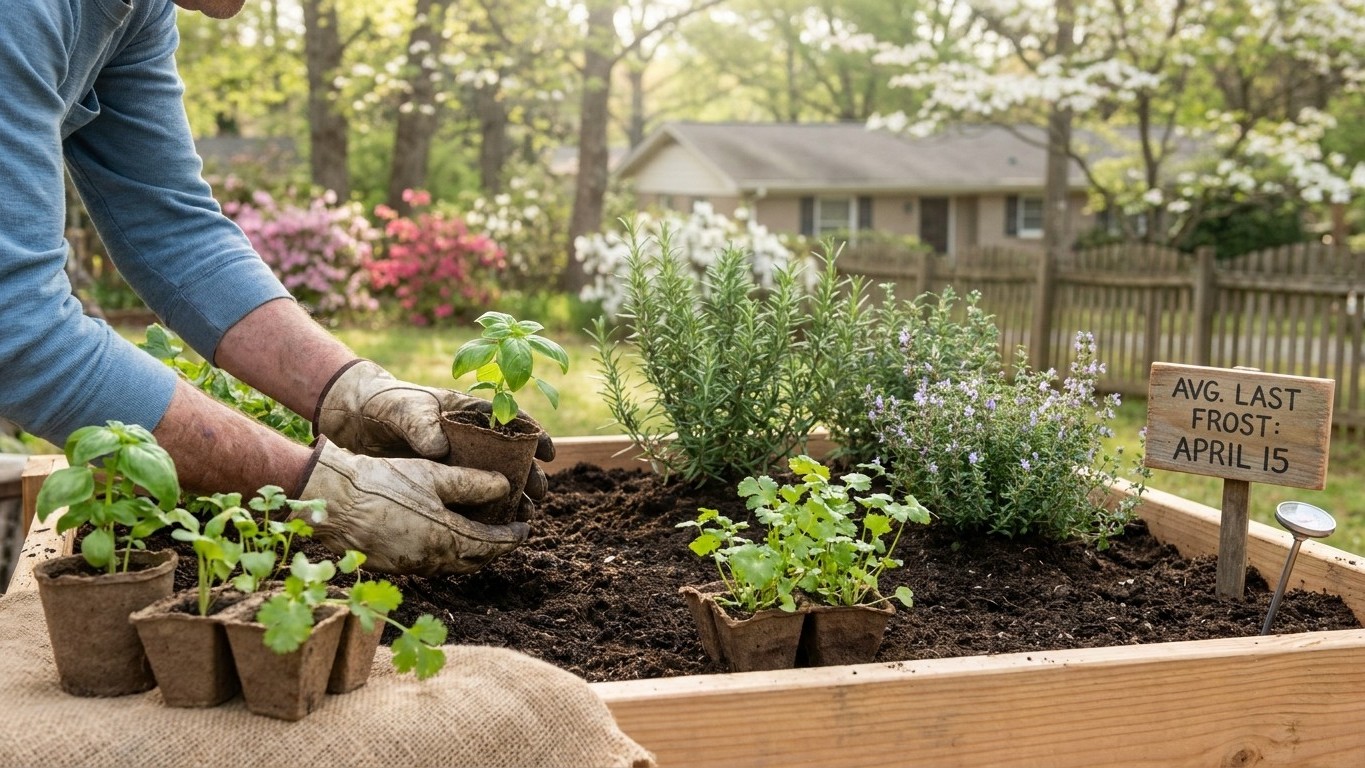

Cold-hardy herbs like parsley, chives, and cilantro go in the ground anywhere from mid-March to early April in most of Virginia, timed to the last spring frost. Basil, dill, and other warm-season herbs wait until after that frost has passed, usually late April into May. A second, hardy-herb planting fits into late August through September, ahead of the first fall frost.
The short answer for Virginia
Virginia’s last spring frost falls somewhere between March 20 and April 3, and the first fall frost arrives between November 10 and November 24. Those aren’t guesses pulled from a farmer’s almanac. They come from NOAA’s 1991-2020 Climate Normals, measured at the NAS Oceana station in Virginia Beach, and they mark the window where a 32-degree freeze has a 30 to 70 percent chance of happening on any given day. In practical terms, that’s the range where frost is genuinely a coin flip, not a certainty and not a fluke.
That distinction matters for how you use the dates. If you plant cold-tolerant herbs, parsley, chives, cilantro, right at the early edge of that window, you’re accepting real odds of a frost event, not just a remote possibility. Most Virginia gardeners split the difference and sow those crops two to three weeks before the midpoint of the window, watching the extended forecast rather than a fixed calendar square.
Basil and other tender herbs need the soil to have actually warmed, and frost isn’t the only obstacle, cold soil stalls germination even without a freeze. The safer move is to wait until the back half of the frost window has passed entirely, which for most of the state means late April at the earliest and into May for anyone at higher elevation.
Perennial herbs, rosemary, thyme, sage, oregano, are a different question because they’re not about the sowing date at all. They’re about whether they survive the winter that follows. Virginia’s coldest month has a mean daily minimum temperature of 31.6 degrees Fahrenheit at the Virginia Beach reference station, a figure from the same NOAA Climate Normals dataset. That’s the number that decides whether a marginally hardy perennial herb makes it through January, not the occasional record cold snap that makes the news.
For the fall planting window, hardy herbs like parsley, cilantro, and chives can go in again in late summer, giving them roughly ten to twelve weeks to establish before the first fall frost shuts things down. That window closes earlier the further you are from the coast, a point the next section covers in more detail.
What will not work here
Do the arithmetic on Virginia’s frost dates and you get a growing season that runs anywhere from about 220 days, if you’re working from the latest possible last frost and the earliest possible first frost, to roughly 249 days at the mild end of the range. That’s a wide spread, and it means a herb that needs a long, uninterrupted warm stretch to mature its full flavor, certain slow-bulbing types or herbs grown to full maturity for seed, can run out of runway in a short-season pocket of the state even though it would finish fine near the coast.
Rosemary is the herb that trips up the most Virginia gardeners, and the 31.6-degree coldest-month minimum explains why. That figure is a mean, not a worst case, which means plenty of nights dip well below it. Varieties rated for reliable winter survival need consistent minimums warmer than what much of inland Virginia delivers most winters. Treating rosemary as a guaranteed perennial anywhere outside the mildest coastal pockets sets up a spring surprise: a woody, dead-looking plant that isn’t dormant, it’s finished.
Basil planted too early is the mirror-image mistake. It doesn’t die from a light frost most years, it just sits there. Cold soil below roughly 50 degrees stalls basil germination and stunts transplants even without an actual freeze event, so a gardener who plants right at the earliest edge of the frost-risk window often loses two to three weeks of growth to sulking seedlings rather than to a killing frost.
Herbs sown too close together run into a different problem in Virginia’s humid summer stretch. Dense, humid air sitting between crowded plants is exactly the condition that lets fungal issues take hold on herbs like basil and oregano. A planting scheme copied from a drier climate’s spacing chart, one built around water conservation rather than airflow, tends to backfire here. The fix isn’t a different herb, it’s more room between plants than the seed packet’s minimum suggests.
None of this means Virginia is a hard place to grow herbs. It means the failures cluster around three specific mismatches: perennials pushed past what the winter minimum supports, warm-season herbs rushed ahead of soil temperature, and spacing borrowed from a climate that doesn’t share Virginia’s summer humidity.
What changes across Virginia
Virginia spans USDA hardiness zones 5a through 8b, a range wide enough that no single planting date works for the whole state. That’s not a rounding artifact, it’s the actual spread across the Blue Ridge highlands and the Atlantic coastline, and it’s the reason a state page like this one can give a window but never a single day.
The frost dates and coldest-month figure cited above come from the Virginia Beach station, which sits at the mild end of that zone range. Coastal Virginia gets both the latest possible first fall frost and the earliest possible last spring frost, stretching the usable herb-growing season as long as the state allows. Move inland toward the Blue Ridge, or south into the higher terrain of southwest Virginia, and both frost dates shift against you: spring frost lingers weeks longer, and fall frost arrives weeks earlier. The growing season doesn’t just start later there, it also ends sooner, squeezing both ends at once.
That has a direct effect on which herbs make sense as perennials. A gardener near the coast, closer to zone 8, has a real shot at rosemary or bay laurel surviving outdoors most winters. A gardener at higher elevation, closer to zone 5, is working with a climate that behaves more like inland New England for winter hardiness purposes, and should plan for those same herbs as annuals or container plants brought indoors.
The practical shift for anyone north of the coastal plain or up in elevation is straightforward even without knowing an exact zone number: push spring sowing dates later than the state-level window suggests, pull fall sowing dates earlier, and treat any perennial herb rated for zones 7 and warmer as a seasonal gamble rather than a permanent planting. Exactly how much later or earlier depends on where in that 5a-8b spread a given garden actually sits.
Where to check this for your own county
Virginia Cooperative Extension, run jointly by Virginia Tech and Virginia State University, is the source built to answer what actually works in your specific county. Their site is at ext.vt.edu, and it’s organized by county office, each with its own local staff and its own trial data.
What’s worth pulling up there is twofold. First, look for the local planting calendar for your county or the nearest office to you, since Extension offices closer to the mountains publish different sowing windows than offices on the coastal plain, reflecting the frost-date spread covered in the previous section. Second, look for variety trial results or recommended cultivar lists specific to herbs, since Extension services test which rosemary, thyme, or basil varieties actually hold up to local disease pressure and winter conditions rather than just relying on a seed packet’s generic zone rating.
A county-level recommendation from a Virginia Cooperative Extension office will beat anything on this page, because it accounts for local elevation, local soil, and local microclimate patterns that a statewide frost-date range simply can’t capture. This page works from station-level NOAA data and a statewide hardiness zone range, which is useful for understanding the shape of the problem across Virginia as a whole. It isn’t a substitute for what your county office already knows about your specific ground.
If your county’s office doesn’t publish a herb-specific calendar, the vegetable and annual flower planting calendars they do publish are still useful, since they’re built from the same frost-risk logic and the same local station data, just applied to different crops. The underlying frost dates don’t change based on what you’re planting.
Some gardeners also time this by the Moon: when to plant herbs by the moon, as almanac tradition rather than fact.
Checking this against your own garden
Every date on this page is a state-level average built from one weather station’s history. Your own garden will tell you more than any calendar can, and it does it without needing a single tool.
Soil warmth is the first check, and you can read it with your hands. Push a finger a couple of inches into the bed where you plan to sow basil or dill. If it feels cool and damp rather than merely cold, and stays that way through midday rather than warming noticeably in the sun, the soil likely hasn’t crossed the threshold warm-season herbs need to germinate reliably, regardless of what the calendar says the date should be.
Watch any herbs that self-seed or overwinter in your beds, like dill, cilantro, or chives that came back on their own. The point at which they push their first true leaves, the second set that actually looks like the mature plant rather than the rounded seedling leaves, is a direct readout of when your specific plot has warmed enough for that plant to grow, not just survive.
Watch for early bolting, too, particularly on cilantro and other cool-season herbs. If they throw flower stalks and go to seed unusually fast in what should still be a mild stretch, that’s your garden telling you it runs warmer, or dries out faster, than the regional average assumes, useful information for timing next year’s fall planting a little earlier than the state window suggests.
None of these three signs require a thermometer or a soil probe. They require paying attention to what’s already growing, and treating that as the tie-breaker whenever it disagrees with a date on a page like this one.