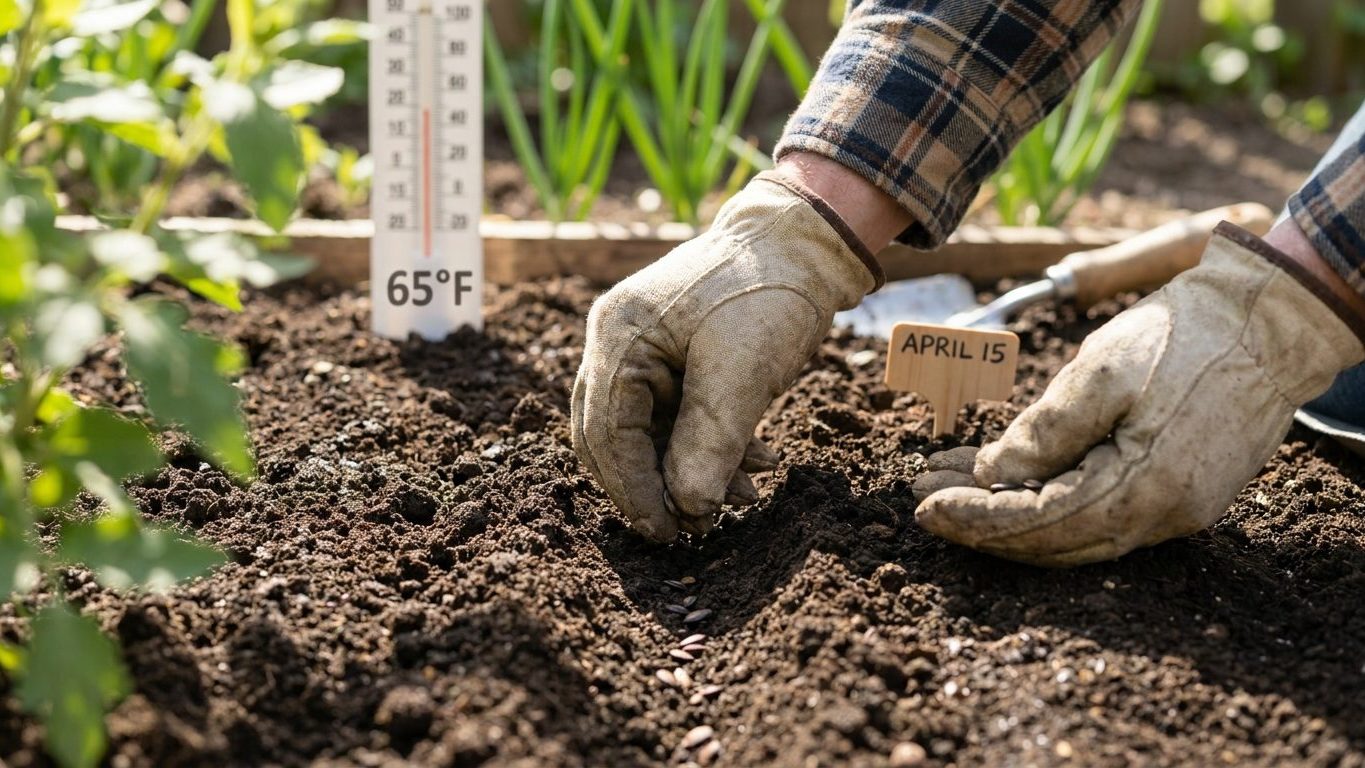

Melon seed goes into Virginia ground only after the soil itself has warmed, not simply after the last frost has passed. At the coastal reference station near Virginia Beach, the safe frost window runs from March 20 to April 3, but melons want soil pushing past 65°F, so the real planting date lands closer to late April through mid-May for most of the state, later inland and in the mountains.
The short answer for Virginia
The last spring freeze at NAS Oceana, the NOAA reference station for coastal Virginia, falls somewhere between March 20 and April 3 in a typical year. That window is a 30-70% probability band for a 32°F freeze, not a guarantee. It marks the range where a freeze becomes likely rather than a fixed day it will happen, and it’s the earliest safe outdoor date for anything that can’t handle frost, melons included.
Frost tolerance isn’t the limiting factor, though. Melon seed barely germinates below 60°F soil temperature and stalls below 65°F, and vines set fruit fastest once nights stay above 60°F too. Soil in Virginia typically needs another two to three weeks past the last frost date to reach that mark, which puts direct seeding or transplanting for most of the state into late April through mid-May, with the coastal strip able to start closer to the early end of that stretch.
The other side of the calendar matters just as much. First fall frost at the same reference station arrives between November 10 and November 24, again a 30-70% probability band, this time for the freeze that ends the season. Counted from a mid-May planting, that leaves roughly 180 to 190 frost-free days at the coast, more than enough for any melon variety sold in the U.S., since even the slowest muskmelons and watermelons mature in 85 to 100 days.
Where the calendar actually tightens is heat, not season length. The reference station averages 26.0 days a year at or above 90°F, the load melon vines are bred to enjoy and roughly what pushes flowering and fruit-set into gear through July and August.
| Factor | Value (coastal reference station) |
|---|---|
| Last spring frost | March 20 – April 3 |
| First fall frost | November 10 – November 24 |
| Days ≥ 90°F per year | 26.0 |
| Summer rainfall (Jun–Aug) | about 15.0 in. |
What will not work here

Planting before the soil warms is the most common melon failure in Virginia gardens. Seed sown in cold ground doesn’t sit dormant, it rots, especially in the clay soils common across the Piedmont, which hold moisture and heat unevenly compared with the sandy loams near the coast. Jumping the gun by even ten days, ahead of that frost window turning into consistently warm soil, usually means a bare patch of ground and a second planting in June.
On the other end, gardeners at higher elevation or farther inland who wait too long run into the fall frost instead. The state’s hardiness zones span 5a to 8b, and the coldest of those zones will see both a later spring frost and an earlier fall frost than the coastal reference station’s November 10 to November 24 window. A melon variety needing 95 days to mature, planted in early June in a zone 5a pocket, can run out of season before the fruit finishes sizing.
Watering on a weekly schedule fails more often than either planting mistake. Summer rainfall across the state averages about 15.0 inches over June, July and August, but that hides the shape of the problem: June, the driest of the three, brings only 4.15 inches, right as young melon plants are establishing roots and vining out. Add 26.0 days a year at 90°F or hotter, and a single weekly soaking on sandy soil can leave roots dry for days before the next watering, showing up as blossom drop and misshapen fruit rather than obvious wilting.
Tight spacing is the fourth failure, and it’s a humidity problem more than a heat one. Summer rain here tends to arrive as thunderstorms rather than steady drizzle, so foliage gets soaked all at once and stays wet longer in a dense planting than in an open one. Powdery and downy mildew move fast through melon vines once leaves stay damp overnight, and a planting spaced for a drier state will mildew out well before frost ends the season.
What changes across Virginia
Virginia’s USDA hardiness zones run from 5a to 8b, a range built on one number: the average coldest temperature a spot sees in a typical winter. That’s a wider spread than separates some entire regions of the country, and it means the frost dates and heat totals above, all measured at the coastal reference station, describe the mild end of the state and nowhere else with the same precision.
A gardener working land in the Blue Ridge or far southwest Virginia, closer to the 5a end of that range, should expect the last spring frost to land later than March 20 to April 3, and the first fall frost to arrive earlier than November 10. Both shifts squeeze the frost-free season from both directions at once, which matters more for melons than for a quick crop like lettuce, since even a fast melon variety needs the better part of three months of warm nights to finish.
Elevation compounds the zone effect independent of latitude. A mountain valley and a ridge a few hundred feet higher, both technically in the same county, can differ by a full USDA zone or more, because cold air drains downhill and pools in low ground on clear nights, exactly when frost forms. That’s part of why this page can’t hand a single reader a single date. The right move for anyone gardening away from the coastal plain is to treat the dates above as a floor, not a target, and add one to two weeks of cushion on the spring end especially, since a late cold snap does far more damage to melon seedlings than a slightly delayed start does to the harvest.
The summer heat and rainfall picture shifts less predictably. Days above 90°F generally drop off with elevation, so mountain gardeners tend to see less of the heat stress described above, though this page doesn’t have station-level numbers for those counties to put a figure on it.
Where to check this for your own county
Virginia Cooperative Extension is the place this page’s frost-date estimates get replaced with something sharper: numbers pulled from a weather station and research plots much closer to a given county than the coastal reference station used throughout this article.
Every Virginia county and several independent cities have their own extension office, most reachable through that same statewide site, and most publish or can point to a planting calendar built around local frost data rather than a single coastal station. That local calendar is the number worth writing down, not the March 20 to April 3 window cited here, which only ever applied precisely to the area around Virginia Beach.
Beyond the date itself, county extension offices track which melon varieties actually finish a crop in local conditions. A county in the Blue Ridge with a short, cool growing season needs varieties bred to mature in 75 to 80 days; a county on the coastal plain with a long hot season can grow slower, larger-fruited types without the fall frost ever becoming a risk. Those variety trial results, when a local office has run them, sit inside county-level extension publications and newsletters rather than any statewide document.
The rule worth keeping: a county recommendation beats a state recommendation every time, and this page is the state one. Everything above describes what the numbers say for Virginia as a whole, weighted toward the coastal station where the clearest long-term data happens to exist. A local extension agent, or the county-specific pages linked from the statewide site, will narrow that down to the frost dates and varieties that actually apply to one particular piece of ground.
Checking this against your own garden
Every date on this page is a regional average built from decades of station data, which makes it a starting point rather than an instruction. A garden watched closely for a few weeks each spring will say more about the right moment to Plant Melons than any frost-date range can.
Soil warmth by feel is the first check, and it needs no thermometer. Press a bare hand a few inches into the planting bed in mid-morning, once the surface has had a chance to warm. Soil that still feels cool and damp, the way it does in early spring, isn’t ready for melon seed no matter what the calendar says. Soil closer to room temperature, with some give and a dry, crumbly top inch, is the signal the ground has caught up to the season.
The first flush of male flowers on an already-planted vine is the second signal, and it says something about a gardener’s own microclimate rather than about planting date. Melon vines produce male flowers well before the female flowers that actually set fruit, sometimes by a week or two, and a vine that flowers unusually early or late compared with a neighbor’s garden a few miles away is showing the effect of a warmer or cooler pocket, a south-facing slope, a wind-sheltered corner, that no regional average can capture.
First true leaves, the second set that emerges after the rounded seed leaves, mark the point where a seedling stops living off stored seed energy and starts drawing on the soil and sun where it’s actually planted. A slow, pale set of true leaves after normal-looking germination usually points to soil still too cool or too wet, the same condition the frost-date math above is meant to help a gardener avoid in the first place.
Some gardeners also time melons by the Moon: when to plant watermelon and cantaloupe by the moon, as almanac tradition rather than fact.