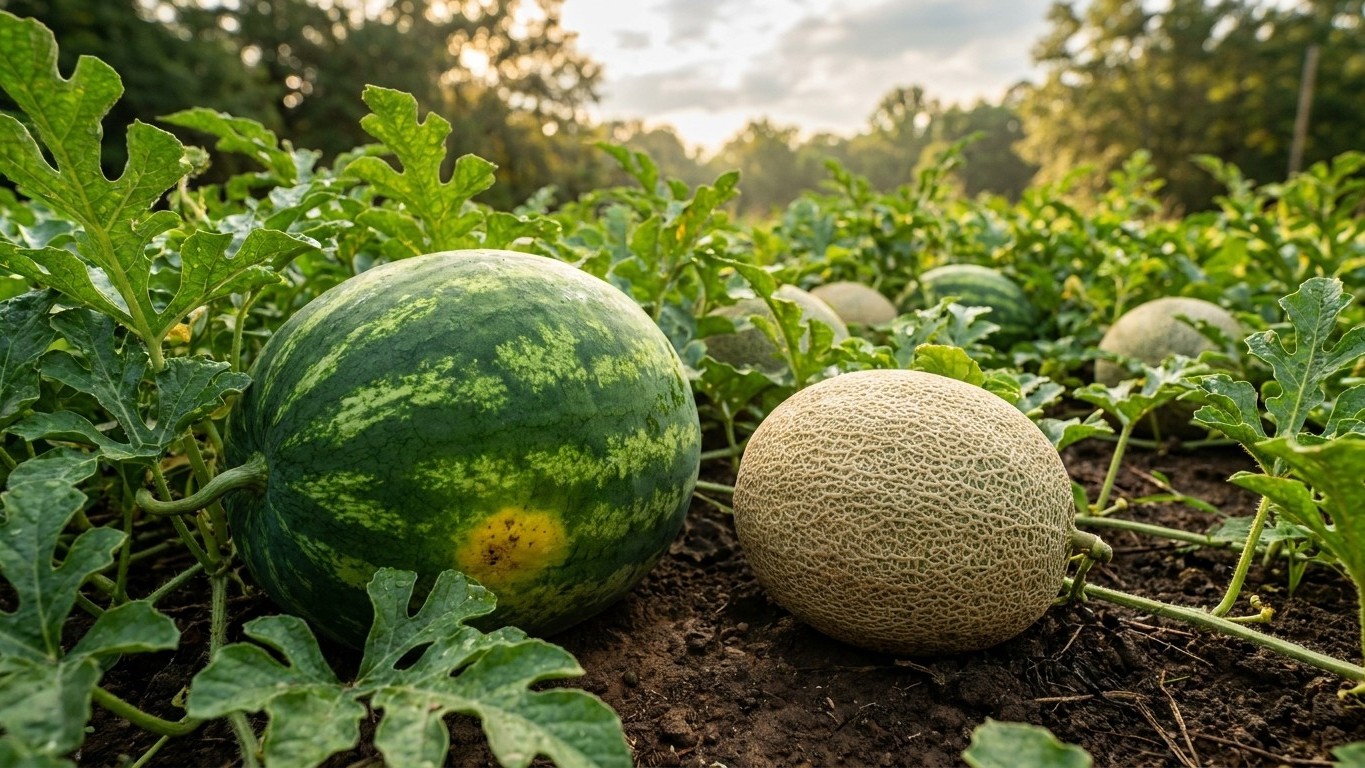

Virginia’s long, warm coastal season handles nearly every melon type well, but quick-to-mature cantaloupes and muskmelons are the safest bet statewide. Large, slow watermelons and heat-hungry honeydews belong in the warmer, longer-season parts of the state, not in the mountains.
The short answer for Virginia
Start with what the coastal reference station actually measures: a frost-free window running from as early as March 20 to as late as April 3 in spring, and from November 10 to November 24 in fall. Stretch those dates to their widest, and you get a season that can run close to 250 days near the coast. That’s a genuinely long growing window by East Coast standards, and it’s the single biggest reason melons do well in Virginia at all.
Heat is the second variable, and it’s more modest than gardeners often assume. The reference station averages just 26.0 days a year at or above 90F. That’s steady summer warmth, not the blast-furnace heat of the Deep South or the desert Southwest. It matters because melons aren’t all equally demanding: some finish on moderate heat and a long-enough clock, others need sustained, intense heat units to sweeten up properly.
Put those two facts together and the decision by type becomes fairly clean. Cantaloupes and muskmelons, which are built to finish quickly and don’t demand extreme heat, fit almost anywhere in the state that gets a reasonable frost-free stretch. Watermelons, especially the standard full-size types, want both the long season and the accumulated warmth the coastal and Piedmont regions can offer; they’re a strong choice there and a riskier one at elevation. Honeydew and other late, heat-loving melons are the pickiest of the group. They want a long run of consistently warm nights as well as warm days, which is exactly the kind of heat load the 26-day average suggests Virginia has only in modest supply, concentrated toward the warmer half of the state.
There’s no single “best melon for Virginia” the way there might be for a state with one climate zone. The honest answer is a short-season type for anywhere in the state, and the longer-season, heat-hungrier types reserved for the parts of Virginia that run mild and long, which the next sections narrow down.
What will not work here

The clearest failure mode in Virginia is a slow-maturing melon planted somewhere the season can’t back it up. The frost-free window at the coastal reference station is generous, but the CAUTION attached to both frost dates is specific: the Blue Ridge and southwest Virginia run weeks later in spring and weeks earlier in fall. A melon that needs every one of those 249 coastal days to ripen simply runs out of runway once you’re inland and up in elevation, where both ends of the season close in. That’s not a marginal effect. Losing two or three weeks off each end of the frost-free window can erase a month of growing time, which is enough to leave a slow watermelon or honeydew unripe when the first hard frost hits.
Heat-hungry types fail for a related but distinct reason. With only 26.0 days a year averaging 90F or hotter at the reference station, Virginia isn’t short on warmth, but it isn’t stacked with it either. Melons bred for regions with much longer hot stretches, or trial varieties known to sulk without sustained heat, will size up slowly and taste thin here, particularly away from the coast where even that modest heat count likely drops further.
Watering on a fixed weekly schedule is the third trap, and it comes straight out of the rainfall numbers. Summer rain averages about 15.0 inches across June, July and August, but it isn’t spread evenly: June is the driest month at 4.15 inches, while July jumps to 5.76 inches. A gardener who waters once a week regardless of what’s actually fallen will often underwater a dry June and then, if a July thunderstorm dumps a big chunk of that 5.76 inches at once, oversaturate everything at the same time. Melons respond to that kind of swing with blossom drop, cracked fruit, or rot at the vine.
Tight spacing is the fourth problem, and it’s a humidity issue as much as a moisture one. Combine the summer rain totals with 26 days of real heat, and you get the warm, damp air that powdery and downy mildew thrive on. Melons planted close together, the way a small garden bed tempts you to plant them, trap that moisture around the leaves. In a state with this rainfall and heat profile, generous spacing and airflow matter more than they would in a drier climate.
What changes across Virginia
Virginia’s official hardiness range, per the USDA Plant Hardiness Zone Map, spans zone 5a to 8b. That’s not a narrow band. It’s one of the widest zone spreads any single state can claim, and it means a planting decision that works near the coast can be flatly wrong two hundred miles inland or a few thousand feet higher up. There is no single answer for “Virginia” on paper hardiness alone.
The reference station behind the frost and heat data in this article, Virginia Beach, sits at the mild end of that spread. Its frost dates and its 26-day heat count describe a coastal climate with a long season and moderate but real summer warmth. That’s the best-case scenario for melon growing in this state, not the statewide average.
Move toward the Blue Ridge or into southwest Virginia and the picture shifts on both ends of the calendar. Spring frost lingers weeks longer than the coastal March 20 to April 3 window suggests, and fall frost arrives weeks ahead of the coastal November 10 to November 24 range. A shorter frost-free season at higher elevation also tends to come with fewer very hot days, which pulls the realistic melon list toward the fastest, least heat-demanding types and away from the big, slow watermelons and honeydews that do fine at the coast.
What it can say is that the gap between zone 5a and zone 8b is large enough that “grow Melons in Virginia” has to be answered differently depending roughly on where in that range a garden falls, and that the USDA’s own zone map is the tool for placing a specific address inside that 5a-8b spread.
Where to check this for your own county
Virginia’s state-level climate picture is built on one coastal reference station’s normals. That’s useful for understanding the pattern, but it isn’t a substitute for a county-level recommendation, and it was never meant to be. A state-wide page smooths over exactly the kind of elevation and latitude differences described above.
Virginia Cooperative Extension, at ext.vt.edu, is the place built to fill that gap. It’s organized by county office, which means the guidance available there reflects local frost records, local soil conditions, and years of variety trials run in that specific part of the state rather than averaged across all of it.
Two things are worth searching for once there. First, a local planting calendar, which will translate the general frost-date ranges cited in this article into dates that reflect the office’s own county rather than the coastal station used here. Second, any listing of melon varieties the local extension office has actually trialled or recommends for that county. Those recommendations exist because someone tested how a given type performed against the actual heat, rainfall, and season length of that specific place, which is a level of precision no state-wide article can offer.
The honest hierarchy is simple: a county recommendation from Virginia Cooperative Extension beats a state-level article every time, because it’s working from a smaller, more accurate sample. A state-level view can show what’s true across Virginia and where the big divides in season and heat fall. It can’t tell a reader in Wise County the same thing it can tell a reader in Virginia Beach, and it shouldn’t pretend to.
Checking this against your own garden
Every date and average in this article describes a normal, not a promise. The garden itself settles the question, and it does that through a few signs any gardener can read without special equipment.
Soil warmth by feel comes first. Melon seed germinates poorly in cold soil regardless of what the calendar says, so a gardener who pushes a bare hand a couple inches into the bed and finds it still cool to the touch, well past the average last-frost window for their region, is looking at a real local delay, not an average that failed to apply. That delay might come from heavy shade, from clay that holds cold longer than the surrounding soil, or from a low spot where cold air pools. Whatever the cause, the soil is reporting it directly.
The first flush of male flowers is the second signal. Melon vines put out male blooms before the female flowers that actually set fruit, and a vine that’s slow to flower at all, even once it’s clearly established and vining, is often signaling that it hasn’t banked enough warm days yet, echoing the heat-load question raised earlier for anywhere off the coast.
The first true leaves, the ones that follow the rounded seed leaves and actually look like miniature melon foliage, mark the point where a seedling has moved from surviving to growing. A slow, stalled gap between seed leaves and true leaves in a garden that’s otherwise following the expected calendar is worth noting as a microclimate quirk, whether that’s a cooler pocket, thinner soil, or less sun than the rest of the yard gets. None of these three signs need a thermometer or a chart. They just need a gardener willing to look closely and trust what the plant is actually doing over what the regional average predicted it would do.